-
SAPO-34 for Methanol-to-Olefins Catalysis - UCL, 2020
May 20, 2026 | ACS MATERIAL LLCLezcano-Gonzalez, I., Campbell, E., Hoffman, A. E. J., Bocus, M., Sazanovich, I. V., Towrie, M., Agote-Aran, M., Gibson, E. K., Greenaway, A., Wispelaere, K. D., Speybroeck, V. V., & Beale, A. M. (2020). Insight into the effects of confined hydrocarbon species on the lifetime of methanol conversion catalysts. *Nature Materials*. https://doi.org/10.1038/s41563-020-0800-y
Nature Materials · 2020
Operando Kerr-gated Raman and DFT simulations on SAPO-34 and ZSM-5 reveal polyenes as the missing link between active and deactivating species in MTO catalysis.
About this research
Researchers at University College London, working with the UK Catalysis Hub, Ghent University, the University of Glasgow and the STFC Central Laser Facility, used SAPO-34 obtained from ACS Material as a key small-pore catalyst in an operando Kerr-gated Raman spectroscopy study of the methanol-to-hydrocarbons (MTH) reaction, published in Nature Materials in 2020. The headline result is the identification of polyenes as the crucial intermediate class that bridges 'desired' active hydrocarbon pool species and 'undesired' polycyclic aromatic hydrocarbons (PAHs) that deactivate the catalyst. The combination of fluorescence-suppressed operando Raman with ab initio molecular dynamics produced the missing molecular-level link between productive olefin chemistry and coking, and suggests design rules for longer-lived MTO catalysts.
The MTH reaction is a cornerstone of non-petroleum routes to light olefins and gasoline, with the global propylene market alone valued near US$90 billion per year. Methanol is converted over acidic zeolites through an indirect hydrocarbon pool mechanism, in which methylated benzenes and olefins confined inside the micropores act as the actual reaction centres. The same confined chemistry that enables high selectivity also seeds PAHs that block pores and shorten catalyst lifetime to a matter of hours for small-pore frameworks. Despite decades of NMR, IR, UV–vis and Raman work, distinguishing which adsorbed species are productive from which are terminally deactivating has remained elusive. Resolving this requires time-resolved, in-pore measurements that can be made under realistic temperature and feed conditions, which is precisely what this study delivers.
The study compared three zeolite topologies: H-ZSM-5 (MFI, medium pore), SSZ-13 (CHA, small pore) and SAPO-34. The SAPO-34 sample was sourced commercially from ACS Material and used as received after the standard activation protocol described in the Methods ("SAPO-34 material is commercially available (ACS Material)"). A 50 mg catalyst bed was activated at 550 °C under 20% O2 in He, then exposed to methanol at a weight hourly space velocity of 1.6 g methanol per g catalyst per hour while the temperature was ramped from 100 °C to 450 °C at 1 °C min⁻¹ in a Linkam CCR1000 stage. Kerr-gated Raman spectra were acquired using a 400 nm probe beam (3 ps pulses, 10 kHz, ~10 mW, 100 µm spot) at the ULTRA facility, with 20 s time resolution per spectrum. Picosecond gating rejected long-lived fluorescence, allowing in-pore carbonaceous species in SAPO-34 to be tracked in real time. CP2K-based revPBE-D3 ab initio molecular dynamics in a CHA unit cell with Si/Al ≈ 17 provided matching simulated Raman spectra for assignment.As highlighted by the UCL microspectroscopy study and visualized above, the rapid deactivation of SAPO-34 is an inherent topological feature of its chabazite (CHA) cages. The restrictive 0.38 nm window perfectly shape-selects light olefins but physically traps larger polyene intermediates (the 'cage effect'), forcing them to cyclize into coke-forming PAHs. Conversely, medium-pore zeolites like ZSM-5 allow these bulky species to diffuse out. Investigating these fundamental hydrocarbon pool mechanisms or benchmarking novel catalytic pathways requires zeolites with absolute phase purity and strictly defined topologies. Explore ACS Material's highly characterized SAPO-34, ZSM-5, and full Molecular Sieves catalog to establish a reproducible and reliable baseline for your next kinetic study.
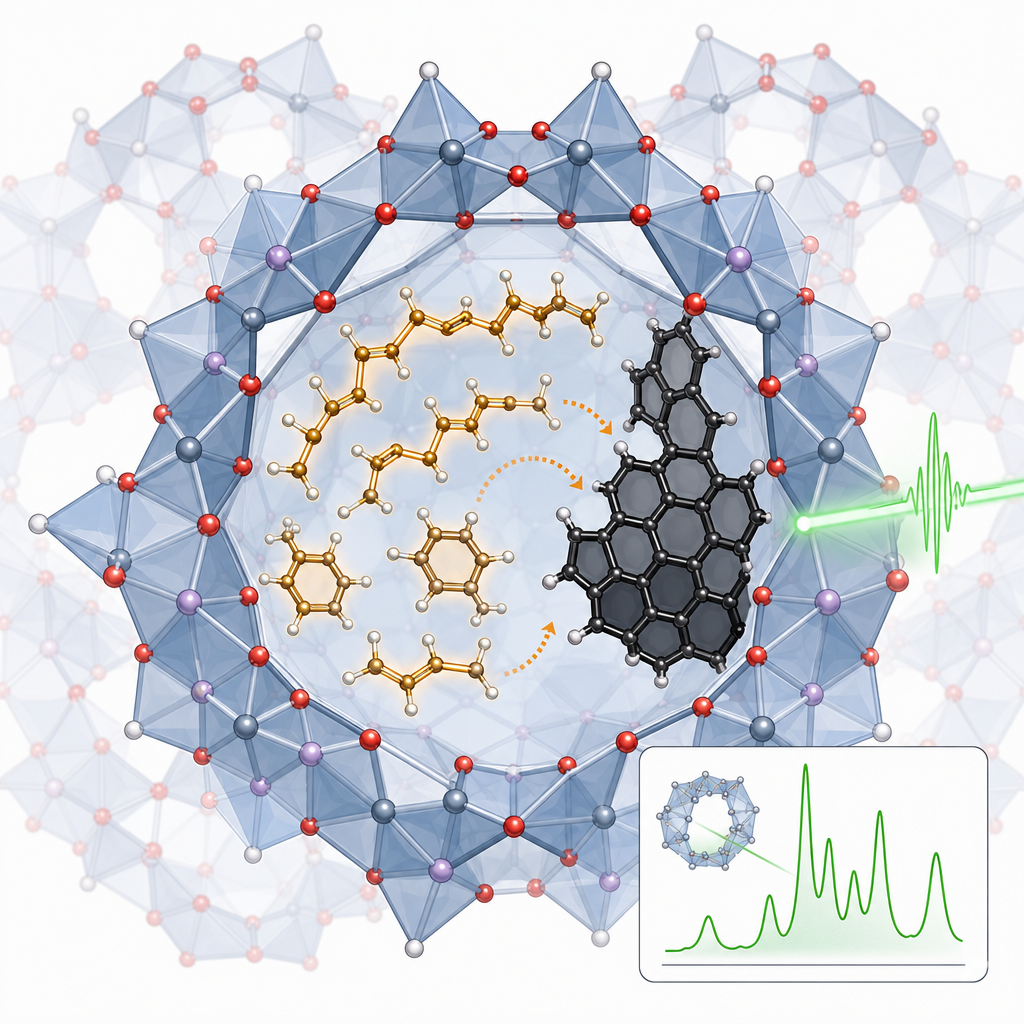
Key findings centre on the temperature- and time-resolved appearance of distinct Raman bands assigned to conjugated polyenes, methylated aromatics and PAHs. In all three zeolites, neutral and protonated polyenes appear as early intermediates well before PAH bands grow in. Their subsequent fate, however, is dictated by topology. In medium-pore ZSM-5, polyenes can diffuse and partially escape, slowing PAH formation and extending lifetime. In the small-pore CHA frameworks SSZ-13 and SAPO-34, polyenes are spatially trapped at the intersections of the chabazite cages, where they cyclize into methylnaphthalenes, pyrene-like species and ultimately extended PAHs that block the 8-ring windows and deactivate the catalyst within hours. The molecular dynamics calculations corroborate this picture, showing that long polyenes have severely restricted mobility in CHA cages while remaining mobile in MFI channels. The work thus quantitatively connects pore geometry, intermediate mobility, and deactivation rate for the methanol-to-olefins process.
For industrial MTO operators, the implication is direct: the rate-determining step toward coke is polyene cyclization inside confined cages, not the initial aromatization. Catalyst designers can target this by tuning cage size, acid site density and connectivity to either accelerate polyene dealkylation back to light olefins or to allow these intermediates to diffuse out before they cyclize. The findings are relevant well beyond MTO, extending to methanol-to-gasoline, methanol-to-aromatics, and dimethyl-ether-to-olefins technologies that all share the hydrocarbon pool framework. They also illustrate how operando Kerr-gated Raman, previously hindered by zeolite fluorescence, can now resolve intermediates that conventional CW Raman cannot.
For researchers working on small-pore zeolites, MTO catalysts, or hydrocarbon pool chemistry, SAPO-34 of the type used here is available from ACS Material's molecular sieves catalogue, alongside related CHA, MFI and MEL frameworks such as SSZ-13 and ZSM-5 variants. The reproducibility of the operando measurements in this Nature Materials study underscores that consistent commercial zeolite supply is a practical prerequisite for time-resolved mechanistic work, where small lot-to-lot variation in Si/Al ratio or crystallite size can confound polyene and PAH band assignments.How ACS Material products were used
- SAPO-34 (Molecular Sieves) — “SAPO-34 material is commercially available (ACS Material).”
Product Performance in this Study
SAPO-34 (CHA topology) served as one of the two principal zeolite catalysts examined under operando Kerr-gated Raman conditions for methanol-to-olefins conversion. Its small-pore CHA framework was central to identifying how zeolite topology controls the evolution of polyene intermediates into deactivating polycyclic aromatic hydrocarbons.
Related product categories
Frequently asked questions
What is SAPO-34 used for in methanol-to-olefins catalysis?
SAPO-34 is a small-pore silicoaluminophosphate with the CHA framework used industrially as the catalyst in methanol-to-olefins (MTO) processes. Its 8-ring windows and cage architecture confine methylated aromatic hydrocarbon pool species, giving high selectivity to ethylene and propylene. In the Nature Materials study, SAPO-34 from ACS Material served as a reference small-pore catalyst alongside SSZ-13 and ZSM-5 to identify polyenes as the key intermediates leading to deactivating polycyclic aromatic hydrocarbons.
Why do small-pore zeolites like SAPO-34 and SSZ-13 deactivate faster than ZSM-5 in MTH?
In ZSM-5, the medium-pore MFI channels allow polyene intermediates and small aromatics to diffuse and partially escape before cyclizing. In CHA-type frameworks such as SAPO-34 and SSZ-13, polyenes are confined within the cages and cyclize rapidly into methylnaphthalenes and larger polycyclic aromatic hydrocarbons. These PAHs block the 8-ring windows, shutting down access to acid sites and deactivating the catalyst within hours.
How does operando Kerr-gated Raman spectroscopy improve mechanistic studies of zeolite catalysts?
Conventional Raman analysis of working zeolite catalysts is often overwhelmed by fluorescence from carbonaceous deposits. Kerr-gated Raman uses a picosecond optical shutter to reject the longer-lived fluorescence signal while preserving the instantaneous Raman scattering, dramatically improving signal-to-noise. Combined with millisecond-to-second temporal resolution, it lets researchers track polyene, methylbenzene and polycyclic aromatic intermediates inside SAPO-34, SSZ-13 and ZSM-5 in real time under operating temperature and methanol flow.