-
SBA-15 Magnetic Adsorbent for Glyphosate Removal - Politecnico di Torino, 2017
Jun 23, 2026 | ACS MATERIAL LLCFiorilli, S. et al. (2017). Iron oxide inside SBA-15 modified with amino groups as reusable adsorbent for highly efficient removal of glyphosate from water. *Applied Surface Science*. https://doi.org/10.1016/j.apsusc.2017.03.206
Applied Surface Science · 2017
Researchers at Politecnico di Torino used SBA-15 from ACS Material to build an amino-functionalized iron oxide adsorbent that removes glyphosate from water.
About this research
A team led by Sonia Fiorilli and Barbara Onida at Politecnico di Torino, in collaboration with INRiM and the University of Torino, used SBA-15 mesoporous silica purchased from ACS Material to construct a magnetic, amino-functionalized iron oxide adsorbent (RED-Fe-NH2-SBA-15) that removes glyphosate from drinking water. Published in Applied Surface Science in 2017, the work shows that combining a high-surface-area mesoporous silica scaffold with embedded iron oxide nanocrystals and grafted primary amine sites yields a regenerable sorbent that performs efficiently on real tap water samples spiked with the herbicide.
Glyphosate is the most widely applied broad-spectrum herbicide in the world and its presence in surface, ground and drinking waters has become a regulatory concern. Conventional treatment routes — coagulation, membrane filtration, oxidation, photodegradation — often suffer from incomplete removal, high energy demand, or generation of secondary waste. Adsorption is attractive because it is mild, scalable and compatible with sorbent regeneration, but activated carbon, the standard option, is costly to produce and to reactivate. Functionalized mesoporous silicas have emerged as a tunable alternative: their large, ordered pores host nanoparticles and their internal surface can be decorated with chemical groups that target specific pollutants. The challenge addressed in this paper is to design a single material that combines selective glyphosate binding with easy magnetic recovery and reuse.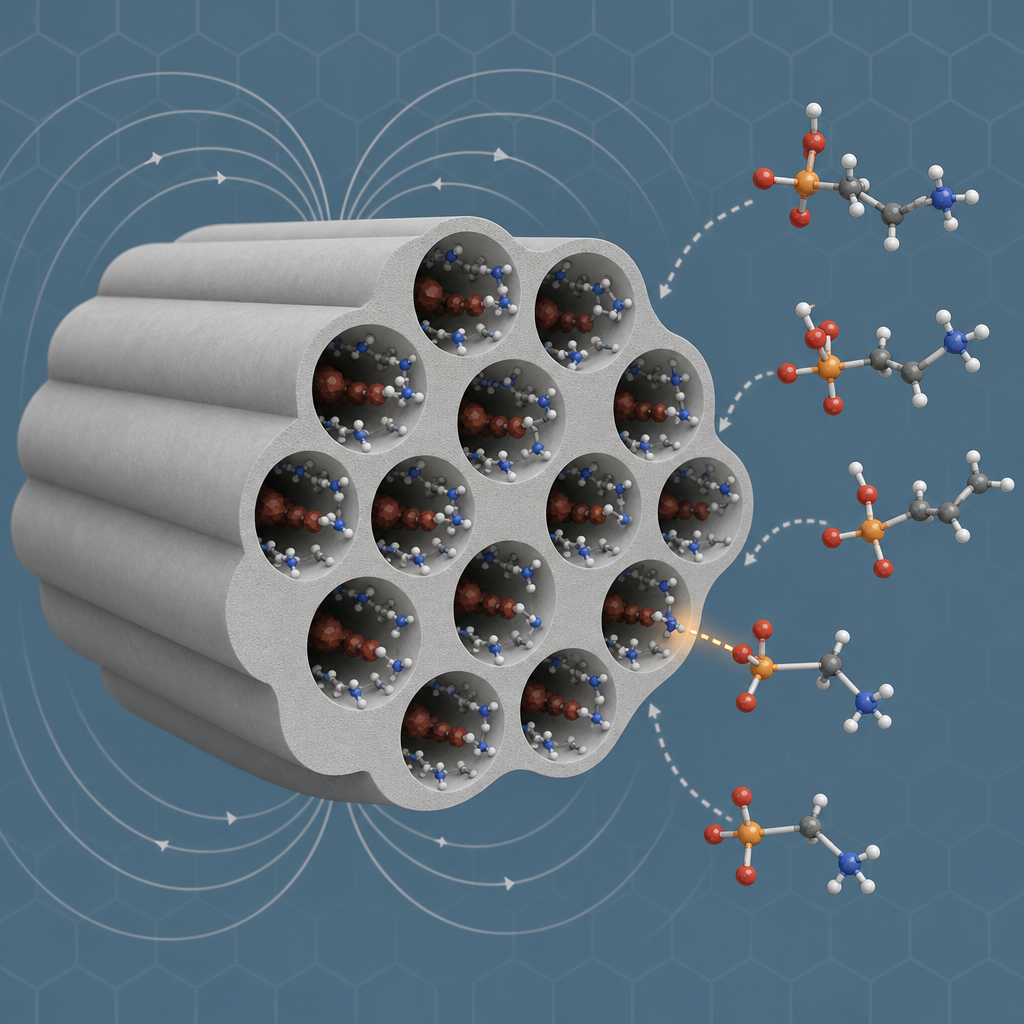
SBA-15 supplied by ACS Material (Advanced Chemical Supplier, USA) was the structural foundation of the composite. The authors used the incipient wetness method to impregnate 3 g of as-received SBA-15 with an aqueous solution of Fe(NO3)3·9H2O (3.2 g salt in 5 mL water), dried the powder at 80 °C, then applied a two-step thermal treatment: oxidation at 700 °C for 12 h in air followed by reduction at 700 °C for 12 h in Ar + 5% H2 to form magnetic iron oxide nanocrystals inside the silica channels (RED-Fe-SBA-15). The pore structure of SBA-15 was essential to confine the nanocrystals at uniform size while preserving accessibility. In a second step the material was suspended in toluene at 383 K and reacted with (3-aminopropyl)triethoxysilane (APTES, 1% v/v) for 24 h, grafting –NH2 groups onto the available silanol surface to give RED-Fe-NH2-SBA-15. XRD, BET nitrogen adsorption (NLDFT pore size analysis), FESEM/STEM with EDS, XPS, FTIR and VSM magnetometry were used to confirm pore retention, amine loading, iron oxide incorporation and ferrimagnetic behaviour suitable for magnetic separation.
The adsorbent was tested on tap water collected from the Torino potabilization plant (pH 7.4, conductivity 490 µS/cm) spiked to a glyphosate concentration of 2 mg/L. Realistic background ions were present, including 13 mg/L Cl−, 32 mg/L NO3−, 35 mg/L SO4 2−, 167 mg/L HCO3−, and 85 mg/L Ca2+, providing strong competitive load. Batch experiments used 0.1 g of sorbent in 17.5 mL of spiked water, stirred for 24 h on an orbital shaker, with operating pH chosen from the pK values of glyphosate and of the grafted amine groups to maximize electrostatic attraction between the protonated –NH3+ sites and the deprotonated phosphonate/carboxylate moieties of glyphosate. Residual glyphosate was quantified by ion chromatography with suppressed conductivity detection on a Dionex IonPac AG16 system, comparing peak area against a non-contacted spiked standard. The amino-functionalized magnetic composite delivered high glyphosate removal efficiency under these conditions, while the unfunctionalized RED-Fe-SBA-15 baseline removed substantially less, confirming that the –NH2 binding sites — not iron oxide alone — drive the selective uptake. The embedded magnetic iron oxide enabled rapid separation of the loaded sorbent from solution without filtration, and the authors verified that the material could be regenerated and reused across multiple cycles.
The demonstrated chemistry is directly relevant to drinking-water treatment plants seeking polishing steps for trace herbicides, to environmental laboratories needing selective pre-concentration of glyphosate for analytical detection, and to agricultural runoff management where magnetic recovery simplifies sorbent handling. The same design principle — confining magnetic oxide inside an ordered mesoporous silica and tailoring surface chemistry — extends to other ionizable pollutants such as phosphonates, tetracycline antibiotics, and acidic dyes, all areas where amine- or metal-coordinated mesoporous silicas are actively studied. The authors point to optimization of regeneration solvent volumes and selectivity in increasingly complex water matrices as natural next steps.
For researchers reproducing or extending this work, the SBA-15 used here is available from ACS Material under the molecular sieves catalog. Consistent pore size and surface area in the starting SBA-15 are key to obtaining reproducible iron oxide loading and amine grafting density, and ACS Material supplies SBA-15 in formats suitable for both screening and scale-up studies in water remediation, catalysis, and separation chemistry.How ACS Material products were used
- SBA-15 (Ordered Mesoporous Silica) (Molecular Sieves) — “Ordered mesoporous silica (SBA-15 type) were purchased from ACS Material (Advanced Chemical Supplier, USA).”
Product Performance in this StudyThe SBA-15 from ACS Material served as the mesoporous silica scaffold for impregnation with iron oxide nanocrystals and subsequent grafting of amino groups, forming the magnetic RED-Fe-NH2-SBA-15 adsorbent that achieved highly efficient glyphosate removal from real tap water.
Related product categories
Frequently asked questionsWhy is SBA-15 a good support for magnetic adsorbents in water treatment?
SBA-15 is an ordered mesoporous silica with a large, uniform pore network and high specific surface area, which allows iron oxide nanocrystals to be confined inside the channels at controlled size while keeping the pores accessible to pollutants. Its abundant surface silanols are also readily functionalized with organosilanes such as APTES, enabling the introduction of selective binding sites like primary amines for ionizable contaminants.
How does amino-functionalized iron oxide / SBA-15 remove glyphosate from water?
At a pH chosen between the pK values of glyphosate and the grafted amine groups, the surface amines are protonated to –NH3+ while glyphosate carries deprotonated phosphonate and carboxylate groups. Strong electrostatic attraction drives glyphosate onto the surface inside the SBA-15 pores. The embedded iron oxide nanocrystals contribute additional binding and, importantly, make the loaded sorbent magnetically separable from the treated water.
What advantages does a magnetic mesoporous silica adsorbent offer over activated carbon?
Compared with activated carbon, an amino-functionalized magnetic SBA-15 composite provides selective binding through tailored surface chemistry rather than non-specific physisorption, magnetic separation that eliminates filtration steps, and easier regeneration with smaller solvent volumes. These features lower operating cost and waste generation, while the ordered mesoporous structure ensures high accessible surface area and reproducible performance across multiple use cycles.