-
SBA-15 Support for Direct Air Capture - University at Buffalo, 2026
Jun 10, 2026 | ACS MATERIAL LLCFriedman, K., & Yu, M. (2026). Epoxide-Modified Diethylenetriamine for Ambient-Temperature Direct Air Capture. *ACS Applied Materials & Interfaces*. https://doi.org/10.1021/acsami.5c21622
Department of Chemical and Biological Engineering · ACS Applied Materials & Interfaces · 2026
University at Buffalo researchers impregnated epoxide-modified DETA onto ACS Material SBA-15 to make ambient-temperature CO2 direct air capture sorbents with 97.8% retention over 50 cycles.
About this research
Researchers at the University at Buffalo used ACS Material SBA-15 mesoporous silica as the support for epoxide-modified diethylenetriamine (DETA) sorbents that capture atmospheric CO2 and regenerate at ambient temperature (23 °C). By reacting DETA with 1,2-epoxybutane and impregnating the product onto SBA-15 at 35 wt% loading, the team produced direct air capture (DAC) materials that retain 97.8% of their capacity over 50 consecutive cycles in real Buffalo, NY air. The work shows that controlled molecular-weight engineering of a small amine, combined with a high-surface-area silica support, can overcome the evaporation and oxidative-degradation problems that have limited small-amine DAC sorbents.
Direct air capture is an important route to atmospheric CO2 removal, and amine-based sorbents are attractive because of their high selectivity at the ~400 ppm CO2 concentrations of ambient air. Small polyamines such as DETA offer fast kinetics and high amine efficiency but suffer from volatility, oxidative degradation, urea formation, and moisture-driven leaching. Conventional regeneration requires 80–120 °C, consuming 2.5–4.0 GJ per ton CO2 and accelerating degradation. The open challenge is to stabilize small amines while preserving their kinetic advantages and lowering the regeneration energy. This paper addresses that challenge directly, targeting energy-efficient DAC for atmospheric carbon removal, flue-gas separation, biogas upgrading, and indoor air quality control.
The ACS Material SBA-15 functioned as the mesoporous host for the modified amines in a fixed-bed configuration. Epoxide-modified DETA was synthesized by dropwise addition of 1,2-epoxybutane to an 11 wt% DETA solution in methanol at 20 °C for 24 h across molar ratios of 1:1 to 1:2. The functionalized amines were then dissolved in methanol and mixed with SBA-15 for 2 h at room temperature, followed by vacuum drying at 60 °C for 18 h to remove methanol while preserving amine inside the pores. Target amine loading was fixed at 35 wt%. Nitrogen physisorption at 77 K (Micromeritics 3Flex) showed the SBA-15 BET surface area decreasing from 390 m2/g for the bare support to 39–86 m2/g after loading, with pore radius near 5.3–5.6 nm, confirming amine occupation of the ordered mesopores. This high-surface-area scaffold preserved access to reactive amine sites and governed the CO2 uptake rate.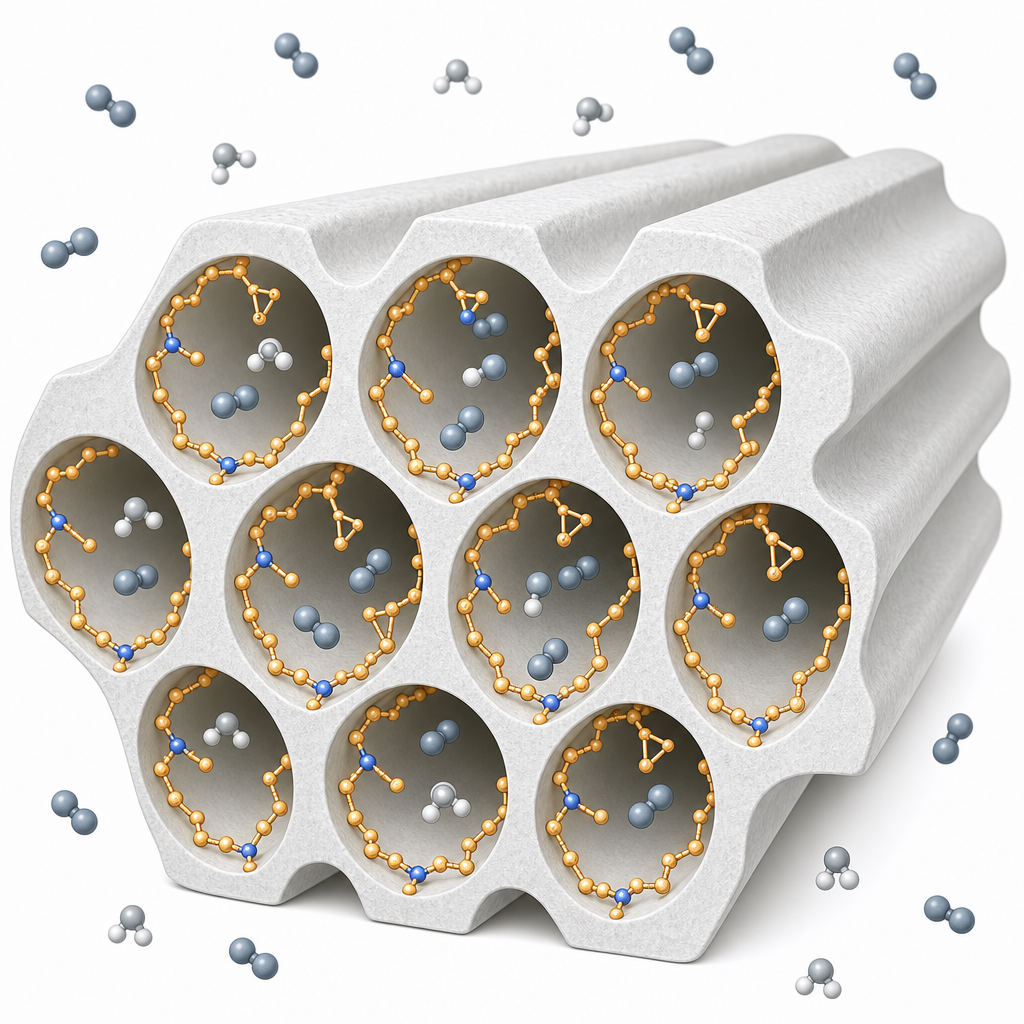
The results demonstrate strong performance. 13C NMR confirmed systematic conversion of primary amines (67% in DETA) down to 14–22% with increasing modification, with minimal tertiary amine formation (<7%). Average molecular weight rose from 103 to 208 g/mol, suppressing evaporative loss. CO2 adsorption rates of 1.03–1.28 mmol/g/h were achieved, and all materials reached >90% of equilibrium capacity within 1 h. The 1:2 material achieved 66% regeneration within 1 h at 30 °C and complete regeneration within 4 h. Under thermal aging (60 °C, N2, 24 h), capacity retention improved to 99.1% for the 1:2 ratio; under oxidative aging (60 °C, air) it reached 97.8%, versus only 46.7% for unmodified DETA. Dry DAC capacities were 0.54–0.76 mmol/g at 400 ppm and 30 °C, rising to ~1.4 mmol/g under 70% RH humid conditions due to moisture-promoted bicarbonate formation. Humid cycling showed negligible change from 1.39 to 1.40 mmol/g over nine cycles, and real Buffalo air (420–460 ppm, 20–25 °C) delivered a working capacity of ~1.05 mmol/g with less than 5% variation and stable performance across 50 cycles. PFO kinetic fits (R2 = 0.992–0.994, k1 = 0.033–0.044 min⁻¹) confirmed rapid uptake.
This research enables lower-energy, more durable direct air capture. By cutting the regeneration temperature from the typical 80–120 °C to ambient 23 °C, the approach can substantially reduce the energy penalty and operating cost that dominate DAC economics, while the eliminated evaporative losses and improved oxidative resistance extend sorbent lifetime. Because the synthesis uses inexpensive commercial reagents under mild conditions without specialized equipment, it is compatible with kilogram-scale production. The authors note the strategy generalizes beyond DETA to other volatile polyamines and point to adjacent applications such as flue-gas separation, biogas upgrading, and indoor air quality control. Future work targets pilot-scale validation, techno-economic analysis, and alternative epoxide modifications to optimize the capacity–stability–energy trade-off.
For researchers working on CO2 capture, gas separation, or amine-functionalized adsorbents, the mesoporous SBA-15 used here is available from ACS Material LLC as part of its molecular sieve and mesoporous silica catalog. Its high surface area and ordered pore structure made it an effective host for amine impregnation, supporting fast kinetics and stable cycling. The performance reported in this paper reflects the combined design of the modified amine and the silica support, offering a practical reference point for groups developing supported-amine sorbents for energy-efficient direct air capture and related separation technologies.How ACS Material products were used
- SBA-15 (mesoporous silica support) (Molecular Sieves) — “Supported sorbents were prepared via incipient wetness impregnation onto a mesoporous silica SBA-15 (ACS Material LLC).”
Product Performance in this StudyThe ACS Material SBA-15 served as the high-surface-area mesoporous support (BET 390 m2/g) onto which epoxide-modified DETA was impregnated at 35 wt%, yielding fixed-bed DAC sorbents that retained fast kinetics and stable cycling.
Related product categories
Frequently asked questionsWhy is SBA-15 used as a support for amine-based CO2 capture sorbents?
SBA-15 is an ordered mesoporous silica with high surface area, around 390 m2/g in this study, and uniform pores of about 5–6 nm radius. These features let it host a high loading of amine, 35 wt% here, while keeping the amine accessible to CO2. Incipient wetness impregnation onto SBA-15 preserved the fast kinetics of small amines and enabled stable fixed-bed direct air capture cycling.
How does epoxide modification of DETA improve direct air capture performance?
Reacting diethylenetriamine with 1,2-epoxybutane converts reactive primary amines into more stable secondary amine-alcohol groups and raises molecular weight from 103 to 208 g/mol. This suppresses evaporative loss and improves oxidative resistance, with the optimized material retaining 97.8% capacity after oxidative aging versus 46.7% for unmodified DETA, while enabling 66% regeneration within one hour at 30 °C.
What CO2 capacity can epoxide-modified DETA on SBA-15 achieve under ambient air?
Under simulated dry conditions at 400 ppm CO2 and 30 °C the 1:2 material captured 0.54 mmol/g, while at 70% relative humidity capacity rose to about 1.4 mmol/g due to moisture-promoted bicarbonate formation. In real Buffalo, NY air the working capacity was around 1.05 mmol/g, with stable performance and under 5% variation over 50 consecutive adsorption-desorption cycles.