-
SBA-15 Support for NiMo Carbide Hydrotreating - Wayne State University, 2013
Jun 19, 2026 | ACS MATERIAL LLCWang, H. et al. (2013). Support effects on hydrotreating of soybean oil over NiMo carbide catalyst. *Fuel*. https://doi.org/10.1016/j.fuel.2013.04.066
Fuel · 2013
Wayne State University used ACS Material SBA-15 to build Al-SBA-15-supported NiMo carbide catalysts that converted soybean oil into 97% diesel-range hydrocarbons.
About this research
Researchers at Wayne State University used SBA-15 mesoporous silica supplied by ACS Material, LLC (Medford, MA) as the starting framework to build an Al-SBA-15-supported NiMo carbide catalyst that hydrotreated soybean oil into diesel-range hydrocarbons with 96% organic liquid yield and 97% selectivity. Published in Fuel in 2013, the study by Wang, Yan, Salley and Ng systematically compared five catalyst supports—Al-SBA-15, γ-Al2O3, ZSM-5, Zeolite β and USY—to identify which architecture best balances surface area, pore accessibility and acidity for converting triglyceride feedstocks into drop-in liquid fuels.
The broader scientific context is the search for economical, sulfur-free routes to renewable diesel. Conventional desulfurization-style hydrotreating relies on γ-Al2O3-supported sulfided Mo/W catalysts that demand high pressure, generate n-paraffin products that solidify at low temperatures, and require continuous sulfiding agents to maintain activity. Transition-metal carbides such as NiMoC are attractive sulfur-free alternatives because they exhibit Pt-like hydrogenation behavior at lower cost. However, the choice of support strongly affects carbide dispersion, acid-site density and resistance to coking. Mesoporous silicas like SBA-15 offer large, uniform channels for diffusing bulky triglyceride molecules, while zeolites bring strong Brønsted acidity that promotes cracking toward gasoline. Resolving which support best matches the hydrotreating of vegetable oils is therefore a practical question for biorefinery process design and for downstream applications including aviation biofuel, green diesel blendstocks and renewable naphtha.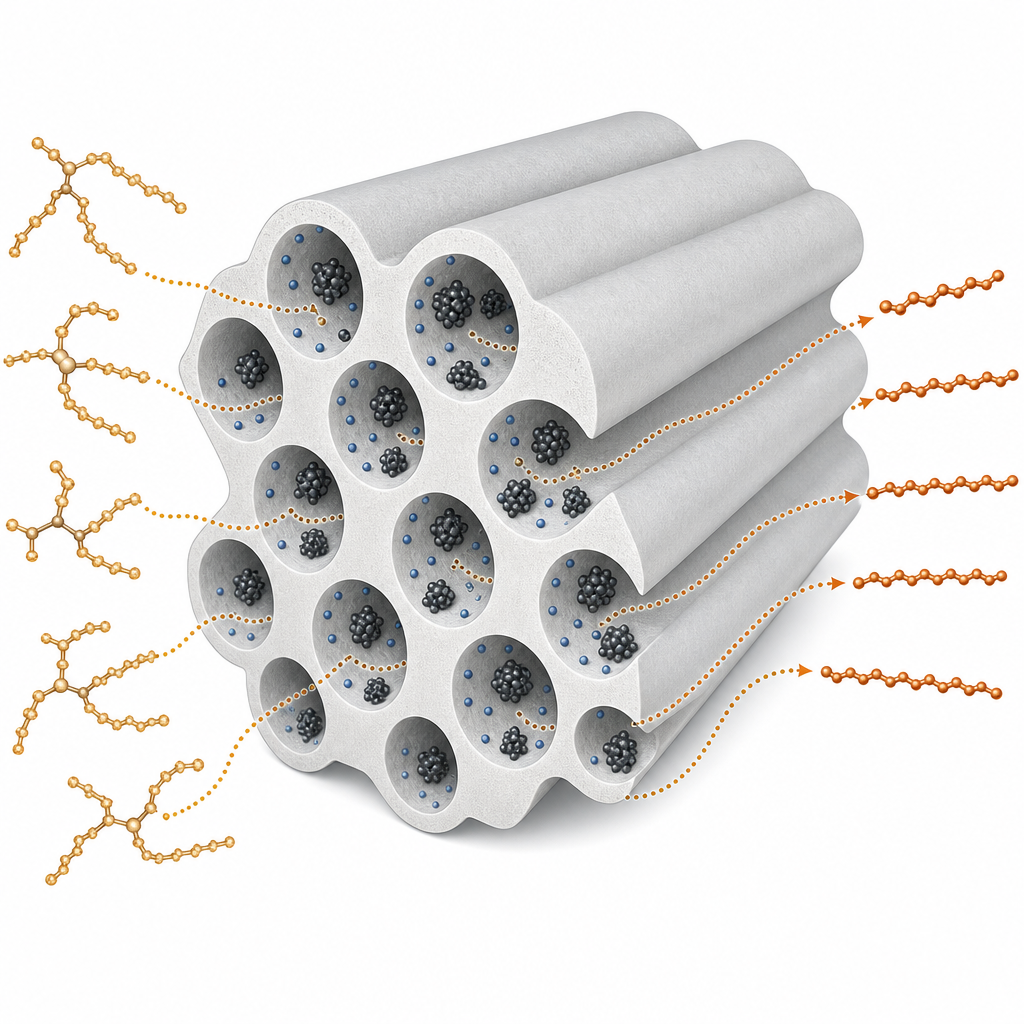
The ACS Material SBA-15 powder served as the precursor for an aluminated derivative. According to the Experimental section, 20 g of commercialized SBA-15 powder (ACS Materials, LLC, Medford, MA) were dispersed in 150 mL of hexane, after which 0.067 g of aluminum isopropoxide in hexane was added with stirring. After 24 h at room temperature the mixture was filtered, washed with hexane, dried overnight at 60 °C, and calcined in air at 773 K for 4 h to yield Al-SBA-15 with a final Si/Al ratio of 80. The Al-SBA-15 was then incipient-wetness impregnated with aqueous Ni(NO3)2 and (NH4)6Mo7O24·4H2O, dried, calcined at 400 °C, and carburized by temperature-programmed reduction in 20 vol% CH4/H2 ramped to 730 °C. The ACS Material SBA-15 therefore sets the textural template that ultimately controls metal dispersion and reactant access. Parallel catalysts were prepared on γ-Al2O3 and on commercial ZSM-5, Zeolite β and USY zeolites for benchmarking.
Nitrogen physisorption confirmed that NiMoC/Al-SBA-15 retained a well-ordered mesoporous architecture, displaying a Type IV isotherm with a Type A hysteresis loop and a specific adsorption capacity of approximately 450 m²/g. After full BET analysis the Al-SBA-15-supported catalyst exhibited the highest surface area of 711.5 m² g⁻¹ and the largest pore volume of 0.71 cm³ g⁻¹ among all five catalysts. NiMoC/γ-Al2O3 also showed a mesoporous Type IV isotherm but with irregular Type E hysteresis and a much lower adsorption capacity. The three zeolite-supported catalysts gave Type I isotherms typical of microporous solids. XRD showed no detectable Ni/Mo carbide or oxide diffraction peaks for any sample, indicating crystallite sizes below 5 nm or amorphous carbide phases, both favorable for active-site exposure. In fixed-bed hydrotreating of soybean oil at 400 °C, 650 psi, an LHSV of 1 h⁻¹ and 50 mL/min H2, NiMoC/Al-SBA-15 delivered the highest organic liquid product yield of 96% and the highest selectivity of 97% to diesel-fraction hydrocarbons (C12–C22). The three zeolite-supported catalysts, by contrast, cracked more of the feed and produced 15–40% of products in the green gasoline boiling range, reflecting their stronger acidity and microporous confinement.
These findings point to clear application paths. For producers targeting renewable diesel and jet-fuel blendstocks from soybean oil, waste cooking oil, animal fats or other triglyceride feedstocks, Al-SBA-15-supported NiMo carbide offers a sulfur-free catalyst with high middle-distillate selectivity and a textural profile that resists pore blockage by bulky lipid molecules. For operators seeking lighter green gasoline cuts, zeolite supports remain attractive because of their cracking activity. The work also suggests follow-up studies on long-duration coking behavior, sulfur and phosphorus tolerance for crude feedstocks, and optimization of Si/Al ratio and Ni/Mo loading to further tune the gasoline-to-diesel product distribution. The strategy is broadly transferable to hydrodeoxygenation of pyrolysis bio-oils and lignin-derived oxygenates.
For researchers developing hydrotreating, hydrodeoxygenation or biorefining catalysts, SBA-15 mesoporous silica is available from ACS Material as a uniform, high-surface-area framework suitable for aluminum grafting, metal impregnation and subsequent carburization or sulfidation. This paper provides a documented example in which ACS Material SBA-15, after conversion to Al-SBA-15, supported a NiMo carbide that outperformed alumina and three zeolite benchmarks for soybean-oil hydrotreating. The product is offered alongside related mesoporous silicas such as MCM-41, KIT-6 and SBA-16, giving catalyst developers a coherent material set for support-effect studies on renewable-fuel reactions.How ACS Material products were used
- SBA-15 (mesoporous silica) (Molecular Sieves) — “20 g of commercialized SBA-15 powder (ACS Materials, LLC, Medford, MA) were dispersed in 150 mL hexane.”
Product Performance in this StudySBA-15 from ACS Material was post-modified with aluminum isopropoxide to yield Al-SBA-15 (Si/Al = 80), which served as the highest-performing catalyst support. The resulting NiMoC/Al-SBA-15 catalyst exhibited the highest BET surface area (711.5 m²/g) and largest pore volume (0.71 cm³/g) among five supports tested, and delivered the best hydrotreating performance.
Related product categories
Frequently asked questionsWhy is SBA-15 a good support for hydrotreating vegetable oils into renewable diesel?
SBA-15 provides large, uniform mesopores and very high surface area, which allow bulky triglyceride molecules from soybean oil to access active metal sites without diffusion limitations. In this study, an Al-SBA-15-supported NiMo carbide catalyst reached a BET surface area of 711.5 m²/g and a pore volume of 0.71 cm³/g, giving 96% organic liquid yield and 97% selectivity to diesel-range hydrocarbons, far exceeding γ-Al2O3 and zeolite supports.
How does the catalyst support affect product distribution in soybean oil hydrotreating?
The support controls acidity, porosity and metal dispersion, which together determine whether the triglyceride is upgraded to diesel or cracked to gasoline. Mesoporous Al-SBA-15 favored diesel-range C12–C22 hydrocarbons at 97% selectivity, while the more acidic and microporous zeolite supports (ZSM-5, Zeolite β, USY) produced 15–40% of their output in the green gasoline boiling range due to stronger cracking activity.
What is the advantage of NiMo carbide catalysts over conventional sulfided NiMo catalysts?
NiMo carbide catalysts behave like noble metals for hydrogenation but do not require continuous sulfiding agents, simplifying operation and avoiding sulfur contamination of renewable fuel products. They are also more compatible with low-sulfur biofeedstocks such as vegetable oils. In this work, NiMo carbide on Al-SBA-15 effectively converted soybean oil at 400 °C and 650 psi without sulfidation, yielding 96% liquid product dominated by diesel-range hydrocarbons.