-
SBA-15-Supported Iron Aquo Photocatalyst - NIMS, 2018
Jul 08, 2026 | ACS MATERIAL LLCIqbal, M. F. et al. (2018). Iron Aquo Complex as an Efficient and Selective Homogeneous Photocatalyst for Organic Synthetic Reactions. *ChemCatChem*. https://doi.org/10.1002/cctc.201801360
International Center for Materials Nanoarchitectonics (MANA) National Institute for Materials Science (NIMS) 1-1 Namiki Tsukuba 305-0044 Japan · ChemCatChem · 2018
NIMS researchers use ACS Material SBA-15 to support an iron(III) aquo photocatalyst, achieving TON 100 and ~100% selectivity in cyclohexane partial oxidation.
About this research
Researchers at the International Center for Materials Nanoarchitectonics (MANA) National Institute for Materials Science (NIMS) 1-1 Namiki Tsukuba 305-0044 Japan used SBA-15 mesoporous silica supplied by ACS Material as a host for iron(III) aquo complexes, producing a photocatalyst that oxidizes cyclohexane to cyclohexanol and cyclohexanone with a turnover number (TON) of up to 100 and nearly 100% selectivity under solar irradiation. The work, published in ChemCatChem in 2018, shows that one of the simplest and cheapest iron salts, Fe(NO3)3·9H2O, can act as an effective homogeneous photocatalyst for a difficult selective oxidation, and that confining the active species in ordered mesoporous silica further enhances performance.
Selective partial oxidation of cyclohexane to cyclohexanol and cyclohexanone is industrially important because both products are intermediates for adipic acid and ε-caprolactam, the monomers of nylon-66 and nylon-6. Established heterogeneous photocatalysts such as TiO2 (P25) and α-Fe2O3 typically suffer from low yields, over-oxidation to CO2, and modest selectivity. Homogeneous iron catalysis is attractive because iron is abundant, inexpensive, and benign, but few examples of iron-based homogeneous photocatalysts have been demonstrated for fine-chemical synthesis. This paper addresses that gap by showing that the dominant aquo species [Fe(H2O)6]3+, formed at strongly acidic pH (~0.19), can drive C–H activation with O2 under solar light, providing a sustainable alternative to noble-metal catalysis.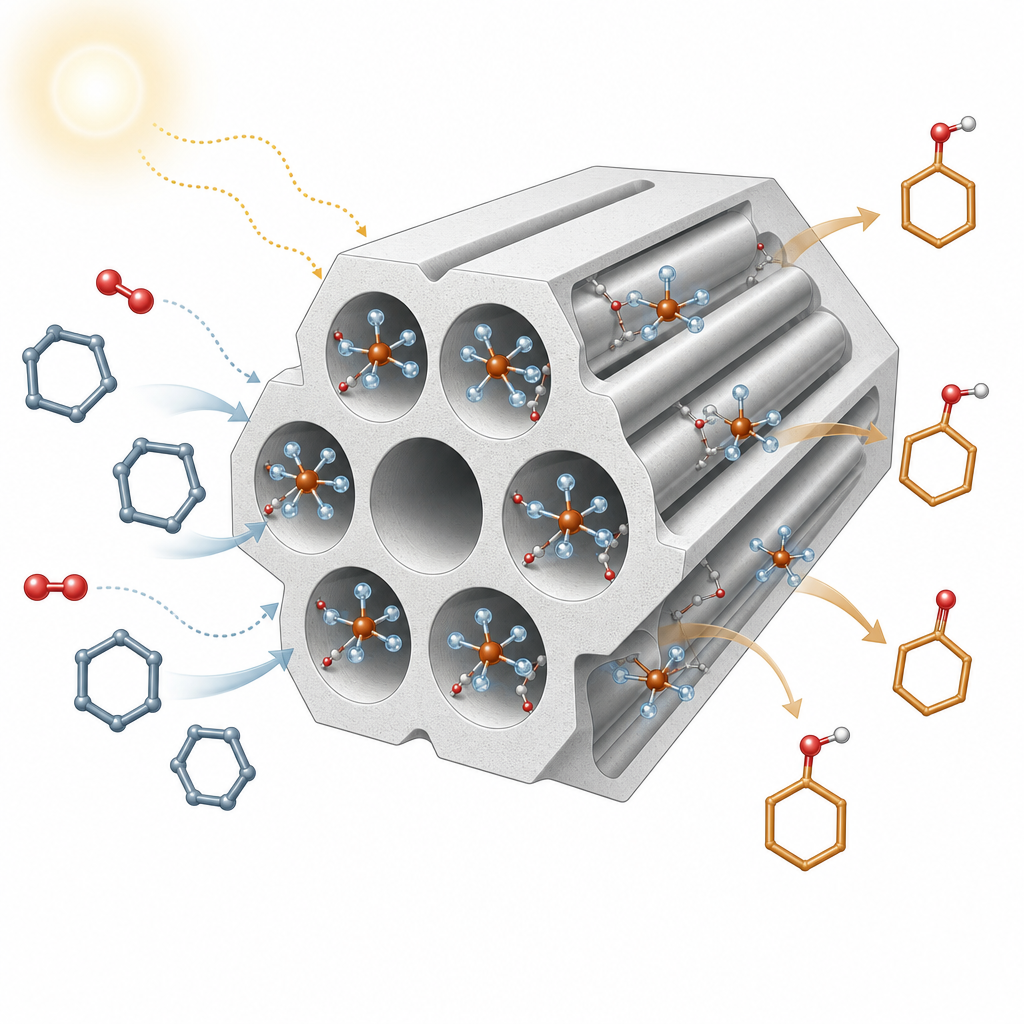
ACS Material SBA-15 was central to the supported catalyst Fe(III)@SBA. As described in the Experimental Section, 100 mg of SBA-15 (ACS Material) was mixed with 3 mL of an Fe(III)aq solution (7.2 mM iron(III) in 1 M HNO3) and dried at room temperature in air for one week while stirring, giving a nominal loading of 53 mmol Fe(III) per gram. Fe K-edge EXAFS analysis of the resulting solid confirmed that the local coordination environment of iron in Fe(III)@SBA closely resembled that of the free [Fe(H2O)6]3+ species in solution, indicating that the mesoporous silica framework preserves the molecular catalyst rather than converting it into iron-oxide clusters. The ordered mesoporous channels of SBA-15 thus functioned simultaneously as a high-surface-area host, a confining medium, and an adsorbent that concentrates cyclohexane near the active iron centers, as supported by separate adsorption tests from acetonitrile in the dark.
Under a solar simulator (>300 nm, 1 SUN) in an O2-bubbled acetonitrile/cyclohexane mixture, the free Fe(III) aquo solution alone catalyzed cyclohexane oxidation with a TON of 88 and nearly 100% selectivity toward cyclohexanol plus cyclohexanone, with minimal CO2 formation detected by GC-TCD/FID. For comparison, commercial TiO2 (P25, Nippon Aerosil) gave only low TON with significant over-oxidation, and α-Fe2O3 (Kanto) was essentially inactive under the same conditions. Impregnating the iron aquo complex into ACS Material SBA-15 pushed the TON further upward to about 100 while maintaining nearly 100% selectivity. UV-Vis spectroscopy of Fe(III)@SBA showed the same dominant absorption near 240 nm characteristic of [Fe(H2O)6]3+, with a weak shoulder near 320 nm assigned to minor [Fe(OH)(H2O)5]2+ and [Fe(OH)2(H2O)4]+ species; no absorption above 400 nm indicative of Fe(III) clusters or particles was observed, confirming that the iron remained in a molecularly dispersed state inside the silica.
The results have practical implications for sustainable fine-chemical and intermediate manufacturing. Selective aerobic oxidation of alkanes under sunlight is a long-standing target for the polyamide value chain, and a system built from Fe(NO3)3·9H2O and mesoporous silica is appealing because both components are cheap, scalable, and free of precious metals. The authors point to broader use of iron aquo photocatalysis across organic synthetic reactions where photoexcited Fe(III) can engage C–H bonds, and the support strategy described here suggests that other ordered mesoporous hosts and zeolites could be screened to tune selectivity, adsorption, and catalyst recovery. Follow-up studies on substrate scope, recyclability, and visible-light-only operation are natural next steps suggested by the work.
For researchers working on photocatalysis, selective oxidations, or single-site iron chemistry, this paper illustrates how a well-defined mesoporous silica can transform a simple molecular iron complex into a more productive catalyst. The SBA-15 used here is available from ACS Material as part of its molecular sieves catalog, alongside related supports such as MCM-41, SBA-16, KIT-6 and a range of zeolites that may be useful for adapting the approach to other reactions, substrates, or metal centers.How ACS Material products were used
- SBA-15 mesoporous silica (Molecular Sieves) — “Fe(III)@SBA was prepared via mixing 100 mg of SBA-15 (ACS Material) with 3 mL of the Fe(III)aq solution and drying up the mixture at room temperature in air for 1 week while stirring.”
Product Performance in this StudySBA-15 served as the mesoporous silica support for impregnating iron(III) aquo complexes. The resulting Fe(III)@SBA hybrid catalyst delivered an improved turnover number of up to 100 for cyclohexane photo-oxidation while preserving nearly 100% selectivity, demonstrating that the ordered mesoporous structure effectively confined and stabilized the catalytic species.
Related product categories
Frequently asked questionsWhy is SBA-15 a good support for molecular iron photocatalysts?
SBA-15 is an ordered mesoporous silica with uniform channels, high surface area, and chemically inert silanol-rich walls. These properties let it disperse iron(III) aquo complexes at the molecular level without forming inactive iron-oxide clusters, as confirmed by EXAFS in this study. The mesopores also adsorb organic substrates such as cyclohexane near the iron centers, which raises local concentration and improves turnover while preserving high product selectivity.
How does the iron aquo complex outperform TiO2 for cyclohexane oxidation?
Under solar light and O2, the iron(III) aquo complex selectively oxidizes cyclohexane to cyclohexanol and cyclohexanone with a turnover number of 88 and nearly 100% selectivity. TiO2 (P25) gives a much lower turnover and produces significant CO2 from over-oxidation, while α-Fe2O3 is essentially inactive. Supporting the iron complex on SBA-15 further raises the turnover number to about 100 without loss of selectivity.
What loading of iron was used in the Fe(III)@SBA-15 catalyst?
The catalyst was prepared by mixing 100 mg of SBA-15 with 3 mL of a 7.2 mM Fe(III) aqueous solution and drying at room temperature in air for one week. This procedure gave a nominal iron(III) loading of 53 mmol per gram of SBA-15. EXAFS analysis showed the supported iron retained a coordination environment essentially identical to [Fe(H2O)6]3+ in solution, indicating that the molecular catalyst was preserved inside the mesoporous channels.