-
SBA-15 Template for PtRu/MCN Ethanol Fuel Cells - IIT Delhi, 2014
Jun 18, 2026 | ACS MATERIAL LLCGoel, J., & Basu, S. (2014). Effect of support materials on the performance of direct ethanol fuel cell anode catalyst. *International Journal of Hydrogen Energy*. https://doi.org/10.1016/j.ijhydene.2014.01.203
International Journal of Hydrogen Energy · 2014
IIT Delhi researchers used SBA-15 from ACS Material as a hard template to synthesize mesoporous carbon nitride, enabling PtRu/MCN anodes that delivered 61.1 mW/cm² in direct ethanol fuel cells.
About this research
Researchers at the Indian Institute of Technology Delhi used SBA-15 mesoporous silica from ACS Material as a hard template to fabricate mesoporous carbon nitride (MCN) supports for PtRu anode catalysts, achieving a peak direct ethanol fuel cell (DEFC) power density of 61.1 mW/cm² at 100 °C and 1 bar with a 2 M ethanol feed. The work, by Jyoti Goel and Suddhasatwa Basu, systematically compares four supports — MCN, acid-treated multiwall carbon nanotubes (t-MWCNTs), pristine MWCNTs, and Vulcan-XC — to identify which carbon architecture best disperses PtRu, resists CO poisoning, and sustains ethanol electro-oxidation activity. SBA-15 is the critical template that enables the MCN morphology underpinning the best result.
Direct ethanol fuel cells are attractive for portable and stationary power because ethanol is liquid, high in energy density, and producible from biomass. However, complete oxidation to CO₂ is hindered by C–C bond cleavage and CO-intermediate poisoning of Pt anodes. Alloying Pt with Ru improves CO tolerance, but the support material exerts an equally important influence on particle dispersion, electrical conductivity, and accessible porosity. Carbon blacks such as Vulcan-XC have been the workhorse support, yet their limited surface area and disordered pore structure cap the achievable electrochemical surface area. Ordered mesoporous carbons and nitrogen-doped variants offer higher BET surface area, tunable pore size, and nitrogen functionalities that can anchor metal nanoparticles. This paper benchmarks an MCN support against carbon nanotube and carbon-black baselines in a working DEFC.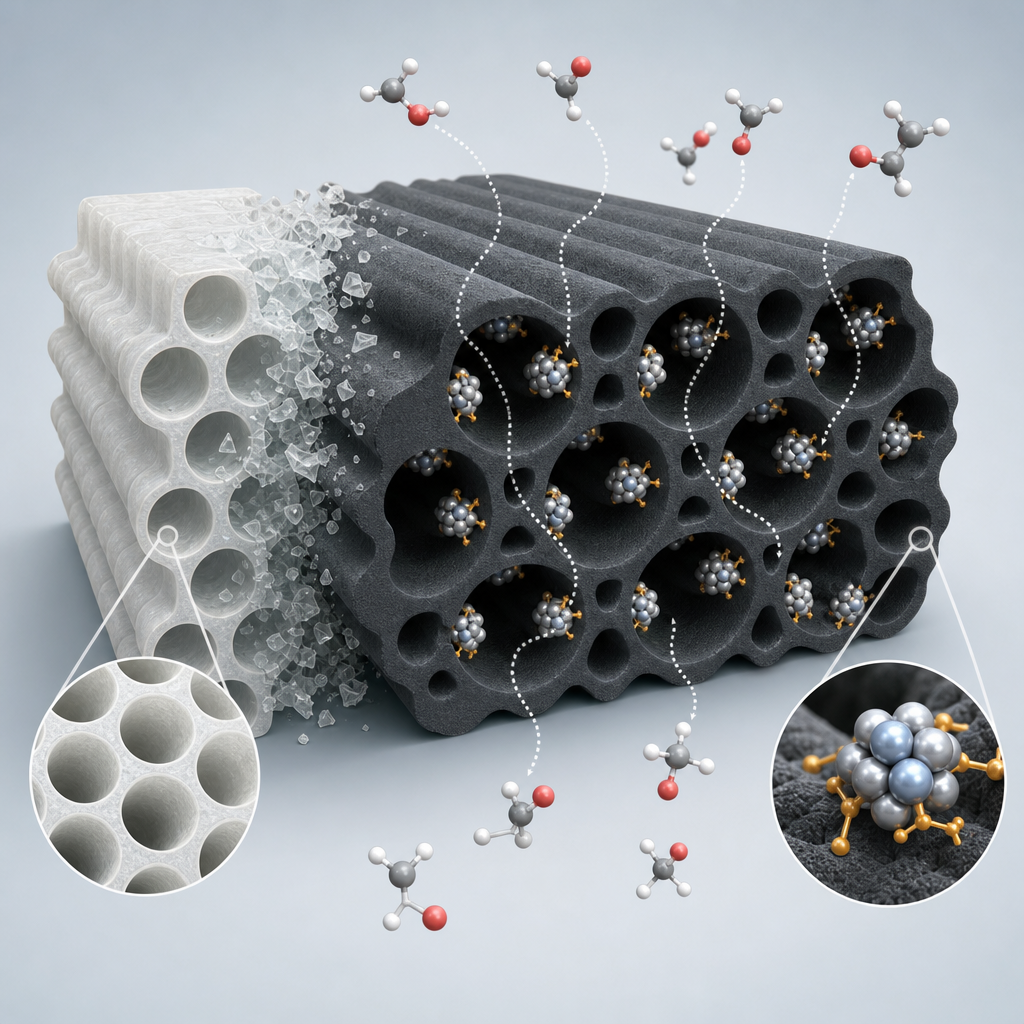
SBA-15 from ACS Material was used as the sacrificial hard template for MCN synthesis. Specifically, 0.30 g of calcined mesoporous silica SBA-15 was mixed with 1.2 g ethylenediamine and 2.4 g carbon tetrachloride at room temperature, then refluxed at 90 °C for 10 h to polymerize the nitrogen-containing carbon precursor inside the SBA-15 pore network. The composite was pyrolyzed at 400 °C for 2 h under N₂ to carbonize the polymer, after which the silica template was etched away in 5 wt% HF, leaving a replica MCN with mesoporosity inherited from the SBA-15 channels. The MCN was then loaded with PtRu (40 wt% total metal) by co-impregnation of H₂PtCl₆·6H₂O and RuCl₃ in iso-propanol, followed by reduction in flowing hydrogen at 400 °C for 4 h. Parallel catalysts were prepared on t-MWCNTs (refluxed in 1:3 HNO₃/H₂SO₄), pristine MWCNTs, and Vulcan-XC for direct comparison. The quality of the SBA-15 template therefore directly controls the porosity, surface area, and metal-anchoring sites of the final MCN support.
XRD confirmed formation of bimetallic PtRu nanoparticles with crystallite sizes between 7 and 17 nm depending on support. In single-electrode tests (1 M ethanol, 0.5 M H₂SO₄), cyclic voltammetry, linear sweep voltammetry, and chronoamperometry consistently ranked PtRu/MCN highest in ethanol electro-oxidation activity, followed by PtRu/t-MWCNTs, PtRu/MWCNTs, and PtRu/Vulcan-XC. In a full membrane-electrode assembly built with Nafion 117 and a Johnson Matthey 40 wt% Pt/C cathode, operated at 100 °C and 1 bar with 2 M ethanol at 1 mL/min and humidified O₂ at 60 SCCM, the same ordering held for maximum power density. PtRu/MCN delivered 61.1 mW/cm² at an anode loading of 2 mg/cm², substantially exceeding the carbon nanotube and Vulcan-XC counterparts. The authors attribute this to MCN's higher accessible surface area, nitrogen functional groups that stabilize small PtRu particles, and the ordered mesopore network that improves mass transport of ethanol and removal of intermediates. Chronoamperometry also showed better long-term current retention on MCN, indicating reduced poisoning.
The results are relevant to anyone developing anode catalysts for liquid-fuel proton-exchange-membrane fuel cells, including DEFCs, direct methanol fuel cells, and direct formic acid fuel cells. They also speak to broader electrocatalysis applications — alcohol electro-reforming, electrochemical CO₂ reduction, and hydrogen evolution — where ordered mesoporous nitrogen-doped carbons are increasingly used to lower precious-metal loadings. Templating with SBA-15 remains one of the most reproducible routes to such ordered porous carbons. The authors point to further optimization of metal loading, Pt:Ru ratio, and operating temperature, as well as exploration of ternary alloys on MCN, as productive next steps.
For researchers planning similar work, SBA-15 mesoporous silica is available from ACS Material in research-scale quantities suitable for hard-templating syntheses of ordered mesoporous carbons, carbon nitrides, and metal oxide replicas. The same catalogue also offers MCM-41, KIT-6, and related mesoporous silicas for groups exploring alternative pore geometries. As this paper demonstrates, the quality of the template translates directly into the performance of the downstream electrocatalyst, making the choice of starting silica an upstream decision that meaningfully shapes fuel-cell results.How ACS Material products were used
- SBA-15 Mesoporous Silica (Molecular Sieves) — “SBA-15 (ACS material) template for MCN”
Product Performance in this StudySBA-15 from ACS Material served as the hard template to synthesize mesoporous carbon nitride (MCN), the best-performing catalyst support in the study. The well-defined mesoporosity inherited from SBA-15 directly enabled PtRu/MCN to achieve the highest power density among all tested supports.
Related product categories
Frequently asked questionsWhy use SBA-15 as a template for mesoporous carbon nitride fuel cell supports?
SBA-15 provides an ordered hexagonal array of uniform mesopores that can be infiltrated with nitrogen-containing carbon precursors. After carbonization and HF etching of the silica, the resulting mesoporous carbon nitride (MCN) inherits high surface area, accessible mesoporosity, and nitrogen anchoring sites. These features disperse PtRu nanoparticles uniformly, improve ethanol mass transport, and yield higher electro-catalytic activity than carbon black or MWCNT supports.
How does the support material affect direct ethanol fuel cell performance?
The support governs PtRu particle size, dispersion, electrical conductivity, and access of ethanol and intermediates to active sites. In this study, PtRu crystallite sizes ranged from 7 to 17 nm depending on support. Maximum power density at 100 °C followed the order PtRu/MCN > PtRu/t-MWCNTs > PtRu/MWCNTs > PtRu/Vulcan-XC, with MCN reaching 61.1 mW/cm² thanks to its larger surface area, nitrogen functionality, and ordered mesopores.
What PtRu loading and operating conditions gave the best DEFC results?
An anode loading of 2 mg/cm² PtRu (40 wt% metal on 60 wt% MCN) paired with a 1 mg/cm² Pt/C cathode delivered the best results. The cell used a Nafion 117 membrane, was fed 2 M ethanol at 1 mL/min on the anode and humidified O₂ at 60 SCCM on the cathode, and was operated at 100 °C and 1 bar absolute pressure, yielding 61.1 mW/cm² peak power density.