-
SBA-15 Templated Mesoporous Ceria for Soot Combustion - Politecnico di Torino, 2015
May 29, 2026 | ACS MATERIAL LLCPiumetti, M. et al. (2015). Nanostructured ceria-Based catalysts for soot combustion: Investigations on the surface sensitivity. *Applied Catalysis B: Environmental*. https://doi.org/10.1016/j.apcatb.2014.10.062
Applied Catalysis B: Environmental · 2015
Politecnico di Torino used ACS Material SBA-15 as a hard template to cast mesoporous CeO2 catalysts for diesel soot oxidation, revealing surface-sensitive behavior.
About this research
Researchers at Politecnico di Torino used SBA-15 mesoporous silica supplied by ACS Material as the hard template for nanocasting a mesoporous CeO2 catalyst (Ce-M) and benchmarked it against a family of ceria nanostructures for diesel soot combustion. Published in Applied Catalysis B: Environmental (2015), the study by Piumetti, Bensaid, Russo, and Fino compares CeO2 nanocubes, nanorods, nanocubes deposited on ZSM-5, the SBA-15-templated mesoporous CeO2, and a solution-combustion-synthesized ceria. The central finding is that soot oxidation over ceria behaves as both a structure-sensitive and a structure-insensitive reaction, depending on temperature, with the (100) and (110) facets of truncated nanocubes dominating activity at higher temperatures and surface area dominating activity at the onset of oxidation.
Diesel particulate matter is a regulated pollutant linked to lung disease and stringent NOx/PM emission limits in the EU and elsewhere. Catalyzed diesel particulate filters must oxidize accumulated soot at exhaust temperatures of 200–500 °C, well below the ~600 °C required for uncatalyzed combustion. Ceria-based catalysts are among the most attractive options thanks to their reversible Ce4+/Ce3+ redox cycling and abundant chemisorbed oxygen species (Oα). However, activity depends strongly on exposed crystal facets, surface area, and the density of coordinatively unsaturated sites. Understanding which structural descriptor controls the rate in each temperature regime is essential for designing the next generation of soot oxidation catalysts and diesel particulate filter washcoats.
The authors prepared mesoporous CeO2 (Ce-M) by impregnating SBA-15 from ACS Material with Ce(NO3)3·6H2O in ethanol, calcining at 550 °C, and selectively dissolving the silica template in 2 M NaOH at 50 °C. The procedure is reported in the Materials and Methods section: "0.5 g SBA-15 (ACS materials) was added to this solution and heated at 60 °C under vigorous stirring. After the ethanol had evaporated, the cerium precursor/silica composite was calcined at 450 °C for 4 h." The high specific surface area (724 m²/g) and ordered mesopore network of the SBA-15 template were crucial for confining ceria nucleation and producing 4–10 nm crystalline CeO2 nanoparticles interconnected into a 3D mesoporous framework. After template removal, Ce-M retained a BET surface area of 75 m²/g and a total pore volume of 0.15 cm³/g — values orders of magnitude higher than the bulk Ce-NC (4 m²/g) and Ce-NR (4 m²/g) samples, making Ce-M the key high-surface-area reference for disentangling shape versus area effects.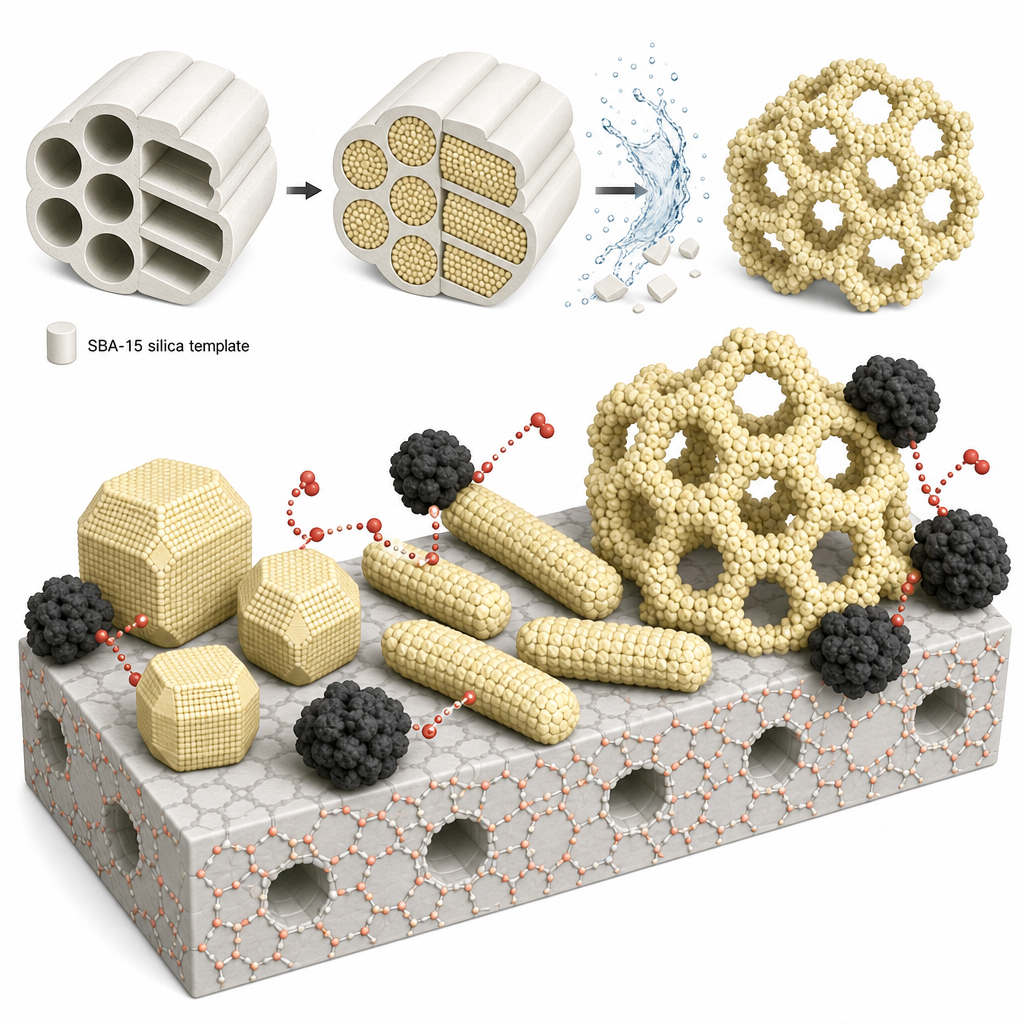
In temperature-programmed oxidation tests in 10% O2, the CeO2 nanocubes delivered the best total soot conversion under loose contact, with T50% = 477 °C and T90% = 584 °C, driven by the abundance of reactive (100) and (110) facets visible by HRTEM as truncated cube edges. Ce-NC/ZSM-5 dispersed nanocubes on the zeolite (SBET = 425 m²/g, Vp = 0.20 cm³/g) and achieved the lowest Tpeak among loose-contact runs. The SBA-15-templated Ce-M sample, despite exposing the less reactive (111) plane (interplanar spacing 0.30 nm by HRTEM), achieved T10% = 398 °C — competitive with Ce-NC (T10% = 417 °C) — confirming that surface area dominates at low conversions. XPS quantification gave Oα/Oβ ratios of 1.03 for Ce-M and 0.85 for Ce-NC/ZSM-5 versus 0.04 for Ce-NC and Ce-NR, consistent with the higher density of reactive surface oxygen on the high-area samples. Under tight contact, T10% values dropped to 374 °C for Ce-M and 335 °C for Ce-NC/ZSM-5. Above 410 °C (loose) or 370 °C (tight) the soot oxidation rate became structure-sensitive, while below those crossovers the reaction was structure-insensitive. Three consecutive cycles on Ce-NC/ZSM-5 at 750 °C showed no measurable deactivation.
These findings have direct implications for catalyzed diesel particulate filters, gasoline particulate filters, and other oxidation duties such as CO oxidation, methane reforming, and low-temperature water-gas shift, where ceria morphology is being actively engineered. The structure-sensitivity crossover identified here suggests that real exhaust catalysts should combine reactive facets with high surface area — for example, by anchoring shape-controlled nanocubes onto mesoporous or zeolitic supports, as demonstrated by the Ce-NC/ZSM-5 hybrid. The SBA-15 nanocasting route is also a general platform for templating other reducible oxides (Mn, Fe, Co spinels) with controlled mesoporosity for emissions control and three-way catalysis.
For researchers pursuing similar templated mesoporous oxide catalysts, the mesoporous silica SBA-15 used here is available from ACS Material along with related templates such as SBA-16, MCM-41, MCM-48, KIT-6, and a range of zeolites including ZSM-5 and ZIF-8. The product enabled reproducible nanocasting of a high-surface-area ceria phase that proved essential for distinguishing surface-area effects from facet effects in soot oxidation.How ACS Material products were used
- SBA-15 Mesoporous Silica (Molecular Sieves) — “0.5 g SBA-15 (ACS materials) was added to this solution and heated at 60 °C under vigorous stirring.”
Product Performance in this StudySBA-15 from ACS Material served as the hard template for nanocasting mesoporous ceria (Ce-M). After ceria infiltration and calcination, the silica template was removed by NaOH, yielding a mesoporous CeO2 with a BET surface area of 75 m²/g and a 3D ordered framework that enabled the surface-area-driven low-temperature soot oxidation reported in the paper.
Related product categories
Frequently asked questionsWhy is SBA-15 used as a template for synthesizing mesoporous ceria?
SBA-15 provides an ordered hexagonal array of mesopores with a very high BET surface area (around 724 m²/g) that confines the deposition of cerium precursors during nanocasting. After impregnation and calcination, the silica framework is selectively removed with NaOH, leaving a 3D interconnected mesoporous CeO2 replica with crystalline 4–10 nm particles and a much higher surface area than ceria synthesized by direct precipitation.
Why are CeO2 nanocubes more active than CeO2 nanorods for soot combustion?
CeO2 nanocubes preferentially expose the (100) and (110) crystal facets, which carry a higher density of coordinatively unsaturated cerium and oxygen sites than the (111) facet that dominates nanorods. These unsaturated sites lower the activation energy for oxygen activation and soot oxidation, so truncated nanocubes deliver lower T50% and T90% values, particularly above 410 °C where the reaction becomes structure-sensitive.
How does surface area affect low-temperature soot oxidation over ceria?
At temperatures below about 410 °C the reaction is structure-insensitive, so total exposed surface area and the density of chemisorbed oxygen species (hydroxyls, carbonates, peroxide) dominate the rate. High-surface-area materials such as the SBA-15-templated mesoporous Ce-M and Ce-NC supported on ZSM-5 reach soot oxidation onset (T10%) at lower temperatures than bulk nanocubes, even when their preferred facet is the less reactive (111).