-
Silver Nanowire Stretchable Electrodes for Bioinspired Soft Composites - University of Missouri, 2022
May 21, 2026 | ACS MATERIAL LLCLing, Y., Pang, W., Liu, J., Page, M., Xu, Y., Zhao, G., Stalla, D., Xie, J., Zhang, Y., & Yan, Z. (2022). Bioinspired elastomer composites with programmed mechanical and electrical anisotropies. *Nature Communications*. https://doi.org/10.1038/s41467-022-28185-z
Nature Communications · 2022
University of Missouri researchers used ACS Material AgNW-40 silver nanowires to build anisotropic elastomer composites mimicking muscle for soft robotics.
About this research
Researchers at the University of Missouri, in collaboration with Tsinghua University and the University of Nebraska Medical Center, used silver nanowires (AgNW-40) purchased from ACS Material to construct bioinspired elastomer composites that simultaneously reproduce the anisotropic mechanical and electrical behavior of soft biological tissues such as skeletal muscle. Published in Nature Communications (2022), the work combines mechanically assembled 3D polyimide skeletons with crumpled conductive surfaces made from PEDOT:PSS and ACS Material silver nanowires to yield direction-dependent stiffness, J-shaped stress-strain curves, and anisotropic conductivity. The composites are further integrated with dielectric elastomer actuators (DEAs), pointing toward humanoid artificial muscles and soft robots.
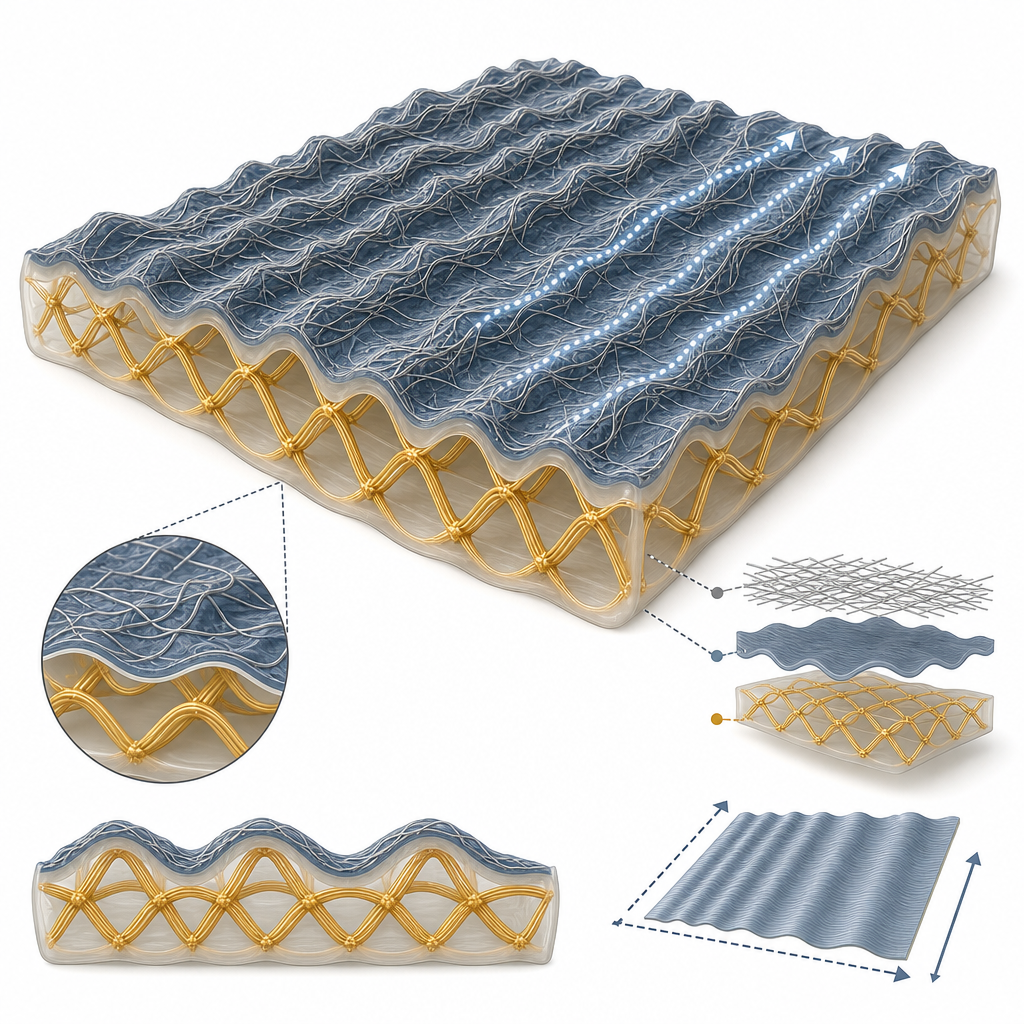
Designing synthetic materials that mimic the directional mechanics and electrical conduction of muscle, skin, and cardiac tissue remains a long-standing challenge. Most stretchable conductors are isotropic, while biological tissues display strong anisotropy that is essential for their function—muscles contract along defined fiber directions, and cardiac tissue conducts impulses preferentially along myofiber axes. Closing this gap is critical for tissue engineering scaffolds, biointegrated electronics, and soft actuators that must couple compliantly to the body. The authors address this need by combining compressive-buckling assembly with crumpled metal-nanowire networks, producing composites whose mechanical and electrical responses can be programmed independently in two orthogonal directions.
In the fabrication workflow, 2D precursors of polyimide (Kapton HN100) and polycaprolactone are CO2-laser cut and transfer-printed onto biaxially prestretched silicone substrates (Ecoflex 00-20, Dragon Skin, or Silbione). Release of the prestrain self-assembles the precursors into 3D skeletons, which are then encapsulated in silicone. A 15 min oxygen plasma treatment forms a thin SiO2 layer that templates surface wrinkling. Conductive films are spray-coated through an airbrush using PEDOT:PSS, ACS Material AgNW-40 silver nanowires, or hybrids of the two. On final prestrain release, the metallic film crumples into hierarchical microstructures whose period and amplitude differ along the x and y axes, generating the desired electrical anisotropy. The silver nanowire layer provides the high in-plane conductivity needed for compliant electrodes, while PEDOT:PSS adds adhesion and conformal coverage. AgNW networks are also coated onto the top of VHB 4910 dielectric elastomer membranes to form the top electrode of the DEA stack.
The resulting composites exhibit programmable, tissue-like J-shaped stress-strain curves with tunable stiffening onset, controlled by the geometry of the polyimide skeleton (filament width, prestrain ratio, lattice topology). Finite element analyses using ABAQUS with Mooney-Rivlin constitutive laws closely reproduce the measured nonlinear stress-strain responses and capture the post-buckling 3D geometry. Mechanical anisotropy ratios between x and y directions can be programmed over a wide range by adjusting prestrains (e.g., εx = 10% and εy = 50%). Electrically, the crumpled AgNW/PEDOT:PSS surfaces show direction-dependent sheet resistance measured by four-point probe, with conductivity preserved under large biaxial strain because the crumples accommodate deformation without rupture. When integrated into a heart-like DEA driven up to 7000 V, the composite undergoes anisotropic electric field-induced deformation while the skeleton-integrated regions show nonlinear, tissue-like mechanical responses under stretching as large as εx = εy = 80%. Incorporation of polycaprolactone skeletons that soften above body temperature lets the composite switch between relaxed and contracted mechanical states, mimicking muscle activation. Joule heating via the AgNW electrodes provides the local temperature stimulus.
These results enable a class of soft actuators and bioelectronic interfaces that can match the anisotropy of the tissues they contact. Direct applications include artificial skeletal-muscle constructs, cardiac patches that respect myofiber directionality, stretchable electrophysiological electrodes for ECG and EMG recording, and dielectric elastomer actuators for humanoid soft robots and adaptive optics. The compatibility of the fabrication route with conventional silicones, DEA membranes, and laser patterning makes the platform attractive for scale-up. The authors note potential extensions to electrically programmable artificial muscles and shape-morphing soft machines.
For researchers developing stretchable bioelectronics, soft actuators, or anisotropic tissue scaffolds, this study illustrates how high-aspect-ratio silver nanowires function as a robust stretchable conductor when crumpled on prestrained elastomers. ACS Material offers AgNW-40 and a broader Nanowire Series suitable for spray-coated transparent or opaque electrodes, hybrid conductive inks, and electrode integration with dielectric elastomers. The product behaved as the paper required, retaining conductivity through repeated large-strain deformation in the composite electrodes.How ACS Material products were used
- Silver Nanowires (AgNW-40) (Nanowire Series) — “AgNWs (Agnw-40) was purchased from ACS Material.”
Product Performance in this Study
Silver nanowires from ACS Material were spray-coated together with PEDOT:PSS to form the crumpled, stretchable conductive surfaces that delivered the anisotropic electrical properties of the bioinspired elastomer composites and served as compliant electrodes in dielectric elastomer actuators.
Related product categories
Frequently asked questions
Why use silver nanowires instead of metal films for stretchable electrodes on elastomers?
Silver nanowire networks form percolating conductors that tolerate large strains because the high-aspect-ratio wires slide and reorient under deformation. In this work the AgNW film was crumpled onto a prestretched silicone with a thin SiO2 capping layer, producing hierarchical wrinkles that absorb strain. The result is a compliant electrode that remains conductive at biaxial strains up to 80%, which rigid metal films cannot survive.
What role do silver nanowires play in dielectric elastomer actuators?
In this study AgNWs were coated on the top surface of a VHB 4910 dielectric elastomer membrane, with carbon grease on the bottom, to form a stretchable electrode pair. When high voltage (up to 7000 V) is applied, the AgNW electrode delivers uniform electric field across the membrane while accommodating the large area expansion of the actuator without losing electrical contact.
How is electrical anisotropy achieved in the crumpled silver nanowire surface?
Biaxial prestrain of the silicone is intentionally unequal (for example 10% in x and 50% in y). When released, the AgNW/PEDOT:PSS film wrinkles with different amplitudes and wavelengths along the two axes. This produces a sheet resistance that depends on measurement direction, mimicking the directional conductivity of biological tissues such as cardiac muscle.