-
Silver Nanowire–Graphene Transparent Electrodes — Max Planck, 2018
May 21, 2026 | ACS MATERIAL LLCRicciardulli, A., & Yang, S. (2018). Hybrid silver nanowire and graphene‐based solution‐processed transparent electrode for organic optoelectronics. *Advanced Functional Materials*. https://doi.org/10.1002/adfm.201706010
Advanced Functional Materials · 2018
Max Planck researchers combined ACS Material silver nanowires with exfoliated graphene to form ITO-free transparent electrodes for solar cells and PLEDs.
About this research
Researchers at Max‐Planck‐Institut für Polymerforschung Ackermannweg 10 55128 Mainz Germany used silver nanowires (AgNWs) purchased from ACS Material to fabricate a solution-processed hybrid transparent electrode that pairs the 1D metal network with electrochemically exfoliated graphene (EG), achieving a sheet resistance of 13.7 Ω/sq at 89% transmittance and a surface roughness of only 4.6 nm. The hybrid AgNWs–EG electrode was integrated as the anode in organic solar cells (OSCs) and polymer light-emitting diodes (PLEDs), delivering power conversion efficiencies of 6.57% and external quantum efficiencies of 4.4%, matching commercial indium tin oxide (ITO) references. The work demonstrates a scalable, ITO-free pathway for flexible optoelectronics.
The replacement of ITO remains one of the most persistent challenges in flexible optoelectronics. ITO suffers from rising indium costs, brittleness on polymer substrates, and degradation under mechanical stress, which limits roll-to-roll manufacture of solar cells, OLED displays, and wearable photovoltaics. Metal nanowire networks have emerged as the leading ITO alternative because they combine sub-20 Ω/sq sheet resistance with >80% transmittance, but they suffer from three intrinsic weaknesses: junction resistance between crossing wires, surface roughness that causes electrical shorts in thin-film devices, and chemical instability of silver under ambient oxygen. Neither thermal welding, plasmonic light welding, nor reduced graphene oxide (rGO) overcoats have simultaneously solved all three problems. The community needs a planarizing, conductive, and chemically protective overlayer that does not sacrifice transparency.
In this study, AgNWs dispersion with 99.5% purity was purchased from ACS Material; the nanowires had a diameter of 40 nm and lengths of 20–30 µm, ideal for percolating networks at low surface coverage. The AgNWs were diluted in 2-propanol and spray-coated onto quartz and flexible polyethylene naphthalate (PEN) substrates at a concentration of 0.8 mg/mL and a spray pressure of 1.8 bar — conditions optimized through a parameter sweep to yield uniform coverage. On top of this AgNW layer, electrochemically exfoliated graphene flakes (1–3 layers thick, 1–10 µm lateral size, C/O ratio of 19.4, ID/IG of 0.35) were spray-coated from a 0.05 mg/mL DMF dispersion. The graphene filled the junctions and voids between nanowires, planarizing the surface and electrically bridging the silver wires. The AgNWs from ACS Material thus served as the conductive backbone of the entire device stack, with EG acting as both a series-resistance-reducing welder and an oxidation barrier.Replacing brittle, indium-limited ITO in flexible solar cells, OLED displays, and wearables needs a transparent conductor that is low-resistance, smooth, and air-stable. In this Max Planck study, spray-coated silver nanowires (40 nm diameter, 20–30 µm length, 99.5% purity) formed the conductive backbone; a graphene overlay then cut sheet resistance to 13.7 ohm/sq at 89% transmittance, planarized the surface to 4.6 nm, and extended ambient stability past 120 days — yielding ITO-class organic solar cells (6.57% PCE) and PLEDs (4.4% EQE). Explore our Silver Nanowires (Nanowire Series) to build ITO-free flexible electrodes, OLEDs, perovskite/organic solar cells, and printable transparent conductors.
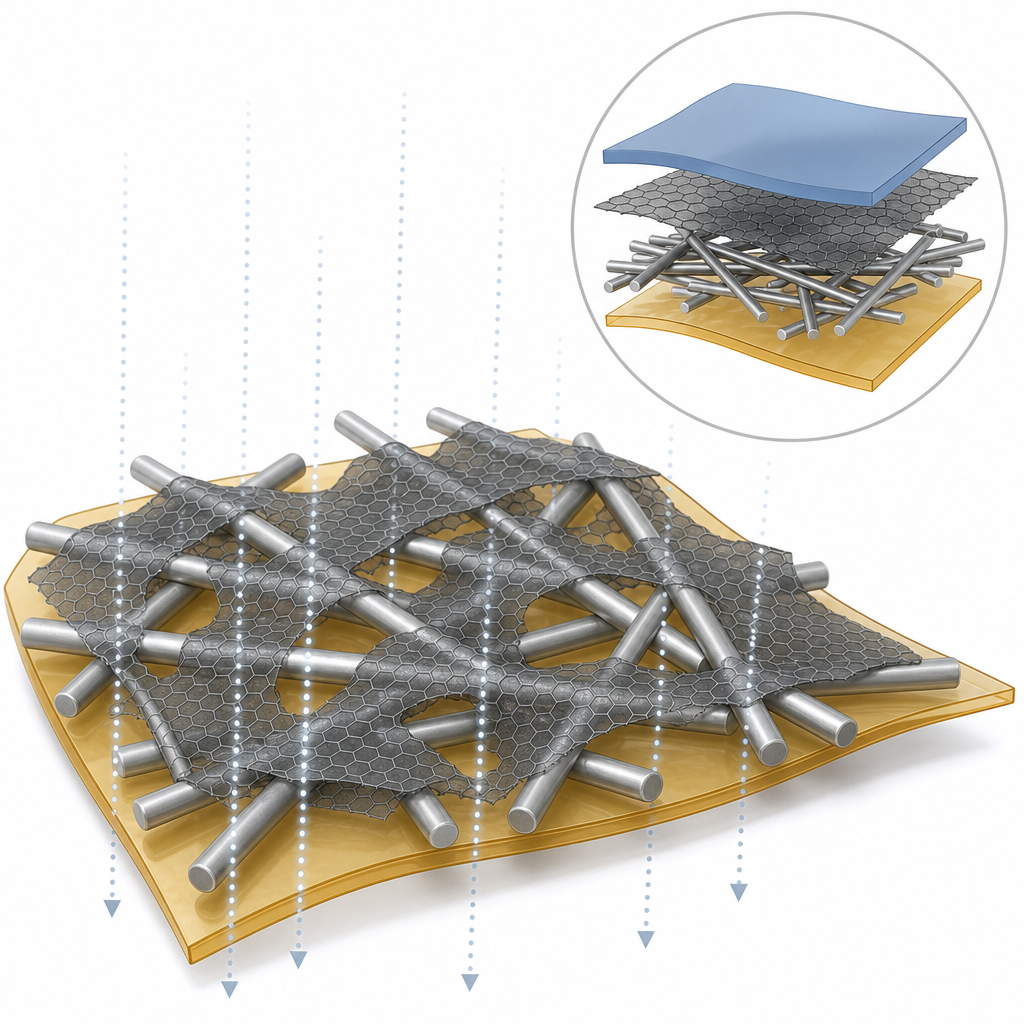
The quantitative results validate the hybrid design. Adding EG to the bare AgNW film dropped the sheet resistance by 83%, from 78 to 13.7 Ω/sq, while transmittance remained at 89%. Root-mean-square surface roughness fell from 16.4 nm (bare AgNWs) to 4.6 nm (AgNWs–EG), eliminating the spike features that cause shorts in 100 nm-thick organic active layers. Under mechanical bending, the hybrid film on PEN retained near-constant sheet resistance through repeated bending cycles, with a maximum variation of 25%, while pristine AgNW films degraded from 78 to 222 Ω/sq. Air exposure tests over 120 days showed negligible Rs change for the hybrid; bare AgNWs rose to 312 Ω/sq from silver oxidation. After 48 hours at 85 °C the hybrid resistance stayed flat, versus 78 → 129 Ω/sq for unprotected AgNWs. In PTB7:PC71BM bulk-heterojunction OSCs, the AgNWs–EG anode yielded Jsc of 15.5 mA/cm², Voc of 727 mV, FF of 58.3%, and PCE of 6.57%, statistically indistinguishable from the ITO reference (7.07% PCE). Flexible OSCs on PEN reached 6.18% PCE with no degradation over 250 bending cycles. PLEDs using 87 nm Super Yellow PPV reached 4.4% EQE and luminance exceeding 10,000 cd/m², closely matching the 4.7% EQE of ITO-based controls.
The demonstration directly enables flexible OLED displays, wearable photovoltaics, transparent heaters, electrochromic windows, and roll-to-roll-fabricated solar modules where ITO's brittleness and supply constraints are limiting factors. Because both AgNW and graphene layers are deposited by spray coating from solution, the process is compatible with large-area manufacturing and avoids the troublesome CVD-graphene transfer step that often damages underlying metallic networks. The authors note that laser patterning could further raise transmittance, expanding the design window for high-brightness PLEDs and tandem solar cells. The chemical-stability gain — 120 days of ambient stability versus catastrophic oxidation of bare AgNWs in 20 days — is also crucial for any field-deployed flexible electronics product. Adjacent applications include transparent EMI shielding, biosensor electrodes, and conductive coatings for photocatalytic windows.
For researchers exploring ITO-free transparent conductors, this study illustrates how silver nanowires from ACS Material can serve as the foundation of high-performance hybrid electrodes when paired with 2D planarizing overlayers. The Silver Nanowire product line — including the 40 nm × 20–30 µm grade used here — is available from ACS Material for groups working on flexible OLEDs, organic and perovskite solar cells, transparent heaters, and wearable sensors. The paper is a useful reference for benchmarking realistic Rs/transmittance trade-offs and bending-cycle stability in spray-coated AgNW networks.How ACS Material products were used
- Silver Nanowire (Nanowire Series) — “AgNWs dispersion with purity of 99.5% was purchased from ACS material. The diameter of the AgNWs is 40 nm and the length between 20 and 30 µm”
Product Performance in this StudyThe ACS Material silver nanowires (40 nm diameter, 20–30 µm length, 99.5% purity) formed the percolating 1D backbone of the hybrid AgNWs–EG transparent electrode. Together with exfoliated graphene, they enabled a sheet resistance of 13.7 Ω/sq at 89% transmittance and supported OSCs with 6.57% PCE and PLEDs with 4.4% EQE, on par with ITO.
Related product categories
Frequently asked questionsWhat is the typical sheet resistance of silver nanowire transparent electrodes for solar cells?
Pure spray-coated silver nanowire networks typically achieve sheet resistances of 50–80 Ω/sq at around 89% transmittance, but junction resistance and surface roughness limit device performance. Adding a planarizing 2D overlayer such as electrochemically exfoliated graphene drops this to 13.7 Ω/sq while keeping transmittance high. This value is competitive with commercial ITO and enables organic solar cells exceeding 6.5% power conversion efficiency.
Why are silver nanowires combined with graphene in transparent electrodes?
Silver nanowires provide excellent transparency and electrical percolation, but their crossing junctions create high contact resistance and protruding wires cause shorts in 100 nm-thick organic active layers. Bare silver also oxidizes in air. A graphene overlayer welds the junctions electrically, planarizes the surface from 16.4 nm to 4.6 nm RMS roughness, and acts as an oxygen barrier, extending stability from roughly 20 days to over 120 days under ambient exposure.
What diameter and length of silver nanowires are best for flexible transparent electrodes?
Nanowires with diameters near 40 nm and lengths of 20–30 µm offer a favorable aspect ratio for percolating networks at low surface coverage, maximizing transparency while keeping sheet resistance below 20 Ω/sq. This geometry, used in the Max Planck study and supplied by ACS Material at 99.5% purity, also preserves mechanical flexibility on PEN substrates with negligible resistance change through hundreds of bending cycles.