
Single-beam and double-beam UV-Vis spectrophotometers measure the same thing, how much light a sample absorbs, but they handle time differently. A single-beam instrument reads the blank and then the sample, one after the other. A double-beam instrument uses a reference path to track changes in the instrument while the sample is measured. That difference decides some experiments and barely touches others. This guide explains what a reference beam corrects, what it cannot correct, and which experiments actually benefit. It then compares a closely matched pair of ALab™ models using only their product specifications.
Quick answer: A double-beam spectrophotometer compensates for drift in the lamp and electronics during a measurement, because it compares the sample with a reference almost continuously [1][2]. It does not correct changes in the sample itself, such as temperature, evaporation or settling [1][2][4]. For short readings taken right after a fresh blank, a single-beam instrument works well. Double beam earns its place in long kinetic runs, repeated scans and unattended series where frequent re-blanking is impractical. Beam design is only one line on a spec sheet, so compare the other specifications one by one.
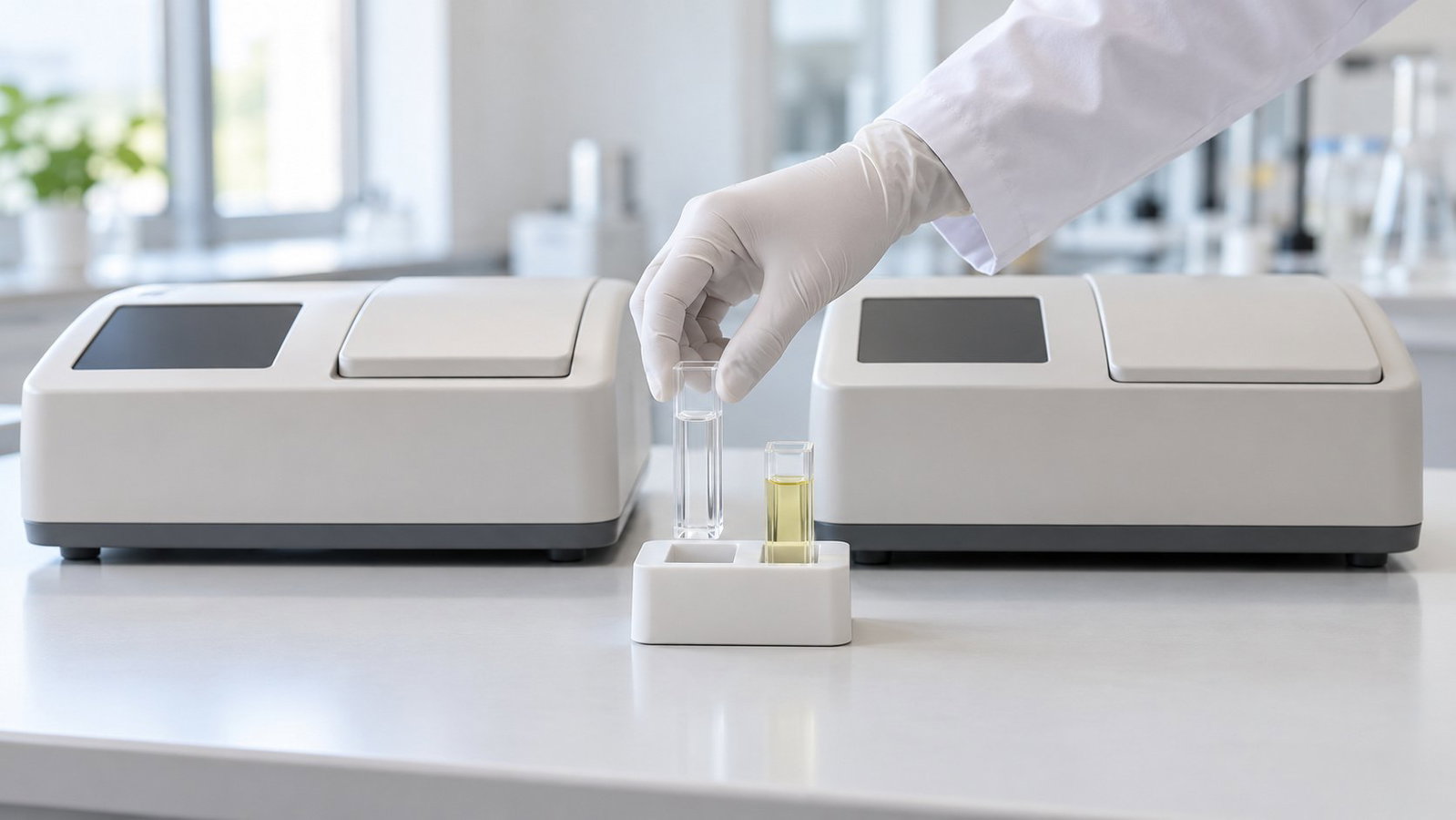
1. How a Single-Beam Spectrophotometer Measures
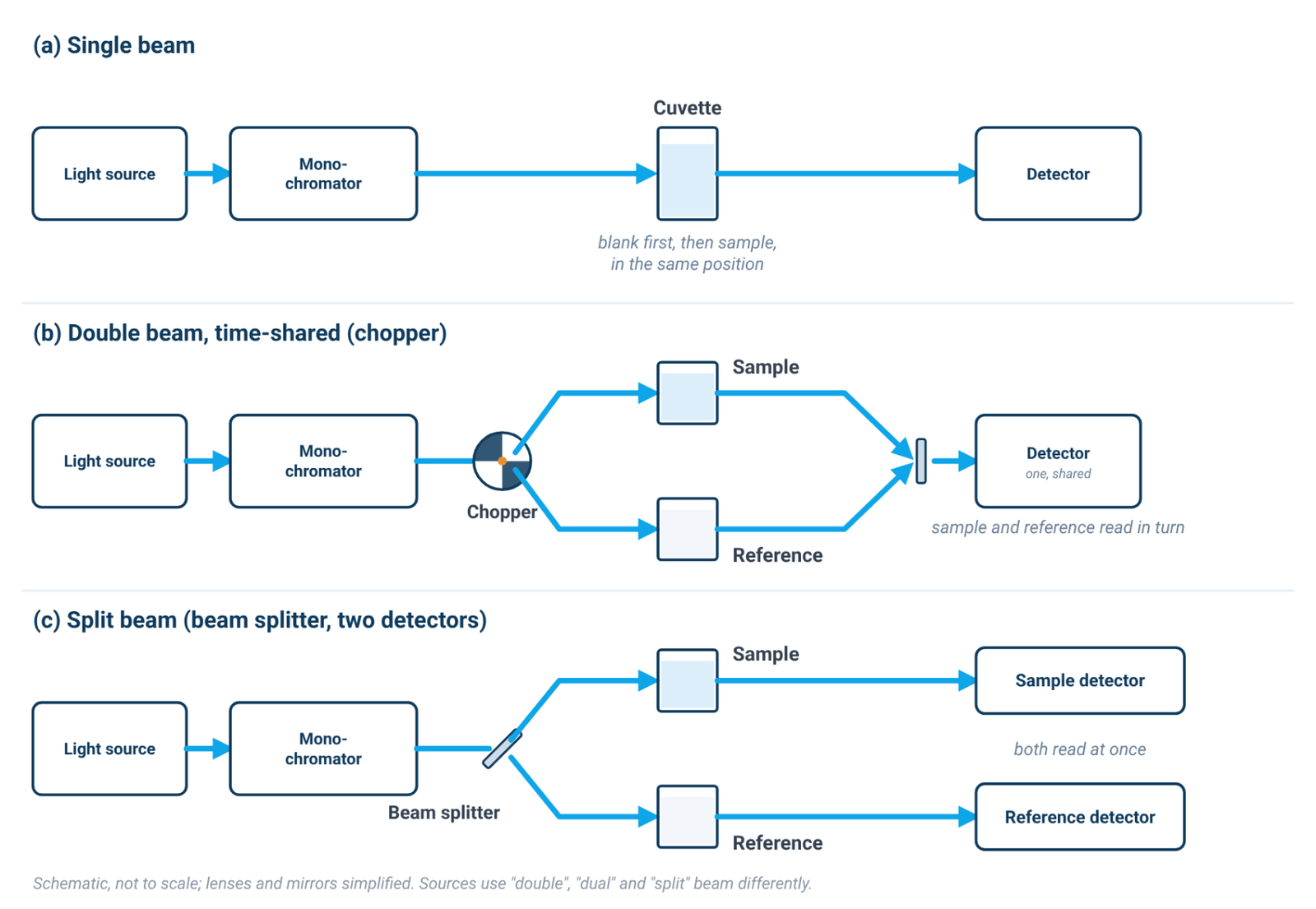
In a single-beam instrument, light from the source passes through the monochromator, through one sample position and on to the detector [1][2]. Absorbance is not read directly. It is calculated from two intensity readings: first the blank (solvent in the cuvette), which sets the incident intensity, and then the sample [1]. On a conventional scanning instrument, the gap between the two readings is several seconds for a single wavelength and up to several minutes for a full spectrum [1].
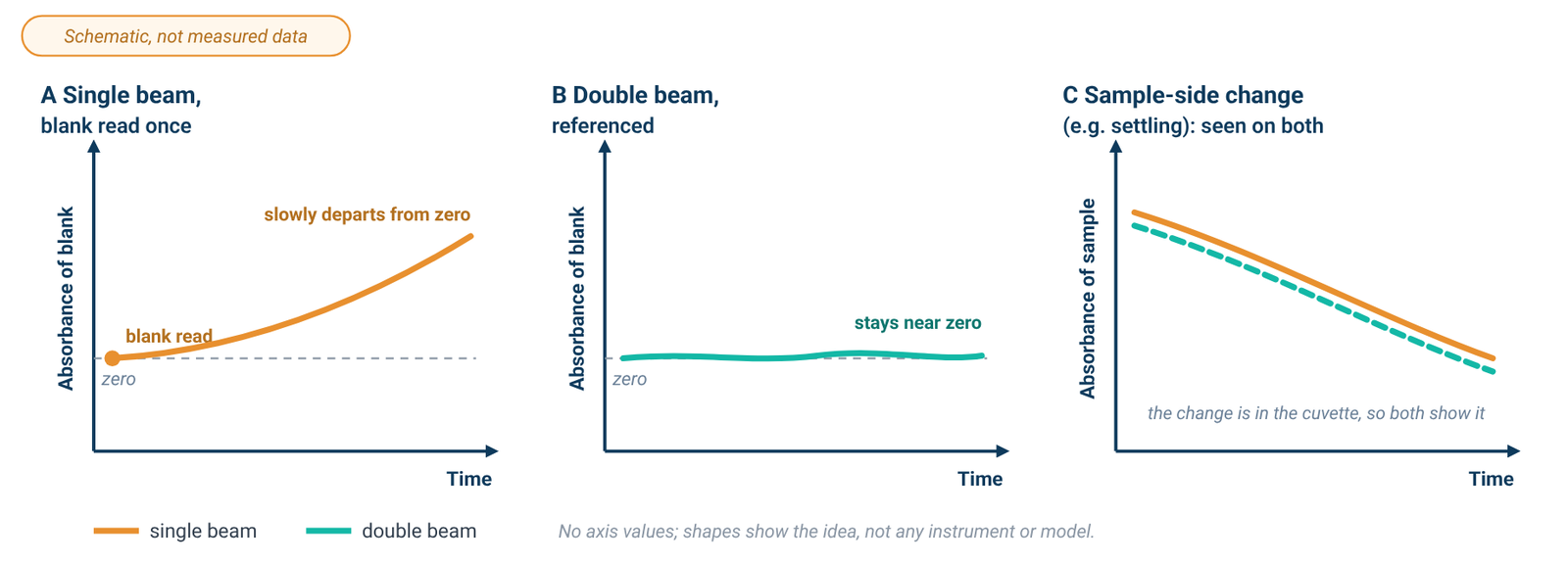
Anything that changes during that gap ends up in the result. If lamp output or the system's optical performance shifts between the baseline and the sample, the reading is less accurate. This matters most for measurements that take a long time, or where the blank itself may change [2]. The practical remedy is to measure the blank frequently and regularly during a session [2]. An open analytical chemistry textbook puts the limit plainly: the accuracy of a single-beam spectrophotometer is limited by the stability of its source and detector over time [3].
The simple design is also the strength. Fewer optical components mean more light reaches the detector, which helps sensitivity, and the instrument can be smaller and lower in cost [1][2]. Owen's primer notes that the reference spectrophotometers used by national standards institutes, such as NIST in the United States and NPL in the United Kingdom, are single-beam designs [1]. Single beam does not mean low quality. It means the user manages the timing.
2. How a Double-Beam Spectrophotometer Measures
A double-beam instrument divides the light leaving the monochromator into a sample path and a reference path [2]. In the classic design, a rotating chopper sends the beam alternately through the reference and the sample several times per second. Blank and sample are therefore compared almost continuously, which corrects for medium- and long-term changes in lamp intensity [1]. Some choppers also have an opaque segment that acts as a shutter, so the instrument can keep adjusting its 0%T reading [3]. Because reference and sample are measured at effectively the same time, instrument fluctuations can be corrected in real time [2].
Terminology varies between sources, so read the labels with care. Owen calls the chopper design "dual-beam". He also describes a "split-beam" design, in which a beam splitter sends light down both paths at once to two detectors. That is mechanically simpler, but two detectors can drift independently, so its stability is high but not as high as the chopper design [1]. Agilent's 2025 primer uses "double beam" for light split by a mirrored rotating wheel or a beam splitter. It uses "dual beam" for a layout in which a reference detector corrects lamp brightness fluctuations, while the blank is measured in the sample position and subtracted afterwards [2]. On a spec sheet, "double beam" tells you the reference principle, not the exact optical layout.
The principle has costs. The extra optical components reduce throughput and therefore sensitivity, and the more complex mechanics may affect reliability [1]. Double-beam instruments are more versatile than single-beam ones, but they are also more expensive and not particularly portable [3]. A two-cuvette double-beam measurement also needs a balance step. Both cuvettes are first filled with solvent, the difference between the two paths is recorded, and that balance spectrum is subtracted from the sample spectrum [1]. Cuvettes that do not match, or that change during use, affect the result through this step [2].
3. What Drift Is, and How a Spec Sheet States It
Drift is a slow change in the instrument's response that has nothing to do with the sample. It usually comes from variations in lamp intensity between the measurement of the blank and the measurement of the sample, and changes in the instrument's electronics can add to it [1]. Good design minimizes drift, but it can still reduce accuracy, especially over long periods [1].
How big is the gap between the two designs? Writing in 2000, Owen noted that advances in lamp and electronics design had improved single-beam stability, with drift "typically only a factor of two worse than that of dual-beam instruments" [1]. That is a general remark about instrument classes from one primer, not a figure for any particular model, and it says nothing about your own samples.
Spec sheets express this behaviour as a stability figure: the change in absorbance per hour at a given wavelength, after a given warm-up. The two ALab™ models compared in Section 7 are both specified at ≤0.001 A/h at 500 nm after one hour of preheating: the single-beam SP-UV2102 and the double-beam SP-UV3102. How the figure was measured is not specified. The stability value applies after the one-hour preheating period; follow the operating manual for measurement readiness and the required warm-up procedure. Noise (0.0005 A at 500 nm) and baseline flatness (±0.001 A) are also identical for both models. For what each of these specifications means, see our guide to reading spectrophotometer specifications.
4. What a Reference Beam Does Not Correct
The reference beam watches the instrument, not the sample. Anything that changes inside the sample cuvette shows up on both designs, and it should, because it is a real change in the light reaching the detector. The common causes are listed below.
- Temperature. As a solvent warms it expands, which changes the apparent absorbance. Temperature also shifts chemical equilibria, and convection currents can create refractive-index effects, known as the Schlieren effect, that disturb the reading [1]. A thermostatted cell holder, either water-jacketed or Peltier-controlled, is the usual control [1][2]. In kinetics, the reaction rate itself depends on temperature, so slight variations in temperature can have a significant impact on results [2].
- Evaporation. A volatile solvent concentrates the sample as it evaporates. Stoppered or capped cells reduce the problem [1][2].
- Settling. Particles scatter light and add apparent absorbance [1], and a dispersion that settles loses that contribution over time. In one study, graphene dispersions were monitored by optical absorbance at 650 nm, and the absorbance fell steadily as larger flakes settled out over several weeks [4]. A double-beam instrument records that decline just as faithfully as a single-beam one.
- Bubbles and mixing. Stirring helps keep a thermostatted sample uniform, but stirring too fast can trap air bubbles that cause erroneous results [2].
- Cuvette position and cleanliness. The optical properties of a sample cell are not uniform, so repositioning it can change the transmitted intensity; this matters most at low absorbance [3]. Keep the cell facing the same direction every time [1]. Fingerprints absorb in the UV, and if you clean the windows after blanking, take a new blank [2]. Below ambient temperature, condensation on the outside of the cuvette can interfere with the measurement [2].
If a reading drifts on a double-beam instrument, check both sample-side changes and possible instrument or referencing problems. A reference beam compensates for some instrument fluctuations, but it does not eliminate every source of error.
5. When Double Beam Matters: A Decision Table
The question is not which design is better. It is how long your measurement takes and how often you can re-blank. The table matches common measurement types to the factor that actually limits them.
| Measurement | What mainly limits it | Single beam workable? | What to do |
|---|---|---|---|
| Endpoint readings with a fresh blank | Short gap between blank and sample | Yes | Blank, then read promptly [1][2] |
| Calibration series in one session | Instrument drift over the session | Yes, with blank checks | Re-measure the blank regularly [2] |
| Long single-wavelength kinetic run | Drift adds up over the run; sample temperature | With care | Double beam worth considering; thermostat the cell [1][2] |
| Repeated scans or unattended series | Each scan takes minutes; no one re-blanks | Harder | Double beam reduces re-blanking; still control the sample [1][2] |
| High-absorbance samples | Stray light and low light at the detector | Beam design does not decide it | Dilute or use a shorter path; compare stray-light specifications [1][2] |
| Broad absorption bands | Bandwidth, not beam design | Either | Match bandwidth to the band [1][2] |
| Settling or temperature-sensitive samples | Changes in the sample itself | Either, and neither corrects it | Stabilize, mix and thermostat the sample [1][2][4] |
The pattern is simple. The longer the measurement, and the less often you can re-blank, the more a reference beam helps. For high-absorbance work, check the stray-light specification rather than the beam design [2]. For band shape, check the bandwidth; our guide to choosing a UV-Vis spectrophotometer explains the one-tenth rule.
6. Controlling Drift on Any Instrument
Good practice narrows the gap between the two designs, and it is still needed on a double-beam instrument.
- Warm up as specified. Both models are specified for stability after one hour of preheating. Readings taken before that point are outside the specified condition.
- Re-blank on a schedule. On a single-beam instrument, run the blank frequently and regularly through the session [2]. For a long run, a blank or a check standard read at intervals shows whether the baseline has moved.
- Check baseline behaviour at your own wavelength. Before a long run, measure a blank or stable reference at the wavelength of interest and repeat the check over a period comparable to the planned measurement. Compare any change with your method's acceptance criteria. This is a practical baseline check, not a verification of the manufacturer's stability specification.
- Use internal referencing where the chemistry allows it. Subtracting the absorbance at a nearby wavelength where the analyte does not absorb reduces the effect of lamp drift on the result [1].
- Control the sample. Thermostat it, cap it, stir it gently, and keep the same cuvette in the same orientation [1][2]. On a two-cuvette double-beam measurement, record the balance with solvent in both cells first [1].
- Keep the cells clean and handled by the frosted sides. Our guide to quartz, glass and plastic cuvettes covers cell choice and blanking.
7. A Closely Matched Pair: SP-UV2102 vs SP-UV3102
The SP-UV2102 and SP-UV3102 form a closely matched single-beam and double-beam comparison: they have the same specified wavelength range, bandwidth, photometric accuracy, lamp type, detector type, display specifications and physical dimensions. Of the 23 specifications compared, three differ: optical system, stray light and the standard cell holder. The specified detector type does not establish the internal detector count or optical layout. The table shows the specifications that matter for this article.
| Specification | SP-UV2102 | SP-UV3102 | Same? |
|---|---|---|---|
| Beam design (Optical System) | Single Beam | Double Beam | Different |
| Wavelength Range | 190–1100 nm | 190–1100 nm | Same |
| Spectral Bandwidth | 2.0nm | 2.0nm | Same |
| Stray Light | ≤0.05%T @ 220,360nm | ≤0.03%T @ 220,360nm | Different |
| Photometric Accuracy | ±0.002A(0–0.5A) ±0.003A(0.5A–1A) | ±0.002A(0–0.5A) ±0.003A(0.5A–1A) | Same |
| Stability | ≤0.001 A/h / 500 nm (After 1 hour of preheating) | ≤0.001 A/h/500nm (After 1 hour of preheating) | Same |
| Noise | 0.0005A@500nm | 0.0005A@500nm | Same |
| Baseline Flatness | ±0.001A | ±0.001A | Same |
| Light Source | Tungsten + deuterium lamps | Tungsten + deuterium lamps | Same |
| Standard cell holder | Manual 4-position 1cm holder (standard for single beam) | Single hole 1cm holder (standard for double beam) | Different |
Source: ACS Material product specifications (October 2026). The pair shares bandwidth, photometric accuracy and lamp type, but differs in stray light and standard holder as well as beam design, so it is not a beam-only comparison. Both models have the same stability figure.
Stray light is a separate specification. The SP-UV3102 has a lower specified stray light than the SP-UV2102. Stray light is light outside the selected band that reaches the detector. It depends on how well the instrument keeps out room light and how cleanly the monochromator separates wavelengths [2], not on whether there is a reference beam; the cause of the difference is not specified. It matters most at high absorbance, where stray light biases readings low [1]. If your samples read high, compare this specification on its own terms.
The holders differ. The SP-UV2102 comes with a manual four-position 1 cm holder, which lets you load a blank and several samples and step through them. The SP-UV3102 comes with a single-position 1 cm holder. The reference position is not described, so check the operating manual or ask before planning a two-cuvette method.
Stability is the same. Both models have the same specified stability, noise and baseline flatness. The specifications therefore show no measured drift advantage for the double-beam model. What the double beam adds is the principle in Section 2: continuous compensation for lamp and electronics drift during a run. Whether that is worth having depends on how long your runs are (Section 5).
A practical way to choose. If most of your work is short readings with a fresh blank, or batches through a multi-position holder, the SP-UV2102 fits that pattern. If you run long kinetics, repeated scans or unattended series, the SP-UV3102 is the one to consider. If high-absorbance work matters, weigh the stray-light specification separately from the beam design.
8. Other Single- and Double-Beam Models
The SP-UV3101 is also double-beam, but it lists a 1.0nm bandwidth, so comparing it with the SP-UV2102 mixes beam design with bandwidth. A narrower bandwidth matters for narrow bands, not for the broad bands of most solution samples. Other ALab™ models are covered in our guide to choosing a UV-Vis spectrophotometer, which sets the full range out in one table.
9. Frequently Asked Questions
Does a double-beam spectrophotometer eliminate drift?
It compensates for drift that comes from the lamp and electronics, because the reference is measured almost continuously alongside the sample [1][2]. It does not remove changes in the sample, such as warming, evaporation or settling [1][4]. Those need temperature control, capped cells and a stable sample.
Is a single-beam spectrophotometer accurate enough for quantitative work?
Yes, for many methods, provided the blank is measured close in time to the samples and re-measured regularly through a session [2]. Its accuracy is limited by the stability of the source and detector over time [3], so the longer a run, the more it relies on blank checks.
Do I still need a blank on a double-beam instrument?
Yes. The reference beam corrects instrument changes, but the solvent and cuvette still contribute absorbance. With two cuvettes, a balance measurement with solvent in both is recorded first and subtracted from the sample spectrum [1].
Why do the SP-UV2102 and SP-UV3102 list different stray light if beam design is the difference?
Beam design is not the only difference. The two models also differ in stray light and standard holder, and stray light depends on how the instrument handles light outside the selected band [2], not on the reference beam. The cause of the difference is not specified.
How long should I warm up the instrument?
Follow the specifications and the manual. Both models are specified for stability after one hour of preheating, so readings taken earlier are outside that condition.
10. Keep Exploring the UV-Vis Hub
- UV-Vis spectrophotometry guide: how the instrument works and what limits an absorbance reading.
- How to choose a UV-Vis spectrophotometer: wavelength range, bandwidth, beam design and light source, with a table of all models.
- Reading a spectrophotometer spec sheet: bandwidth, stray light, stability and photometric accuracy.
- Beer–Lambert law: the formula behind absorbance and concentration.
- Quartz vs glass vs plastic cuvettes: cell choice, path length and blanking.
The pair compared here: SP-UV2102 and SP-UV3102.