-
Single-Layer GO for ZIF-8 Supercapacitors - Sookmyung, 2025
Jun 24, 2026 | ACS MATERIAL LLCKim, B. et al. (2025). Individually Encapsulating Metal–Organic Frameworks in Partially Reduced Graphene Oxide to Enhance Electrical Conductivity While Preserving Porosity. *ACS Applied Nano Materials*. https://doi.org/10.1021/acsanm.5c02501
Department of Mechanical Systems Engineering · ACS Applied Nano Materials · 2025
Sookmyung Women's University used ACS Material single-layer graphene oxide to encapsulate ZIF-8, boosting capacitance 347% while preserving microporosity.
About this research
Researchers at Sookmyung Women's University, working with Chonnam National University collaborators, used ACS Material single-layer graphene oxide (H method) to individually encapsulate zeolitic imidazolate framework-8 (ZIF-8) particles, achieving a 347% increase in specific capacitance while preserving the framework's intrinsic microporosity. The team developed a facile self-assembly route in which ZIF-8 surfaces are first functionalized with 3-aminopropyltriethoxysilane (APTES) so that protonated amine groups electrostatically attract negatively charged GO sheets. The resulting G|ZIF-8 composite features a conformal, wrinkled graphene shell that wraps each MOF particle without blocking pore windows, combining efficient charge transport with open ion-diffusion pathways. This particle-by-particle encapsulation is rarely attainable with conventional mixing-based MOF composites.
The broader challenge addressed here is the poor electrical conductivity of metal–organic frameworks, which limits their use as electrode materials despite their large surface areas and tunable pore architectures. Conventional strategies—designing intrinsically conductive MOFs, postsynthetic modification, or mixing MOFs with carbon—often suffer from limited ligand availability, complex processing, phase separation, agglomeration, or pore blockage from stacked carbon shells. Because MOFs adhere weakly to conductive additives owing to saturated coordination bonds and hydrophobic surfaces, achieving uniform coverage without sacrificing porosity has remained difficult. Energy-storage applications such as supercapacitors, electrocatalysis, and gas separation all benefit from porous frameworks that simultaneously transport electrons efficiently and retain accessible micropores, making conductivity-versus-porosity trade-offs a central concern in this field.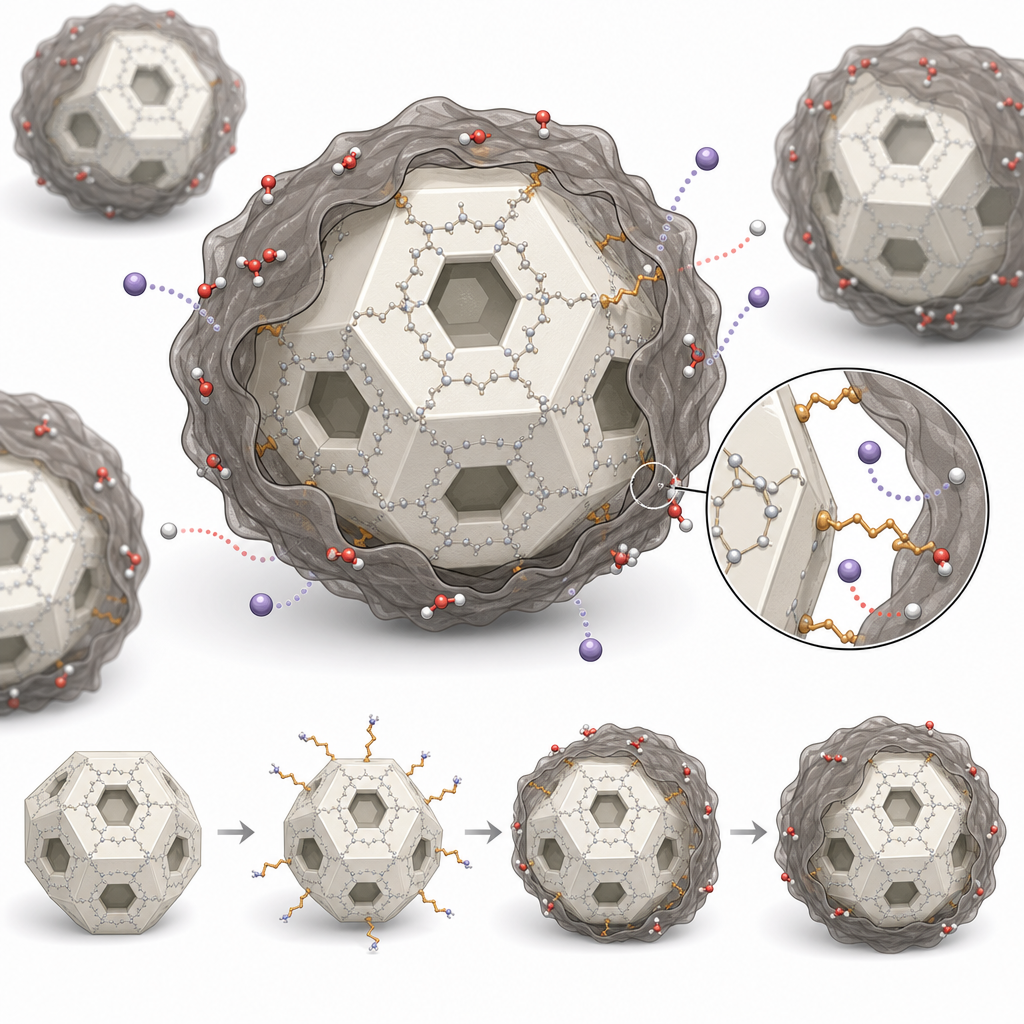
The ACS Material single-layer graphene oxide powder (H method) was the conductive component of the composite. According to the Experimental section, the GO was prepared as a dilute aqueous solution (0.2 mg/mL), and 5 mL was added to 20 mg of APTES-modified ZIF-8 and stirred for 30 minutes before washing and drying. The mildly acidic-to-neutral GO dispersion (pH ~4–6) carries a net negative surface charge that pairs with the protonated −NH3+ groups on the APTES-grafted MOF, driving conformal electrostatic self-assembly. The propyl spacer of APTES introduces nanoscale interstitial voids between the GO sheets and the MOF surface, leaving open ion-diffusion channels. During encapsulation the GO loses oxygen functional groups and gains sp2 character, effectively becoming partially reduced graphene oxide, as confirmed by attenuated FTIR −OH, C=C, and C−O peaks and weakened epoxy/hydroxyl and carbonyl features in C 1s XPS spectra. TEM showed a 0.25 nm lattice fringe and hexagonal diffraction, evidence of graphitic ordering in the encapsulating shell.
Quantitatively, the results demonstrate clear performance gains. BET surface areas were 1405 m²/g for ZIF-8, only 5 m²/g for GO, and 1364 m²/g for G|ZIF-8—meaning the composite retained 97% of the ZIF-8 surface area despite GO addition. The Horvath–Kawazoe micropore peak shifted only slightly from 0.769 nm (ZIF-8) to 0.755 nm (G|ZIF-8), confirming preserved microporosity. Electrochemically, in 1 M KOH three-electrode tests, specific capacitances at 1 A/g were 33 F/g for GO, 61 F/g for ZIF-8, and 212 F/g for G|ZIF-8, the latter a 347% improvement over bare ZIF-8. Charge-transfer resistance (Rct) from Nyquist plots dropped from 104 mΩ (GO) and 89 mΩ (ZIF-8) to 40 mΩ for G|ZIF-8. The phase-angle frequency at −45° rose to 2.22 Hz for G|ZIF-8 versus 1.49 Hz (ZIF-8) and 0.39 Hz (GO), indicating unobstructed porosity. Capacitive-versus-diffusion deconvolution showed a larger capacitive share for G|ZIF-8 while retaining a comparable diffusion-controlled component. Over 10,000 cycles at 50 mV/s, capacitance retention reached 49% for G|ZIF-8, exceeding 37% for ZIF-8 and 31% for GO. Raman ID/IG ratios decreased from 0.968 to 0.925, consistent with partial sp2 restoration.
This encapsulation strategy enables porous MOFs to be used as practical electrode materials where both electron transport and ion accessibility are required. The authors highlight applications in supercapacitors, electrocatalysis, and gas separation, noting the route's scalability and simplicity. Because the method works through generic surface silanization chemistry and electrostatic self-assembly, it could in principle be extended to other MOF chemistries and other 2D conductive coatings, broadening the library of conductive porous composites. The preservation of open ion-diffusion pathways alongside enhanced capacitive storage is particularly valuable for next-generation energy-storage electrodes that need to balance rate capability with capacity, and for separation media that depend on retained microporosity.
For researchers pursuing similar conductivity-versus-porosity objectives, the single-layer graphene oxide (H method) used here is available from ACS Material's graphene series. The paper shows that a well-dispersed, single-layer GO source supports uniform conformal coatings that partially reduce in situ during assembly, delivering measurable gains in conductivity and capacitance without sacrificing the host framework's surface area. Reliable GO sheet quality is central to reproducing the particle-by-particle encapsulation reported, making the grade relevant to groups developing MOF composites, supercapacitor electrodes, and other porous conductive nanomaterials.How ACS Material products were used
- Single Layer Graphene Oxide Powder (H Method) (Graphene Series) — “single-layered GO powder (H method; ACS Material)”
Product Performance in this StudyThe ACS Material single-layer GO (H method) served as the conductive encapsulation layer; after self-assembly onto APTES-modified ZIF-8 it partially reduced to sp2-rich graphene, lowering charge-transfer resistance to 40 mΩ and raising specific capacitance by 347% over bare ZIF-8.
Related product categories
Frequently asked questionsHow does graphene oxide encapsulation improve MOF electrical conductivity?
Encapsulating ZIF-8 in single-layer graphene oxide creates a conformal conductive shell around each particle. During self-assembly the GO partially reduces, losing oxygen groups and gaining sp2 carbon, which lowers charge-transfer resistance from 89 mΩ for bare ZIF-8 to 40 mΩ. This continuous graphene network provides efficient electron transport pathways without integrating into the MOF crystal structure.
Why is APTES important for uniform graphene oxide coating of ZIF-8?
3-aminopropyltriethoxysilane grafts onto the ZIF-8 surface and provides protonated amine groups (−NH3+) that electrostatically attract negatively charged graphene oxide sheets. This drives particle-by-particle conformal encapsulation rather than agglomerated coverage. The propyl spacer also leaves nanoscale interstitial voids that keep ion-diffusion pathways open, preventing the pore blockage common in conventional mixing-based composites.
What grade of graphene oxide is best for MOF supercapacitor composites?
This study used single-layer graphene oxide powder produced by the H method, dispersed at 0.2 mg/mL for self-assembly onto ZIF-8. A well-exfoliated single-layer source supports uniform conformal coatings and partial in-situ reduction during assembly. The resulting composite retained 97% of the ZIF-8 surface area (1364 m²/g) while delivering a 347% capacitance increase, indicating single-layer GO suits such composite electrodes.