-
Single Layer Graphene Oxide Cytotoxicity Study - Institute of Biology, 2021
Jun 26, 2026 | ACS MATERIAL LLCDziewięcka, M. et al. (2021). The structure–properties–cytotoxicity interplay: A crucial pathway to determining graphene oxide biocompatibility. *International Journal of Molecular Sciences*. https://doi.org/10.3390/ijms22105401
Institute of Biology · International Journal of Molecular Sciences · 2021
Institute of Biology researchers compared four commercial graphene oxide products, including ACS Material Single Layer GO (H method), for in vivo cytotoxicity in Acheta domesticus.
About this research
Researchers at the Institute of Biology, University of Silesia in Katowice, used ACS Material Single Layer Graphene Oxide (H method) as one of four commercially sourced graphene oxide samples in a systematic 2021 study probing how subtle differences in GO physicochemistry translate into distinct biological responses in the model insect Acheta domesticus. The work, published in the International Journal of Molecular Sciences, established a structure–properties–cytotoxicity framework by feeding insects GO at 2 and 20 µg·g⁻¹ of food for 10 days, then quantifying cell viability, oxidative stress, apoptosis, and DNA damage. The ACS Material product served as one of the well-defined single-layer flake references against which more aggregated commercial GO materials were benchmarked.
Why this research matters: Graphene oxide is widely promoted as a platform for drug delivery, biosensing, and nanocomposite biomedical devices, but published toxicity data remain contradictory. Different manufacturers use different oxidation routes (modified Hummers, H method, etc.), purification protocols, and starting graphites, producing products that share the name 'graphene oxide' yet differ in flake size, layer count, defect density, residual contaminants, and surface chemistry. Without a structured comparison of commercial GO sources under identical biological assays, it is impossible to compare toxicology studies across labs or to set regulatory benchmarks for biomedical use. The Polish team directly addressed this gap by holding the organism, dose, and exposure protocol constant while varying only the GO source.
How the ACS Material product was used: The ACS Material Single Layer Graphene Oxide (H method) was purchased and coded blindly as one of samples S1–S4 to keep the analysis source-neutral. Stock suspensions of 10 mg·mL⁻¹ were prepared in ultrapure water by ultrasonic homogenization on ice for 10 h (UP-100H, DONSERV) under conditions identical to those used for the other three commercial GO products. The suspensions were then mixed into ground cricket food at 2 and 20 µg·g⁻¹. Highly diluted dispersions (8 µg·mL⁻¹) were deposited onto silicon wafers and freshly cleaved mica for SEM and AFM, dispersed in ethanol on carbon-film copper grids for TEM, and analyzed by Raman spectroscopy (514.5 nm), XPS, TOF-SIMS, and zeta potential measurements. The ACS Material sample showed well-defined single-layer flake morphology, typical layer height near 1.0 nm by AFM, a C/O atomic ratio of ~2.5 by XPS, and a zeta potential between −36.6 and −39.4 mV indicating good colloidal stability.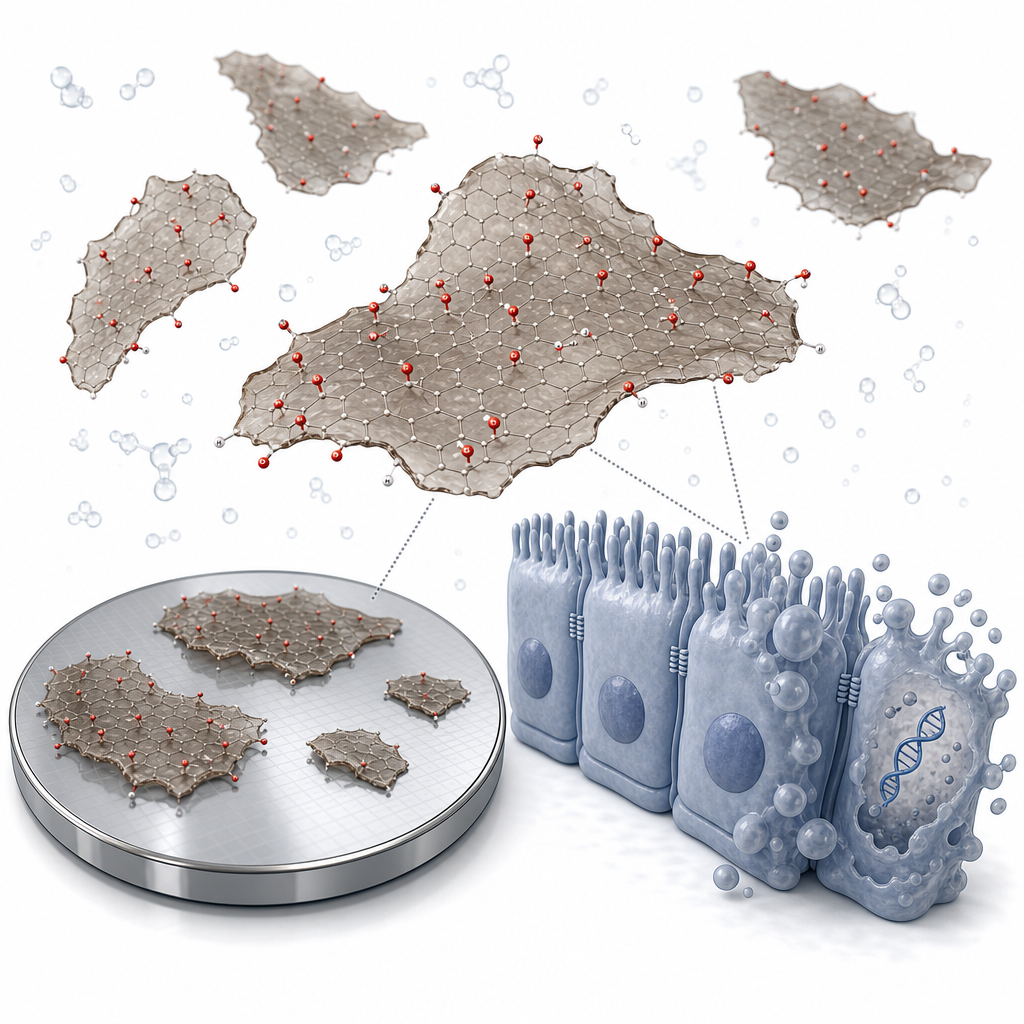
Key results: Across the four GO samples, biological responses tracked physicochemical differences. All GO products at 20 µg·g⁻¹ caused statistically significant drops in gut cell viability in A. domesticus, but the magnitude differed by source. Sample S4, the most graphitized and least oxidized material (C/O ≈ 17.89), elicited the strongest decline in viability and roughly doubled free-radical generation compared with the other GOs on day 10. Single-layer flake samples (S2 and S3, including the ACS Material product) showed average flake areas of ~0.2 µm² and ~2 µm² respectively, with C/O ratios near 2.5 and characteristic C–O and C=O signatures in XPS. These well-defined single-layer GOs induced apoptosis (early and late phases) more strongly than the most aggregated S1 material at both concentrations, with effects becoming pronounced by day 6. DNA damage, measured by comet assay (TDNA% and tail length), increased significantly for several GO sources within the first 6 days; tail length in groups exposed to S2 and S4 remained elevated through day 10 at the higher dose. Principal component analysis confirmed that PC1 captured 78.99% of variance and cleanly separated samples by combined physicochemical and biological signatures.
Applications and outlook: These findings have direct implications for groups developing GO-based drug carriers, antimicrobial coatings, biosensors, tissue scaffolds, and environmental remediation materials. The paper demonstrates that toxicity benchmarks cannot be transferred between GO products without first characterizing flake size, layer number, C/O ratio, residual heteroatom contamination (N, S, Si, Cl, Na), and aggregation state. The authors recommend that future biocompatibility studies on GO-based nanocarriers couple cellular endpoints to detailed structural analysis, and they plan more precise mechanistic studies of GO–cell interactions in invertebrate and mammalian models.
Why this matters for researchers: For laboratories screening commercial graphene oxides for biomedical, agricultural, or ecotoxicology work, the ACS Material Single Layer Graphene Oxide (H method) used here is part of the broader Graphene Series available from ACS Material, alongside large-size GO, low-defect GO, reduced GO, and aqueous GO dispersions. Researchers planning structure–activity studies can source single-layer GO with documented flake morphology and surface chemistry, then compare it against alternative grades to build the same kind of cross-product datasets the Polish team produced.How ACS Material products were used
- Single Layer Graphene Oxide Flake (H Method) (Graphene Series) — “Graphene oxide was purchased from various companies: Sigma Aldrich, USA (Graphene oxide powder; 15–20 sheets), ACS Material, USA (Single Layer Graphene Oxide; H method), MSE PRO, USA (Monolayer Graphene oxide powder), and Nanografi, USA”
Product Performance in this StudyThe ACS Material Single Layer Graphene Oxide (H Method), coded as one of the four GO samples (S2 or S3), exhibited well-defined flake-like morphology with mostly single-layer flakes (~1 nm thickness) and a C/O ratio of ~2.5, consistent with high-quality single-layer GO. It induced cytotoxic responses in Acheta domesticus that correlated with its measured physicochemical properties.
Related product categories
Frequently asked questionsHow does the H method affect the properties of single layer graphene oxide?
The H method, used to produce the ACS Material Single Layer Graphene Oxide in this study, yields well-defined single-layer flakes with a typical AFM height near 1.0 nm and a C/O atomic ratio of about 2.5 measured by XPS. The product showed characteristic C–O and C=O surface groups, a zeta potential between -36.6 and -39.4 mV indicating good colloidal stability, and clear single-layer flake morphology by SEM and TEM.
Why is the C/O ratio important for evaluating graphene oxide cytotoxicity?
The C/O atomic ratio reflects the degree of oxidation and the density of oxygen-containing functional groups on graphene oxide. In this study, samples with C/O near 2.5 behaved as true GO with high colloidal stability and moderate cell effects, while a sample with C/O ~17.89 resembled polycrystalline graphite, formed large aggregates, and produced the strongest cell viability loss and oxidative stress in Acheta domesticus.
What does this study reveal about comparing graphene oxide products from different suppliers?
The study shows that GO products sold under the same name can differ substantially in flake size, layer number, oxidation degree, and residual contaminants such as Na, Cl, S, and Si. These differences drove statistically distinct responses in cell viability, apoptosis, oxidative stress, and DNA damage in Acheta domesticus, meaning toxicity data obtained with one commercial GO cannot be transferred to another without independent physicochemical characterization.