-
Single-Layer Graphene Oxide Transport in Sand - Nanjing University, 2015
Jun 02, 2026 | ACS MATERIAL LLCSun, Y. et al. (2015). Transport, retention, and size perturbation of graphene oxide in saturated porous media: Effects of input concentration and grain size. *Water Research*. https://doi.org/10.1016/j.watres.2014.09.025
Water Research · 2015
Researchers at Nanjing University used ACS Material single-layer graphene oxide to study transport, retention, and aggregation in saturated sand columns.
About this research
Researchers at Nanjing University, in collaboration with the University of Florida and the USDA-ARS U.S. Salinity Laboratory, used single-layer graphene oxide supplied by ACS Material to determine how input concentration and porous-medium grain size govern the transport, retention, and size perturbation of graphene oxide (GO) in saturated quartz sand columns, published in Water Research in 2015. Sand column experiments combined with breakthrough curves (BTCs), retention profiles (RPs), XDLVO calculations, and an advection–dispersion model with second-order blocking kinetics revealed that fine sand retained essentially all of the GO, while transport through coarser media induced clear particle aggregation along the flow path.
Graphene oxide is increasingly produced for applications ranging from energy storage and flexible electronics to water treatment and drug delivery, but this growth makes accidental release into soils and groundwater inevitable. Because GO can be toxic to bacteria, animals, and human cells, regulators and environmental engineers need quantitative models for its subsurface fate. Earlier work showed that solution ionic strength, moisture content, and surface chemistry influence GO mobility, yet the combined roles of input concentration and grain size – two of the most accessible engineering levers in filtration systems – had not been resolved for GO. This study fills that gap and clarifies whether classical colloid filtration theory and XDLVO interaction energies adequately describe a 2D nanosheet whose lateral size is much larger than its thickness.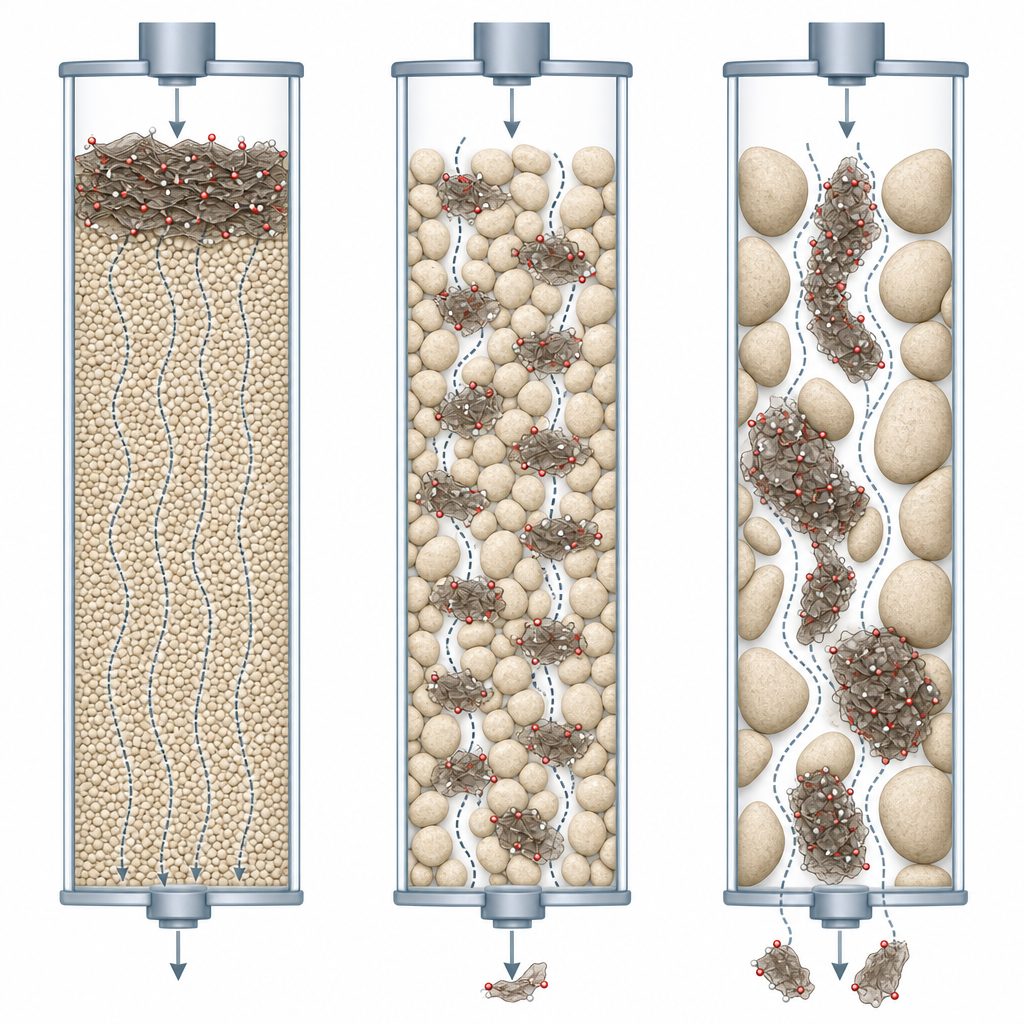
The authors used single-layer graphene oxide from ACS Material (Medford, MA), prepared by a modified Hummers method, as received from the manufacturer. The material was characterized in prior work by atomic force microscopy, giving an average thickness of 0.92 ± 0.13 nm and average lateral square-root area of 582 ± 111.2 nm, consistent with monolayer GO. Stock suspensions were prepared by sonicating 50 mg of GO in 500 mL deionized water for 2 h with a Misonix S3000 ultrasonicator, then diluting to 5, 10, or 25 mg/L in 20 mM NaCl. Hydrodynamic diameter was monitored by dynamic light scattering on a Malvern ZetaSizer, and electrophoretic mobility was measured with a Brookhaven ZetaPlus. The GO was injected as a 4-pore-volume pulse into acrylic columns (2.5 cm i.d., 16.7 cm length) wet-packed with acid-washed quartz sand sieved into fine (0.1–0.2 mm), medium (0.5–0.6 mm), and coarse (0.85–1.0 mm) fractions, at a Darcy velocity of 0.2 cm/min.
Key results spanned three areas. First, grain size strongly controlled retention: effluent recovery dropped from 26.6–56.9% for coarse sand and 16.4–33.2% for medium sand to less than 1% for fine sand across all input concentrations. Fitted first-order retention coefficients k rose from 0.03–0.06 min⁻¹ (coarse) to 0.05–0.09 min⁻¹ (medium) and 0.61–1.39 min⁻¹ (fine), and maximum solid-phase concentrations Smax climbed from ~10.5–12.3 mg/g to 26.7–84.6 mg/g over the same range. Second, input concentration mattered through blocking: doubling Co roughly doubled effluent recovery in coarse and medium columns, producing asymmetric BTCs and RPs that transitioned from exponential to nearly uniform with depth, well captured by a second-order Langmuirian blocking term. Third, GO underwent significant size perturbation during transport. Average hydrodynamic diameter increased from 574 ± 82 nm in the coarse-sand influent to 1059 ± 267 nm in the effluent, and from 678 ± 63 nm to 1176 ± 246 nm for medium sand, with retained-GO size also increasing with travel distance. XDLVO calculations predicted energy barriers above 11.4 mJ/m² but a substantial secondary minimum (~49.5 kT when scaled by GO cross-section), consistent with reversible deposition and near-complete release after deionized-water rinses (96.2–113.2% mass recovery).
These findings have direct implications for water treatment, groundwater risk assessment, and environmental modeling of 2D nanomaterials. Fine quartz sand retained >99% of the injected GO and could be regenerated by simple DI-water rinsing, pointing to low-cost sand filtration as a practical barrier against GO release from manufacturing or disposal sites. At the same time, the observed flow-induced aggregation means that classical clean-bed filtration theory underestimates particle size evolution in plumes, and predictive transport models for nanosheets should couple deposition kinetics with aggregation. The work points to follow-up studies on co-transport with natural organic matter, unsaturated flow, and field-scale heterogeneity.
For researchers studying nanomaterial fate, environmental remediation, or membrane and filter design, reliable single-layer graphene oxide is the foundation of reproducible experiments. ACS Material supplies single-layer graphene oxide prepared by the Hummers method in flake, powder, and dispersion formats, along with related graphene and reduced graphene oxide products in its Graphene Series, supporting work on similar transport, sensing, and water-treatment problems.How ACS Material products were used
- https://www.acsmaterial.com/single-layer-graphene.html (Graphene Series) — “Single layer GO (ACS Material), prepared by the modified hummer's method (according to the manufacture), was used as received from the manufacturer.”
Product Performance in this Study
The single-layer graphene oxide from ACS Material was the central nanomaterial studied. AFM characterization confirmed an average thickness of 0.92 ± 0.13 nm and lateral dimension of 582 ± 111.2 nm, consistent with high-quality single-layer GO. The material remained stable in 20 mM NaCl suspensions and provided reliable, reproducible transport behavior across all column conditions.
Related product categories
Frequently asked questions
How does sand grain size affect graphene oxide transport in porous media?
Grain size strongly controls graphene oxide retention. In this study, effluent recovery dropped from 26.6–56.9% in coarse sand (0.85–1.0 mm) to 16.4–33.2% in medium sand (0.5–0.6 mm) and below 1% in fine sand (0.1–0.2 mm). The first-order retention coefficient rose by more than an order of magnitude as grain size decreased, consistent with colloid filtration theory predicting higher mass transfer to collector surfaces in finer media.
Why does graphene oxide aggregate during transport through sand columns?
Even when influent suspensions are stable, advective flow through porous media provides enough collision energy for graphene oxide nanosheets to overcome the XDLVO energy barrier and aggregate. In this work, average hydrodynamic diameter nearly doubled after passing through coarse or medium sand, and retained-GO size increased with travel distance. Classical clean-bed filtration theory cannot explain this trend, so flow-induced aggregation must be coupled with deposition in transport models.
Can sand filtration be used to remove graphene oxide from water?
Yes. Fine quartz sand (0.1–0.2 mm) retained more than 99% of injected single-layer graphene oxide across input concentrations of 5, 10, and 25 mg/L. The maximum solid-phase capacity reached 26.7–84.6 mg/g, and rinsing with deionized water released nearly all retained GO, indicating the filter media can be regenerated. This makes fine sand a low-cost candidate for removing graphene oxide from contaminated water streams.