-
SU8-Graphene Conductive Photoresist - EPFL, 2014
Jun 04, 2026 | ACS MATERIAL LLCMajidian, M. et al. (2014). Electrical conduction of photo-Patternable SU8–graphene composites. *Carbon*. https://doi.org/10.1016/j.carbon.2014.08.075
Carbon · 2014
EPFL researchers used ACS Material RGO to develop photo-patternable SU8-graphene composites with high conductivity at low filler loadings and 10 μm lithographic resolution.
About this research
Researchers at the Ecole Polytechnique Fédérale de Lausanne (EPFL) used Reduced Graphene Oxide (RGO) supplied by ACS Material as the conductive nanofiller to develop a new photo-patternable SU8–graphene composite, achieving unprecedented electrical conductivities at low filler loadings while preserving full compatibility with standard photolithography. The work, published in Carbon, demonstrates a multifunctional conductive polymer system in which 10 μm resolution features can be patterned directly on Pyrex wafers using a modified MEMS-compatible process. The composite's transport behavior reveals a vanishing percolation threshold and a transport exponent near 6, pointing to inter-flake tunneling rather than classical percolation.
Conductive polymer composites are essential for flexible electronics, microelectromechanical systems (MEMS), sensors and electromagnetic shielding, but most conductive photoresists rely on metallic fillers or carbon nanotubes that complicate processing, raise cost, or compromise optical clarity. SU8 epoxy is widely adopted in microfabrication because of its low optical absorption and excellent photo-patternability, yet it is intrinsically insulating. Combining SU8 with graphene offers a route to MEMS-compatible conductive structures, but achieving low percolation thresholds typically requires either very high filler content (which degrades patterning) or aggressive surface chemistry. This paper addresses how well-dispersed RGO can deliver high conductivity in SU8 at loadings low enough to retain photolithographic fidelity, a long-standing challenge for graphene-polymer systems.
The RGO flakes from ACS Material were dispersed in gamma-butyrolactone (GBL), a solvent compatible with both SU8 and carbon nanomaterials. The team applied 24 h of vigorous stirring followed by 90 min of bath sonication, then added SU8 (Gersteltec GM 1060 grade) and continued with 2–3 h of probe sonication at 80–120 W to ensure that each graphene flake became fully wetted by polymer and remained individually dispersed. The RGO/GBL ratio was fixed at 7 mg/mL to balance ink viscosity and uniformity during solvent evaporation. A parallel composite series (SU8–SRGO) used Disperbyk-145 surfactant at a 40 wt% surfactant/RGO ratio for even better dispersion. Inks were doctor-bladed onto glass for characterization, or spin-coated at a deliberately low 200 rpm onto Pyrex for photolithography to avoid filler-matrix segregation, yielding ~15 μm layers. Soft baking at 130 °C, UV exposure at 15 mW cm⁻² (25–70 s depending on loading), and post-exposure baking at 100 °C completed crosslinking. RGO content was varied from 0.04 wt% up to 3 wt% relative to SU8.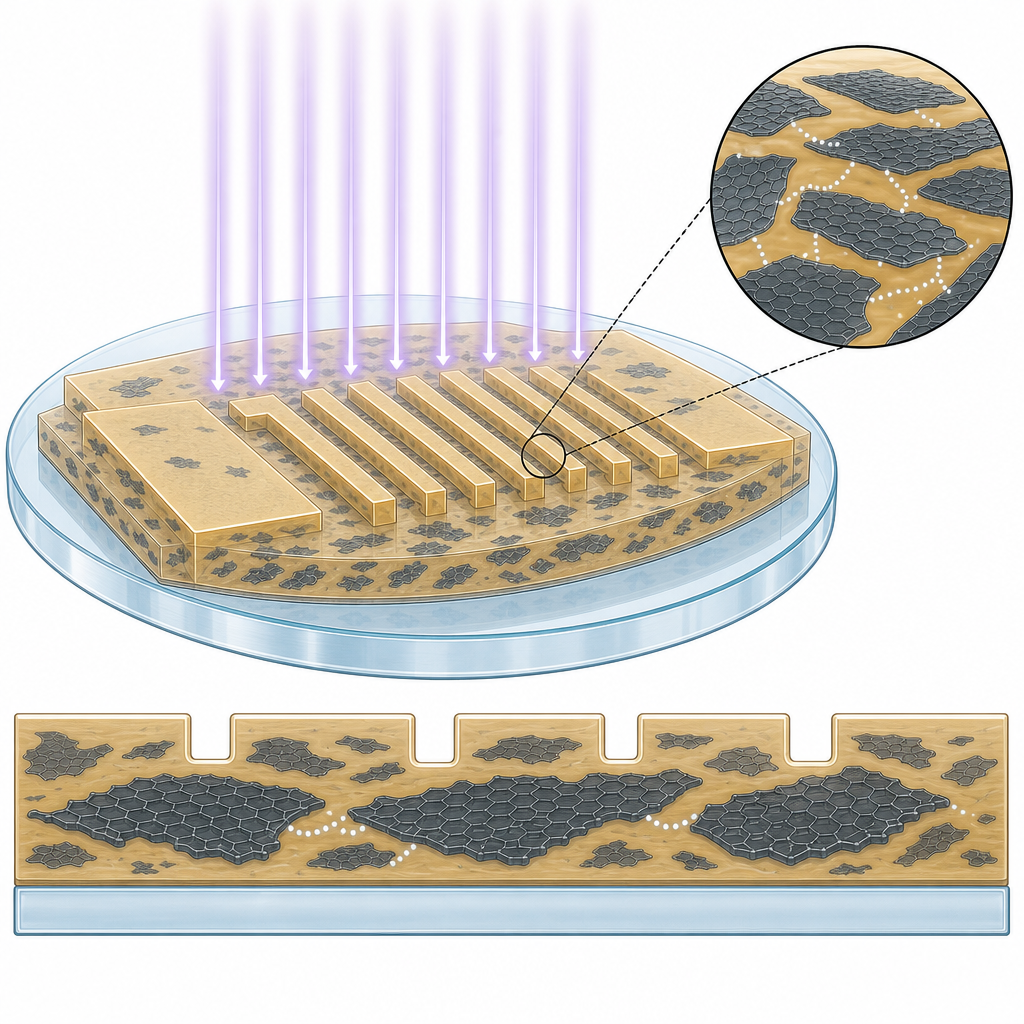
The SU8–RGO composites achieved electrical conductivities markedly higher than other reported graphene-polymer systems at the same loading. The samples showed conduction over the entire 0.04–3 wt% range investigated, with the conductivity-versus-concentration data fitting a power law characterized by a vanishing percolation threshold and a transport exponent of approximately 6. This exponent is far above the universal percolation value (~2), which the authors interpret as evidence that charge transport is governed by tunneling between well-dispersed, flexible graphene flakes rather than by formation of a continuous percolation network. HRSEM (Zeiss MERLIN at 1 kV) imaging of fracture cross-sections and TEM (Philips/FEI CM12, 100 kV) of 80 nm ultramicrotomed slices confirmed that the RGO sheets remained individually dispersed and polymer-wetted. Raman spectroscopy (532 nm, LabRam HR) characterized the as-received RGO flakes. Patterning trials at 0.3, 0.6, 0.9 and 1.2 wt% RGO produced well-defined features with minimum lateral resolution of 10 μm; UV exposure times were tuned (25, 35, 50, and 70 s respectively) to compensate for absorption by the graphene phase. Electrical characterization with Keithley 2400 and 6517 source meters used two- or four-point probe methods depending on resistance range.
The ability to photolithographically pattern a graphene-loaded conductive polymer with 10 μm resolution and high conductivity at sub-percent loading opens routes to integrated MEMS interconnects, microelectrodes for bioelectronics, transparent or semi-transparent conductive patterns, embedded strain and pressure sensors, electromagnetic interference shielding layers, and microfluidic device heaters. Because the formulation is compatible with standard SU8 process flows, it can be adopted by existing cleanroom MEMS lines with only minor modifications to spin-coat speed, bake time, and exposure dose. The tunneling-based conduction model also provides design guidance: optimizing flake flexibility and dispersion is more productive than simply increasing filler content, an insight relevant to other graphene-polymer and 2D-material-polymer systems.
For researchers developing conductive photoresists, flexible microelectronics, or 2D-material-polymer composites, the Reduced Graphene Oxide (RGO) available from ACS Material is well suited to solution-based composite formulation, as demonstrated by its successful incorporation into SU8 in this study. ACS Material also offers complementary graphene oxide grades, dispersions, and nanoplatelets in the broader Graphene Series for groups screening filler morphology effects on composite conductivity and processability.How ACS Material products were used
- Reduced Graphene Oxide (RGO) (Graphene Series) — “SU8–graphene composites were fabricated by solution mixing method, using RGO flakes from ACS Materials as nanofillers, with concentrations ranging from x = 0.04 wt% to x = 3 wt% with respect to the weight of SU8.”
Product Performance in this StudyThe RGO flakes from ACS Material served as the conductive nanofiller in the SU8 photoresist matrix. Their effective dispersion enabled unprecedented high electrical conductivities at very low filler loadings compared to other graphene-based polymer composites, with a vanishing percolation threshold attributed to tunneling between well-dispersed flexible graphene flakes.
Related product categories
Frequently asked questionsHow does reduced graphene oxide improve the conductivity of SU8 photoresist?
Reduced graphene oxide provides a high-aspect-ratio conductive filler that, when individually dispersed in SU8 epoxy, enables charge transport via tunneling between flexible flakes. In this work, RGO from ACS Material delivered measurable conductivity at loadings as low as 0.04 wt% and produced a vanishing percolation threshold, far below the loadings typically required for graphene-polymer systems.
Can SU8-graphene composites be photolithographically patterned for MEMS?
Yes. The EPFL team patterned SU8–RGO composites on Pyrex wafers using a modified standard photolithography process compatible with existing MEMS fabrication. They achieved a minimum lateral feature resolution of 10 μm at RGO loadings of 0.3 to 1.2 wt%, by tuning spin-coat speed (200 rpm), soft-bake time, and UV exposure dose (15 mW cm⁻², 25–70 s).
Why is tunneling, not percolation, responsible for conduction in SU8-RGO composites?
Fits to the conductivity-versus-loading data show a vanishing percolation threshold and a transport exponent near 6, far above the universal percolation value of about 2. This high exponent and the absence of a sharp threshold indicate that charge does not flow through a continuous filler network. Instead, it tunnels between well-dispersed flexible graphene flakes separated by thin polymer layers.