-
Titanium Silicalite-1 (TS-1) for Nylon-6 Precursor Synthesis - Rice University, 2026
May 21, 2026 | ACS MATERIAL LLCZhang, S., Feng, Y., Hao, S., Xu, Z., Ashokkumar, S., Wang, J., & Wang, H. (2026). Integrated electrochemical porous solid electrolyte reactor and packed bed reactor for efficient synthesis of nylon-6 precursor. *Nature Communications*. https://doi.org/10.1038/s41467-026-70236-2
Nature Communications · 2026
Rice University integrates a porous solid electrolyte reactor with a TS-1 packed bed reactor to produce cyclohexanone oxime at 97.2% selectivity and 93.6% yield.
About this research
Researchers at Rice University, using Titanium Silicalite-1 (TS-1) supplied by ACS Material, have demonstrated an integrated electrochemical porous solid electrolyte reactor (PSER) coupled to a TS-1 packed bed reactor (PBR) that produces the nylon-6 precursor cyclohexanone oxime (CyO) at 97.2% selectivity, 93.6% yield, and 96.3% hydrogen peroxide utilization efficiency. Published in Nature Communications (2026), the work uses cyclohexanone, oxygen, and ammonia as the only feedstocks, eliminates separation of hydrogen peroxide intermediates, and reaches a production rate of 28.3 mmol/h at 125 mA/cm² in a 25 cm² cell. The result is a continuous, electrolyte-free route to one of the most important commodity chemicals in the global polyamide industry.
Cyclohexanone oxime sits upstream of caprolactam and nylon-6, with roughly six million tons produced annually. Conventional routes rely on hydroxylamine sulfate cycles or noble-metal-catalyzed hydroxylamine generation, which depend on hazardous oxidizers, acid stabilization of NH2OH, and energy-intensive neutralization steps that create large volumes of ammonium sulfate byproduct. Alternative electrochemical strategies based on nitrate or nitrite reduction often over-reduce nitrogen to NH3 and require supporting electrolytes that complicate downstream separation. Designing a process that combines on-demand oxidant generation with a robust solid catalyst, while avoiding extra salts, addresses a long-standing pain point in green chemical manufacturing and aligns with electrification trends in the chemicals sector.
In this work, ACS Material's Titanium Silicalite-1 (TS-1) is the heterogeneous ammoximation catalyst loaded into the packed bed downstream of the electrochemical cell. TS-1 is a titanosilicate zeolite with isolated framework Ti(IV) sites that activate H2O2 for the selective oxidation of ammonia to hydroxylamine, which then condenses with cyclohexanone to form the oxime. In the standard protocol, 1.5 g of TS-1 was loaded in the PBR, occasionally diluted with SiO2 (70–230 mesh) to maintain bed length. Three feed streams - electrochemically generated ~0.85 mol/L H2O2 from the PSER, 0.8 M ketone in t-BuOH, and 1.6 M aqueous NH3 - were merged at 0.5 mL/min each and passed through the TS-1 bed at 80 °C. SEM characterization on a FEI Quanta 400 confirmed the morphology of the TS-1 crystals used. Because the oxidant arrives in situ and electrolyte-free from the upstream solid electrolyte cell, no stabilizers, acids, or buffer salts contaminate the catalyst bed.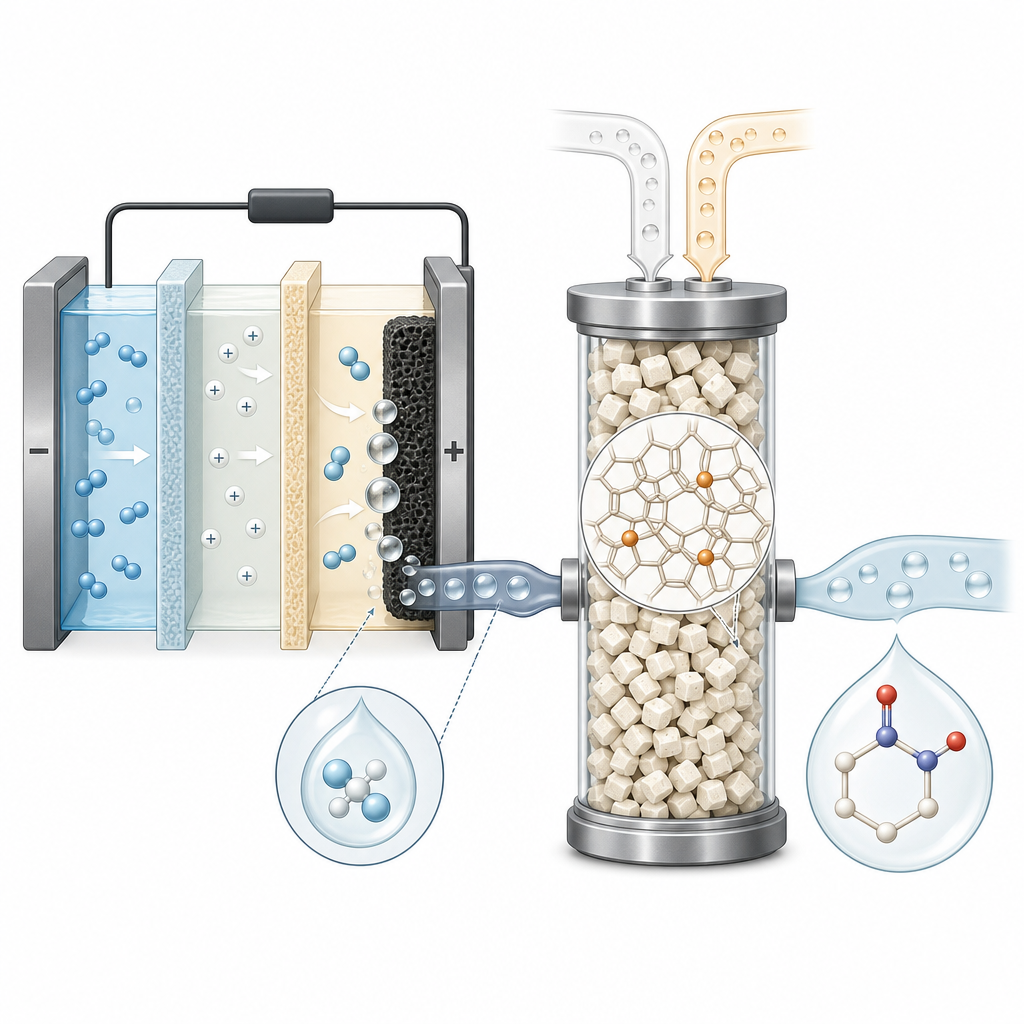
The integrated system delivered consistently strong performance. With an enlarged 25 cm² PSER (six times the team's previous design) feeding the TS-1 PBR, the authors recorded 97.2% CyO selectivity, 93.6% CyO yield, and 96.3% H2O2 utilization efficiency. Operating the PSER at 125 mA/cm² produced cyclohexanone oxime at 28.3 mmol/h. Long-term cascade operation at 60 mA/cm² maintained high CyO yield and selectivity over roughly 25 hours, with H2O2 Faradaic efficiency remaining around 90% and cell voltage stable. The scope was extended successfully to acetone, cyclopentanone, cycloheptanone, 3-pentanone, and benzaldehyde, all of which were converted to the corresponding oximes over the same TS-1 bed using electrochemically generated H2O2. A techno-economic analysis indicated that, at current U.S. electricity prices and 125 mA/cm² operation, the plant-gate levelized cost of CyO falls below the market price of approximately $9,700/ton, supporting the commercial relevance of the approach.
The research enables a more electrified, modular path to nylon-6 monomers and, by extension, polyamide manufacturing. Because the chemistry uses only O2, NH3, and a ketone, with electricity as the only other input, it fits naturally with renewable power and distributed chemical production. The same PSER-PBR concept can be adapted to other oxime products used in pharmaceutical intermediates and crop-protection chemistry, and the in-situ H2O2 strategy is compatible with downstream epoxidation, selective alcohol oxidation, and other titanium-zeolite-catalyzed transformations. The authors point to scale-up of the solid electrolyte stack and longer-duration durability testing as logical next steps for commercialization.
For researchers exploring continuous-flow ammoximation, in-situ H2O2 utilization, or zeolite-catalyzed selective oxidation, Titanium Silicalite-1 (TS-1) is available from ACS Material as part of the molecular sieves portfolio. The Rice University study provides a useful reference point for the productivity, selectivity, and durability that can be achieved when TS-1 is paired with a clean, electrolyte-free oxidant source.How ACS Material products were used
- Titanium Silicalite-1 (TS-1) (Molecular Sieves) — “Titanium Silicalite-1 (TS-1) was purchased from ACS Material.”
Product Performance in this Study
TS-1 served as the ammoximation catalyst packed in the downstream PBR, enabling 97.2% selectivity, 93.6% yield, and 96.3% H2O2 utilization efficiency for cyclohexanone oxime synthesis, and worked effectively across a broad range of aliphatic and aromatic ketones.
Related product categories
Frequently asked questions
Why is Titanium Silicalite-1 (TS-1) used as the ammoximation catalyst for cyclohexanone oxime?
Titanium Silicalite-1 contains isolated framework Ti(IV) sites that activate hydrogen peroxide and convert ammonia into hydroxylamine in situ, which then condenses with cyclohexanone to form the oxime. TS-1 gives high selectivity because the confined micropores favor the desired oxime and suppress over-oxidation. In this Rice University study, TS-1 delivered 97.2% selectivity and 93.6% yield of cyclohexanone oxime in a packed bed.
How does coupling a porous solid electrolyte reactor with a TS-1 packed bed reactor improve cyclohexanone oxime synthesis?
The porous solid electrolyte reactor electrochemically converts O2 into electrolyte-free, high-purity H2O2 that is fed directly into the TS-1 bed without any intermediate purification or stabilizer. This avoids ammonium sulfate byproducts, eliminates separation steps, and keeps the catalyst clean. The integrated system reached 96.3% H2O2 utilization efficiency and 28.3 mmol/h of cyclohexanone oxime productivity at 125 mA/cm².
What other ketones can be converted to oximes with TS-1 and in-situ electrochemical H2O2?
The same TS-1 packed bed fed with electrochemically generated H2O2 successfully converted a range of substrates including acetone, cyclopentanone, cycloheptanone, 3-pentanone, and benzaldehyde to their corresponding oximes. This demonstrates that the PSER-PBR strategy is general for aliphatic and aromatic carbonyls and is not limited to cyclohexanone, making TS-1 a versatile catalyst for green oxime manufacturing.