-
Trivial Transfer Graphene Diaphragm for FP Acoustic Sensor - Beihang University, 2015
Jul 09, 2026 | ACS MATERIAL LLCCheng, L. et al. (2015). An ultra-high sensitivity Fabry-Perot acoustic pressure sensor using a multilayer suspended graphene diaphragm. *2015 IEEE SENSORS*. https://doi.org/10.1109/icsens.2015.7370318
Beihang University · 2015 IEEE SENSORS · 2015
Beihang University used ACS Material Trivial Transfer Graphene to build a Fabry-Perot acoustic sensor achieving 2.38 nm/Pa sensitivity at 15 kHz.
About this research
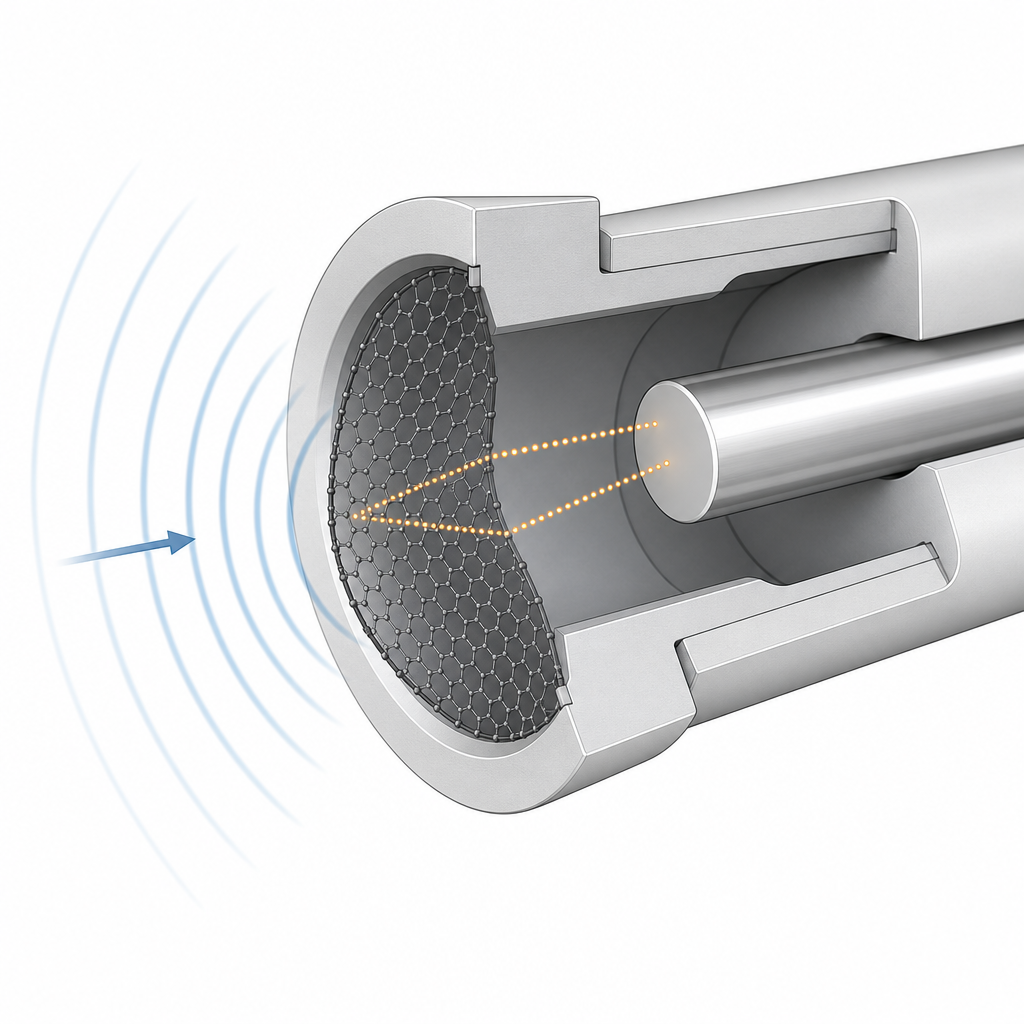
Researchers at Beihang University used ACS Material's Trivial Transfer Graphene to fabricate an ultra-high sensitivity Fabry-Perot (FP) acoustic pressure sensor that achieves a pressure-induced deflection of 2.38 nm/Pa at 15 kHz, the highest reported sensitivity at that time for a diaphragm-based fiber-tip FP pressure sensor. The work, led by Li Cheng and collaborators (including Jin Wei at The Hong Kong Polytechnic University), suspended a 10-15 layer graphene diaphragm across the 125 µm inner bore of a zirconia ferrule and coupled it to a single-mode fiber to form an extrinsic FP interferometer probed at 1550 nm. The diaphragm thickness was estimated at ~4.36 nm based on measured reflectivity matching theory for 13-layer graphene.
Miniature fiber-tip pressure sensors are critical for photoacoustic detection, ultrasound imaging, partial discharge monitoring in transformers, and aerospace acoustic measurements where small footprint, electromagnetic immunity, and high bandwidth matter. The pressure sensitivity of a FP fiber-tip sensor scales strongly with diaphragm compliance, which is set by diaphragm thickness and elastic modulus. Silicon and SiO2 diaphragms are typically thicker than 3 µm, and polymers such as SU-8, while thinner, suffer from porosity and humidity instability. Metallic diaphragms (e.g., 130 nm silver) push sensitivity higher, but at the nanometer-scale thickness limit they become difficult to handle uniformly. A truly atomically thin, mechanically robust diaphragm material is therefore highly attractive, and few-layer graphene transferred onto a fiber endface fits this need.
The ACS Material Trivial Transfer Graphene product is a 10-15 layer graphene film supplied on a sacrificial PMMA carrier specifically designed for clean polymer-assisted wet transfer onto arbitrary substrates. In this study, a piece of the Trivial Transfer Graphene was floated on de-ionized water, and the ferrule was lowered onto the floating membrane so that the graphene/PMMA stack adhered to the ferrule endface through van der Waals interactions. The PMMA was then dissolved in acetone, and after water evaporation in a room-temperature cabinet for about 30 minutes, the freestanding graphene was left suspended over the 125 µm bore. A single-mode fiber was inserted into the opposite end of the ferrule using a high-resolution translation stage to set the FP cavity length. The measured reflectivity of the suspended diaphragm was ~1.49% (close to the 1.72% theoretical value for 13-layer graphene), confirming clean transfer and consistent layer count.
Quantitative characterization included ANSYS modal simulation of the clamped circular diaphragm, which yielded first-order through fourth-order resonance frequencies of 4.47, 7.13, 7.13, and 9.55 MHz, demonstrating very high mechanical bandwidth. Acoustic testing inside an isolation box, calibrated against an MP201 reference microphone (50.7 mV/Pa), produced an FP sensor sensitivity of 47.38 mV/Pa at 15 kHz; converting to mechanical deflection through the FP transfer function yielded a fitted pressure-deflection slope of 2.38 nm/Pa, in good agreement with the 2.43 nm/Pa theoretical value derived from a prestress of 0.1 GPa. Follow-up testing in a 10 m² anechoic chamber confirmed a relatively flat frequency response between 100 Hz and 20 kHz with fluctuation below 9.6 dB. Rotating the probe 90° and 180° around the acoustic axis showed minimal sensitivity variation, demonstrating omnidirectional response. The ~4.36 nm diaphragm complied well with the nanoscale clamped-circular elastic plate model, validating that few-layer graphene, unlike thicker (~100 nm) graphene diaphragms previously reported, behaves as a true nanoscale elastic membrane.
The sensor architecture is directly applicable to fiber-optic photoacoustic spectroscopy of trace gases, hydrophones and underwater acoustic arrays, distributed partial-discharge monitoring in high-voltage equipment, and in-vivo ultrasound probes where compactness, dielectric operation, and broadband response are required. The authors note that the prestress value (0.1 GPa) sets a tradeoff between sensitivity and bandwidth, and that future work should target more uniform large-area transfer, smoother ferrule substrates, and tighter control of adhesion to push sensitivity even closer to the theoretical limit. Comparable diaphragms could be evaluated for resonant pressure sensors, MEMS microphones, and acoustic emission detection in structural health monitoring.
For researchers working on fiber-tip sensors, MEMS acoustic transducers, or any application requiring atomically thin freestanding membranes, ACS Material's Trivial Transfer Graphene offers a ready-made, transferable few-layer graphene film with a PMMA carrier optimized for the wet-transfer protocol described in this paper. The same product line also includes Trivial Transfer Hexagonal Boron Nitride for groups exploring complementary 2D dielectric diaphragms. Documented use in published work like this Beihang University study provides a reproducible starting point for similar device fabrication.How ACS Material products were used
- Trivial Transfer® Graphene (10-15 layer) (Trivial Transfer Series) — “The graphene membrane was prepared from a 10-15 layer Trivial Transfer Graphene sample (ACS Material®, www.xfnano.com).”
Product Performance in this Study
The 10-15 layer Trivial Transfer Graphene served as the acoustic-sensitive diaphragm of the Fabry-Perot cavity. After transfer to the ferrule endface and PMMA removal, it provided an ~4.36 nm thick suspended membrane with ~1.49% reflectivity and yielded a record pressure sensitivity of 2.38 nm/Pa at 15 kHz.
Related product categories
Frequently asked questions
How does multilayer graphene improve Fabry-Perot acoustic sensor sensitivity?
A ~4.36 nm thick 10-15 layer graphene diaphragm is roughly three orders of magnitude thinner than conventional SiO2 or silicon membranes, so its compliance under acoustic pressure is dramatically higher. In this study the suspended graphene delivered 2.38 nm/Pa of cavity-length change at 15 kHz, while keeping the first mechanical resonance at 4.47 MHz. That combination of high sensitivity and high bandwidth is unreachable with micrometer-thick conventional diaphragms.
Why is Trivial Transfer Graphene suitable for fiber-tip device fabrication?
Trivial Transfer Graphene is supplied as a CVD graphene film on a PMMA carrier that floats on water. A target substrate, such as a ferrule endface, can be lifted under the floating film so it adheres by van der Waals interaction. After dissolving the PMMA in acetone and drying, a clean suspended graphene membrane is obtained. The process needs no etchant for copper foil at the user's end and is well suited to small or curved substrates.
What pressure sensitivity did the graphene Fabry-Perot sensor achieve?
The sensor achieved a measured pressure-deflection sensitivity of 2.38 nm/Pa at 15 kHz, in close agreement with the 2.43 nm/Pa theoretical value calculated from a 0.1 GPa diaphragm prestress. Frequency response was relatively flat from 100 Hz to 20 kHz with under 9.6 dB fluctuation, and the sensor showed good omnidirectional behavior when rotated 90° and 180° around the acoustic axis.