-
Trivial Transfer Graphene Electrode for Tunable WS2 Metalens - Stanford University, 2020
May 26, 2026 | ACS MATERIAL LLCGroep, J. v. d. et al. (2020). Exciton resonance tuning of an atomically thin lens. *Nature Photonics*. https://doi.org/10.1038/s41566-020-0624-y
Nature Photonics · 2020
Stanford researchers used ACS Material Trivial Transfer Graphene as a transparent gate electrode on a monolayer WS2 zone plate lens, achieving 33% focal modulation.
About this research
Researchers at Stanford University, working in the Geballe Laboratory for Advanced Materials, used ACS Material Trivial Transfer Graphene as the transparent top-gate electrode in an atomically thin, electrically tunable zone plate lens carved from a monolayer of WS2, achieving a 33% modulation of focusing efficiency through ionic-liquid gating. Published in Nature Photonics (2020) by van de Groep, Song, Celano, Li, Kik, and Brongersma, the work establishes excitonic resonances in two-dimensional semiconductors as a third class of resonance—alongside plasmonic and Mie resonances—for designing dynamic flat optics. The lens is 1 mm in diameter, contains 202 concentric WS2 rings, and operates near the A-exciton wavelength of 620 nm.
This research matters because metasurface optics have largely been static. Plasmonic and dielectric Mie resonators offer excellent control over scattering phase and amplitude but suffer from weak electrical tunability, limiting applications such as LIDAR, dynamic holography, computational imaging, and augmented or virtual reality displays. Excitons in monolayer transition metal dichalcogenides (TMDCs) such as WS2, MoSe2, and WSe2 exhibit binding energies of hundreds of meV due to reduced dielectric screening, so they persist at room temperature and respond strongly to electric fields, strain, and dielectric environment. Harnessing these excitons for wavefront shaping opens a route to tunable, atomically thin optical elements that are virtually invisible at non-resonant wavelengths yet still concentrate light efficiently.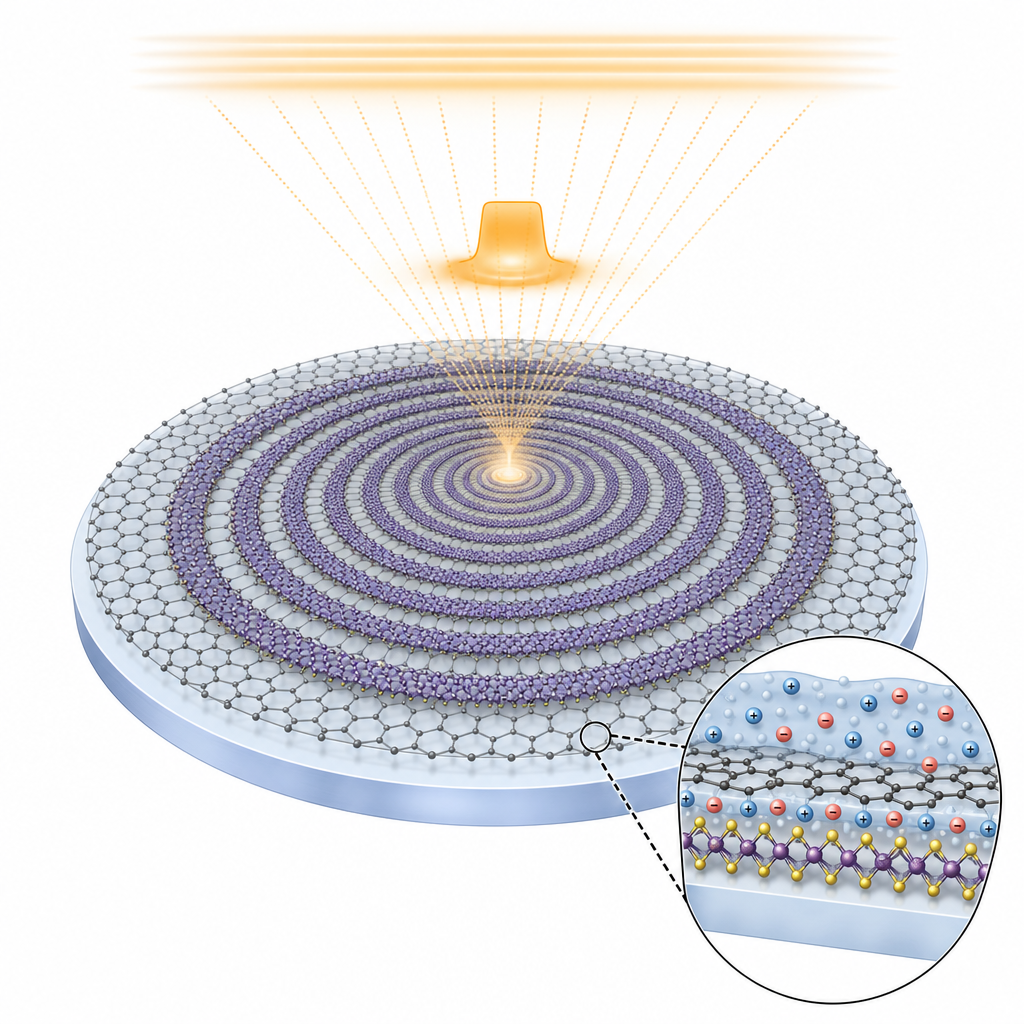
The ACS Material Trivial Transfer Graphene was applied directly on top of the CVD-grown monolayer WS2/sapphire substrate. According to the Methods section, "Large-area commercially obtained monolayer graphene (ACSMaterial Trivial Transfer Graphene) was placed on top of the WS2 to form a WS2/graphene bilayer using wet-transfer techniques." The sample was then annealed at 100 °C in nitrogen for 1 h. The graphene serves three critical roles: (i) it provides enhanced d.c. surface conductivity so the underlying WS2 is gated uniformly across the millimetre-scale lens area; (ii) it does not fully screen gate-induced electric fields, allowing the ionic liquid to electrostatically dope the WS2; and (iii) it protects the WS2 during electrochemical cycling, supporting long-term stability and reversible operation. After graphene transfer, gold finger electrodes were patterned by photolithography, the zone plate rings were defined by electron-beam lithography in PMMA, and CF4 reactive-ion etching transferred the pattern into the WS2/graphene bilayer. A DEME-TFSI ionic-liquid electrochemical cell completed the device.
Key results demonstrate strong exciton-mediated focusing and reversible modulation. The lens forms a clean focal spot approximately 2 mm above the surface with a flat-top super-Gaussian profile and 6.7 µm full-width at half-maximum at 620 nm illumination. The measured focusing efficiency spectrum shows the asymmetric Fano-like line shape predicted from the WS2 complex susceptibility, with the A-exciton at 625 nm and B-exciton near 520 nm. Reflectivity measurements on a 20 × 20 µm² WS2 patch reveal an exciton linewidth of about 75 meV at 0 V; applying a 3 V gate bias to induce n-type doping completely suppresses the main excitonic reflection peak and produces a small redshifted trion (A−) feature at 655 nm. This quenching is fully reversible across many cycles. In the zone plate lens, switching between 0 V and 3 V modulates the focal intensity by up to 33% at 625 nm, with rise and fall times of 39 ± 3 ms and 16 ± 1 ms, respectively, limited by ionic-liquid double-layer dynamics. The light intensity in the focus exceeds the incident plane-wave intensity by a factor of 2.75 despite single-pass interaction with an atomically thin scatterer.
Applications span free-space optical beam tapping, spectral polarimetry, wavefront manipulation, dynamic holography, computational imaging, sensing, and augmented/virtual reality displays. The authors note that solid-state gating schemes could speed device response by orders of magnitude, and that higher-quality, encapsulated large-area monolayer TMDCs—approaching the near-unity reflectivity already demonstrated for exfoliated MoSe2—would dramatically increase focusing efficiency. Interleaved local gating electrodes could enable tunable focal lengths and beam steering on a single chip. The strategy is broadly compatible with other 2D excitonic materials and with van der Waals heterostructures, suggesting a pathway toward reconfigurable, electrically driven flat optics integrated with CMOS electronics.
For researchers building 2D heterostructures, exciton-based photonics, or ionic-liquid-gated devices, the ability to place a clean, large-area graphene monolayer on top of TMDC films with high yield is a practical bottleneck. The Trivial Transfer® Graphene product used here is available from ACS Material in the Trivial Transfer Series, designed specifically for wet-transfer onto arbitrary substrates without the need for in-house CVD growth or PMMA-assisted release. Its performance as a uniform, optically transparent gate electrode in this Nature Photonics study illustrates the kinds of device-quality experiments it can support.How ACS Material products were used
- Trivial Transfer® Graphene (Trivial Transfer Series) — “Large-area commercially obtained monolayer graphene (ACSMaterial Trivial Transfer Graphene) was placed on top of the WS2 to form a WS2/graphene bilayer using wet-transfer techniques.”
Product Performance in this Study
The Trivial Transfer Graphene served as a transparent top electrode on the WS2 zone plate lens, providing enhanced d.c. surface conductivity for uniform ionic-liquid gating and acting as a protective layer that enabled reversible, reproducible exciton quenching and a 33% modulation of focusing efficiency.
Related product categories
Frequently asked questionsWhy use graphene as the top electrode on a WS2 zone plate lens?
Monolayer graphene provides high in-plane d.c. conductivity that distributes the gate potential uniformly across the millimetre-scale WS2 lens, while remaining optically transparent at visible wavelengths. Importantly, single-layer graphene does not fully screen the gate-induced electric field from the ionic liquid, so the WS2 underneath can still be electrostatically doped. The graphene also acts as a chemical barrier during electrochemical cycling, improving long-term device stability.
How does exciton resonance enable a tunable atomically thin lens?
Monolayer WS2 hosts strongly bound excitons with absorption coefficients up to about 1,000 cm⁻¹ in the visible. The complex susceptibility loops sharply around the A and B exciton resonances, producing large changes in scattering amplitude and phase. By patterning WS2 into concentric rings, the scattered fields interfere constructively at the focal plane. Quenching the exciton with electrostatic doping switches the lens between a strongly focusing and a near-transparent state.
What modulation depth and speed did the WS2 metalens achieve?
Cycling the gate voltage between 0 V and 3 V modulated the focal intensity by up to 33% at 625 nm in a single-pass, atomically thin lens. The measured rise and fall times were 39 ± 3 ms and 16 ± 1 ms respectively, limited by the formation and disassembly of the ionic-liquid double layer. The authors note that solid-state gating could increase the response speed by several orders of magnitude.