-
Trivial Transfer Graphene Electrodes for THz Detectors - TU Eindhoven, 2023
Jul 01, 2026 | ACS MATERIAL LLCJumaah, A. J., Roskos, H. G., & Al-Daffaie, S. (2023). Novel antenna-coupled terahertz photodetector with graphene nanoelectrodes. *APL Photonics*. https://doi.org/10.1063/5.0127264
Department of Electrical Engineering, Eindhoven University of Technology 1 , Groene Loper 5, Eindhoven 5612 AE, Netherlands · APL Photonics · 2023
TU Eindhoven used ACS Material Trivial Transfer Graphene to build transparent nanoelectrodes that boost terahertz photomixer responsivity ~30x and double bandwidth.
About this research
Researchers at Eindhoven University of Technology, using 6–8-layer Trivial Transfer Graphene purchased from ACS Material, LLC, demonstrated antenna-coupled terahertz (THz) photodetectors whose responsivity increased by more than an order of magnitude when transparent graphene nanoelectrodes replaced conventional metal fingers. The work, published in APL Photonics (2023) with collaborators at Goethe-Universität Frankfurt, focuses on continuous-wave (CW) photomixers built on low-temperature-grown GaAs (LTG-GaAs). By exploiting the optical transparency of multilayer graphene, the team activated the photoconductive material beneath the electrode fingers—not just at their edges—dramatically increasing the carrier collection volume and, with it, the detected THz photocurrent.
This research matters because antenna-coupled photomixers are the central active components of coherent optoelectronic THz systems used in spectroscopy, sensing, ranging, imaging, and emerging ultrahigh-frequency telecommunications. A long-standing limitation is the low power-conversion efficiency from the optical to the THz regime, compounded by the ultrashort carrier trapping time in LTG-GaAs, which means only carriers generated very close to the electrode edges contribute to the signal. While graphene electrodes had previously improved THz emitters, they had not been applied to enhance detector performance through optical transparency. Addressing this gap is important for extending the usable bandwidth and dynamic range of practical CW THz receivers, which directly affects measurement speed and signal-to-noise in real instruments.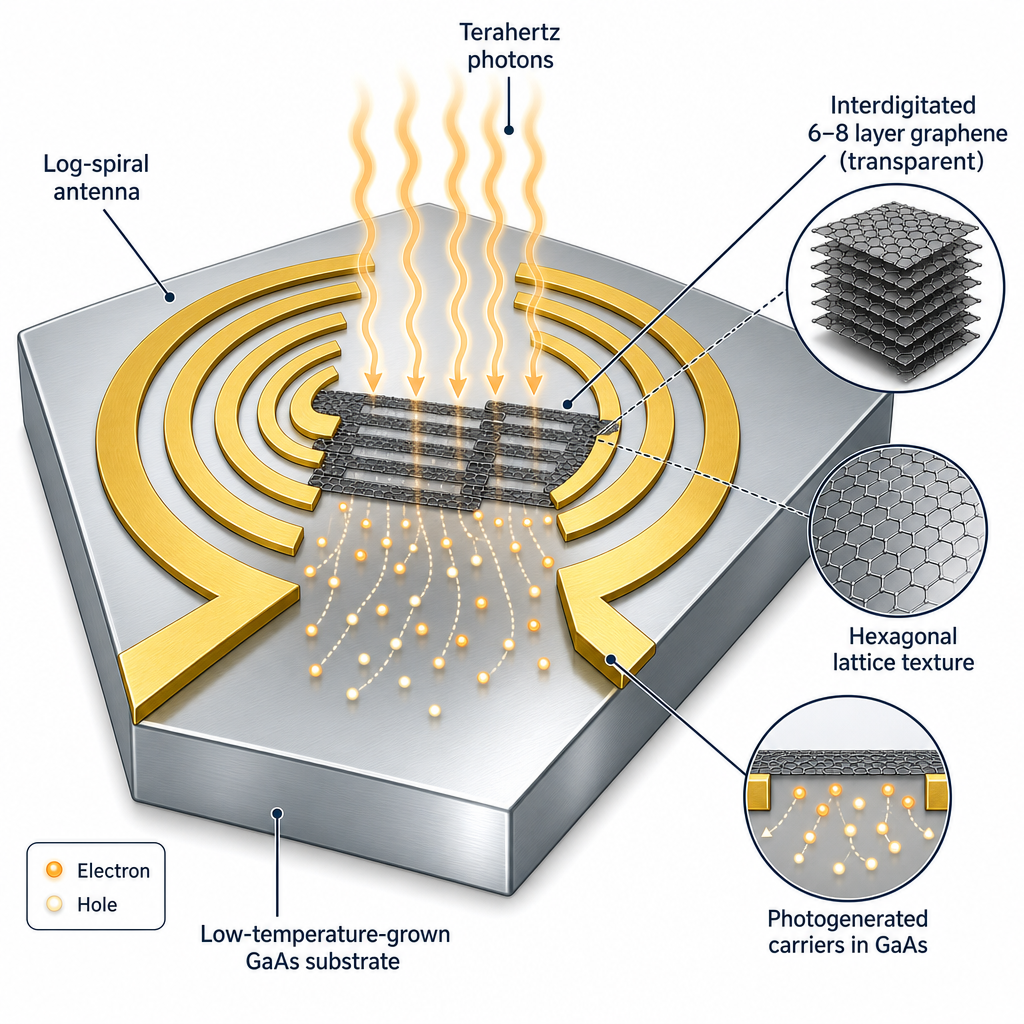
The Trivial Transfer Graphene was central to the device fabrication. The authors chose a 6–8-layer stack rather than a single layer to obtain higher conductivity (a measured sheet resistance of 600 Ω/sq), which kept the electrodes conductive enough to sustain essentially the same THz field in the LTG-GaAs as metal electrodes. Fabrication followed a two-step photolithography route. First, the graphene stack was transferred onto a cleaned LTG-GaAs substrate following the vendor's transfer recipe. A gold log-spiral antenna with a 10-µm gap between arms was then defined from a 150-nm Au layer by standard optical lithography and lift-off. The graphene fingers were patterned in a second photolithography step and etched in an oxygen plasma, then protected with a 150-nm SiNx coating. No annealing was used to improve contact resistance. The interdigitated layout used finger width W = 0.5 µm, spacing S = 1.5 µm, finger length 9 µm, and a total gap width of 10.5 µm—identical geometry to the metal-finger control devices so the comparison isolated the role of graphene transparency.
The key results are quantitative and consistent across measurement and theory. Sensitivity was measured from 50 GHz to 1.9 THz with a TOPTICA TeraScan 780 homodyne setup, with the emitter illuminated at 31 mW and the detector at 30.5 mW. The graphene-finger detector produced an envelope photocurrent roughly a factor of 30 larger than the metal-finger device up to 600 GHz. The graphene detector delivered signal above the noise floor up to 1.25 THz, whereas the metal device reached only about 600 GHz—roughly doubling the usable detection range. A simple geometric estimate of carrier collection efficiency predicted an enhancement factor of about 32.8, while a refined slotline waveguide model that accounts for the field-dependent carrier velocity predicted about 13.2; both confirm an enhancement exceeding one order of magnitude. Dark resistances were 25 MΩ for the metal device and 1.8 GΩ for the graphene device. The authors attribute the gain to photoexcitation occurring in the LTG-GaAs beneath the transparent fingers, increasing the collection volume well beyond the narrow edge regions accessible in opaque-metal devices.
These findings enable more sensitive, broader-band CW THz receivers for spectroscopy, imaging, ranging, high-data-rate communications, and lab-on-chip THz applications. The authors note the benefit of graphene nanoelectrodes is not limited to LTG-GaAs and expect similar responsivity improvements for other photomixer materials, including Er-doped InGaAs operating in the 1.3–1.55 µm telecom wavelength regime. They also identify clear follow-up work: testing whether the predicted voltage dependence of the enhancement factor holds experimentally, and evaluating graphene-electrode photomixers after industrial-level packaging with glued fibers and substrate lenses to capture the coupling gains seen in commercial devices.
For researchers working on 2D-material optoelectronics, this study illustrates how a clean, multilayer graphene transfer film can serve directly as a functional, optically transparent electrode in a working THz device. The Trivial Transfer Graphene product used here is available from ACS Material for groups pursuing transparent conductive electrodes, photomixers, and other van der Waals device architectures. The paper's value lies in showing a straightforward, reproducible route—transfer, pattern, etch, passivate—that yielded a measurable, theory-backed order-of-magnitude performance gain without resorting to complex nanostructuring.How ACS Material products were used
- Trivial Transfer® Graphene (Trivial Transfer Series) — “Devices with graphene fingers were fabricated in a two-step photolithography procedure using 6–8-layer graphene stacks purchased from ACS Material, LLC (material marketed under the trade name "Trivial Transfer Graphene"). First, the stack was transferred onto the cleaned LTG-GaAs substrate following the transfer recipe of the vendor.”
Product Performance in this StudyThe 6–8-layer Trivial Transfer Graphene formed the transparent interdigitated nanoelectrodes that raised THz detector responsivity roughly 30-fold over metal electrodes and extended the usable detection bandwidth.
Related product categories
Frequently asked questionsHow do graphene nanoelectrodes improve terahertz photodetector responsivity?
Graphene is nearly transparent in the visible and near-infrared, so laser light passes through the electrode fingers and excites charge carriers in the LTG-GaAs directly beneath them, not just at the finger edges. This enlarges the carrier collection volume. In this study the change boosted responsivity by about a factor of 30 and roughly doubled the usable detection bandwidth.
Why were 6–8 layers of Trivial Transfer Graphene used instead of single-layer graphene?
Multiple stacked graphene layers provide higher conductivity than a single layer. The 6–8-layer stack reached a sheet resistance of about 600 Ω/sq, conductive enough to sustain essentially the same terahertz field in the LTG-GaAs as metal electrodes while retaining the optical transparency that drives the performance gain.
What detection bandwidth was achieved with graphene electrodes in this THz photomixer?
The detector with graphene nanoelectrodes produced signal above the noise floor up to 1.25 THz, while the otherwise identical metal-finger device reached only about 600 GHz. Up to 600 GHz the graphene device showed an envelope photocurrent roughly 30 times larger than the metal device.