-
Trivial Transfer Graphene for Al Nanoparticle Spallation - University of Missouri, 2022
Jun 10, 2026 | ACS MATERIAL LLCZakiyyan, N. et al. (2022). Spallation of isolated aluminum nanoparticles by rapid photothermal heating. *ACS Applied Materials & Interfaces*. https://doi.org/10.1021/acsami.2c18678
University of Missouri · ACS Applied Materials & Interfaces · 2022
University of Missouri researchers used ACS Material Trivial Transfer Graphene atop a plasmonic grating to demonstrate melt-dispersion spallation of aluminum nanoparticles.
About this research
Researchers at the University of Missouri used single-layer Trivial Transfer Graphene from ACS Material as an interfacial layer on a plasmonic grating microchip to demonstrate, for the first time clearly, the melt-dispersion mechanism (MDM) that governs spallation of isolated aluminum (Al) nanoparticles under rapid photothermal heating. Working with 120 nm Al nanoparticles bearing a 3.8 nm alumina shell, the team coupled a focused 446 nm laser to the grating and to the plasmonic resonance of the particles, generating heating rates of 10^7–10^8 K/s and core temperatures of roughly 1000–1500 K. Under these conditions molten Al was ejected from the heated particles, and the graphene overlayer caused the ejecta to form discrete particles rather than irregular filaments. The result validates a long-debated thermomechanical reaction mechanism.
This research matters because aluminum nanoparticles are widely used energetic materials in solid propellants, explosives, hydrocarbon fuel additives, and metastable intermixed composites. To react with surrounding oxidizer, the metallic Al core must escape its encapsulating alumina shell. Two competing escape pathways have been proposed: the diffusion oxidation mechanism (DOM), active at slower heating rates of 10^4–10^6 K/s, and the melt-dispersion mechanism (MDM), which requires very high heating rates (10^6–10^9 K/s), a core temperature above Al's melting point of 934 K, and a homogeneous alumina shell. Despite its importance for predicting and tuning nanothermite reaction rates, MDM had never been conclusively demonstrated experimentally; prior attempts using patterned Al disks, TEM heating stages, and MEMS heaters failed to observe spallation. A clean experiment on isolated particles that clearly exceeds the MDM threshold was needed.
The Trivial Transfer Graphene played a specific methodological role. A 100 nm silver film and a 10 nm protective alumina capping layer were deposited on an HDDVD-derived grating with a 400 nm pitch and 60 nm ridge height. To differentiate silver grains on the grating from post-reaction products during atomic force microscopy, the authors placed a single-layer graphene sheet (Trivial Transfer Graphene, ACS Material) on top of the grating substrate. The presence of the graphene layer was verified by Raman spectroscopy and SEM, and AFM images confirmed that the sheet conformed well to the grating topology, with graphene wrinkles serving as fiducial reference points for tracking particle motion. Beyond providing a clean imaging surface, the graphene actively shaped the reaction products: rapid Al melting and quenching on the graphene promoted formation of discrete spherical nanoparticles, because surface defects in the graphene arrested migration and aggregation of small molten Al droplets. Al nanoparticles were dispersed in isopropyl alcohol (0.01 mg/mL), sonicated for 2 h, then drop-cast onto the graphene-covered grating and air-dried before laser heating.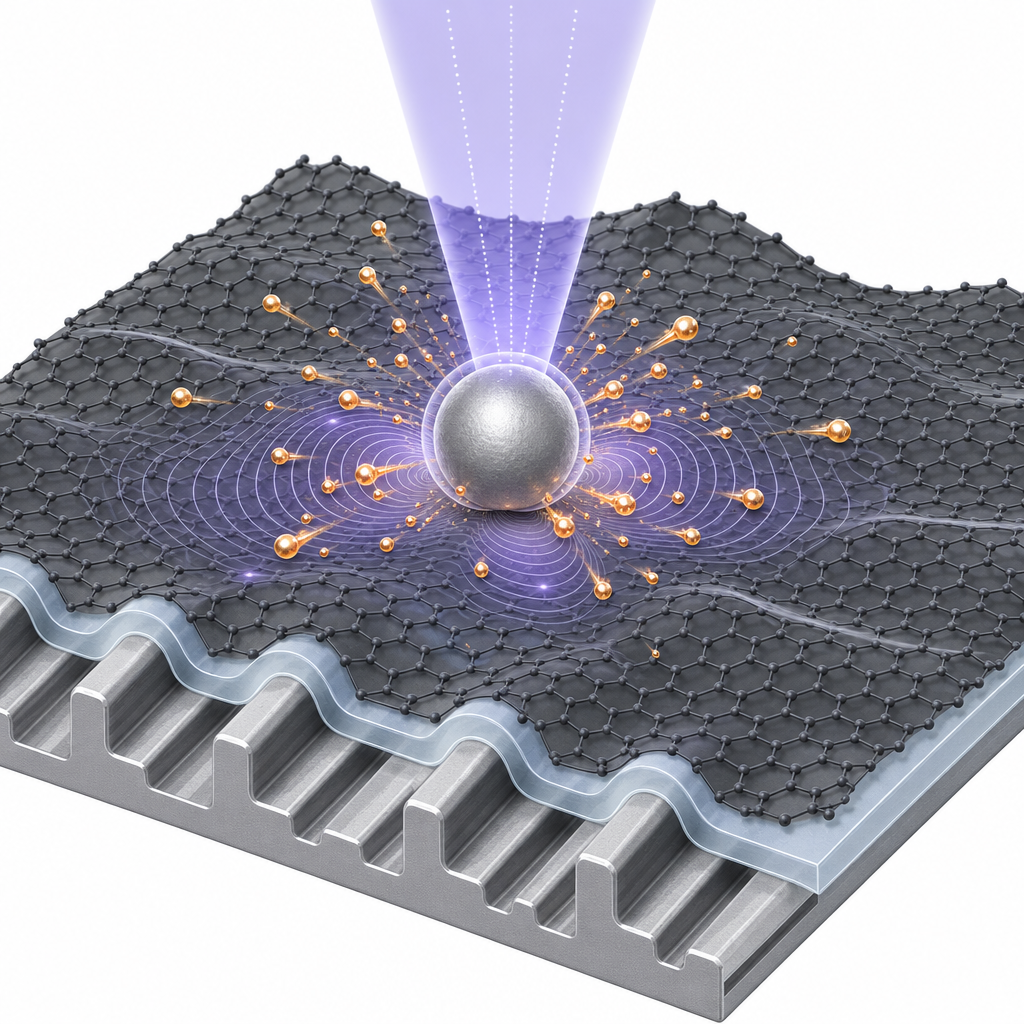
The quantitative findings are detailed. A 446 nm laser with a 7 µs rise time delivered a peak power of 7.6 mW and a power density of 4.2 × 10^5 W/cm^2, producing an energy density of 1.5 J/cm^2. The grating boosted the Al nanoparticle absorption cross section by a factor of 8–18 relative to no substrate, with absorption peaking near 450 nm at the grating's plasmonic resonance. COMSOL simulations matched experiment: in a four-particle cluster, peak temperatures ranged from 937 to 1515 K, and particles reaching full melting (≥1035 K) spalled while a particle reaching only 934 K did not, demonstrating a clear temperature threshold. Estimated heating rates were (1–2) × 10^8 K/s. After irradiation, no original Al nanoparticles remained; fragments dispersed radially more than 500 nm with no pieces larger than 50 nm. In a large cluster of ~65 particles, the average fragment diameter dropped to 21.9 nm from the initial 120 nm, with an estimated volume loss of 23% indicating minimal evaporation. Experiments at 638 nm (10^7 K/s) showed both sintering and spallation, while 808 nm (10^6 K/s) produced only sintering. High-speed imaging at 60,606 frames/s captured light emission within the first frame, consistent with molten Al ejection. Without graphene, ejected Al formed elongated filaments rather than discrete particles.
This work enables better understanding and control of energetic-material reactions. By confirming that the melt-dispersion mechanism can be activated and observed in isolated nanoparticles, the study points toward strategies to accelerate nanothermite reaction rates and raise reaction temperatures in macroscale Al/oxidizer assemblies used in propellants and pyrotechnics. The authors also note relevance to biological phototherapy, where plasmonically driven, rapid photothermal heating of metal nanoparticles is of interest. Planned follow-up parametric studies aim to elucidate structure-property relationships of the spallation reaction and further isolate and control the underlying mechanisms. The graphene-on-grating platform offers a reusable approach for in-situ imaging of single-particle thermomechanical events.
For researchers working on 2D-material substrates, nanoenergetics, or plasmonic photothermal platforms, the single-layer graphene used here is available as Trivial Transfer Graphene from ACS Material. In this study it provided a conformal, clean imaging surface for AFM and SEM and influenced the morphology of molten metal ejecta, demonstrating its utility as a transferable interfacial layer for surface science and nanoscale thermal experiments where reliable, easy-to-place monolayer graphene is required.How ACS Material products were used
- Trivial Transfer® Graphene (Trivial Transfer Series) — “a single-layer graphene sheet (Trivial Transfer Graphene, ACS Material) was placed on the grating substrate.”
Product Performance in this StudyThe single-layer Trivial Transfer Graphene was placed atop the plasmonic grating as an interfacial layer. It conformed well to the grating, aided AFM differentiation of products from Ag grains, and promoted formation of discrete ejected Al nanoparticles versus the irregular filaments seen without graphene.
Related product categories
Frequently asked questionsWhat role did Trivial Transfer Graphene play in the aluminum nanoparticle spallation experiment?
The single-layer Trivial Transfer Graphene was placed atop the silver-coated plasmonic grating as an interfacial layer. It conformed to the grating topology, allowing AFM to distinguish post-reaction Al fragments from underlying silver grains. It also actively shaped the products: rapid melting and quenching of ejected Al on graphene promoted formation of discrete spherical nanoparticles rather than the irregular filaments seen without it.
What heating rate is needed to trigger the melt-dispersion mechanism in aluminum nanoparticles?
The melt-dispersion mechanism (MDM) requires very high heating rates between 10^6 and 10^9 K/s, plus a core temperature exceeding aluminum's 934 K melting point and a homogeneous alumina shell. In this study, photothermal heating reached 10^7–10^8 K/s and core temperatures of about 1000–1500 K, exceeding the MDM threshold and producing clear spallation.
Why does graphene change the morphology of ejected molten aluminum?
Surface defects in the graphene arrest the migration and aggregation of small molten aluminum droplets, so ejected Al solidifies into discrete spherical nanoparticles. Without graphene, molten Al lands on the low-surface-energy alumina capping layer and cools relatively undisturbed, retaining elongated, irregular filament shapes. Graphene therefore acts as both an imaging aid and a morphology-controlling surface.