-
Trivial Transfer Graphene for CryoEM Grids - Osaka University, 2023
Jul 02, 2026 | ACS MATERIAL LLCFujita, J. et al. (2023). Epoxidized graphene grid for highly efficient high-resolution cryoEM structural analysis. *Scientific Reports*. https://doi.org/10.1038/s41598-023-29396-0
Scientific Reports · 2023
Osaka University used ACS Material Trivial Transfer Graphene to build epoxidized cryoEM grids reaching 1.29 Å apoferritin resolution and 1.99 Å GroEL maps.
About this research
Researchers at Osaka University reported an epoxidized graphene cryoEM grid (EG-grid™) fabricated using CVD graphene that can be sourced via ACS Material's Trivial Transfer Graphene, delivering a 1.29 Å apoferritin reconstruction and 1.99 Å GroEL maps from as few as 500 micrographs. Published in Scientific Reports (2023), the study introduces a mild, dry chemical oxidation route using photoactivated ClO2· radicals to install hydroxyl groups on graphene, followed by epichlorohydrin treatment that converts the surface to reactive epoxides. These epoxides immobilize protein particles, eliminate air–water interface denaturation, and break the preferred-orientation bottleneck that limits high-resolution single particle analysis (SPA).
Specimen grid preparation remains the rate-limiting step in cryoEM. Proteins often migrate to the air–water interface during blotting and denature, leading to sparse particles, preferred orientations, and poor reconstructions. Graphene support films have emerged as a powerful workaround because they shield proteins from the interface and can be chemically functionalized to tune adsorption. However, conventional functionalization routes — modified Hummers' methods, glow discharge, and plasma treatment — either break the C–C framework or give poor selectivity between the basal plane and the edges. A mild oxidation chemistry that selectively decorates the basal plane without damaging the lattice would unlock more reliable, reproducible grids for atomic-resolution structure determination of viral antigens, membrane proteins, and other biomedically important targets.
The authors built each EG-grid in three steps. First, a CVD graphene layer was transferred onto Quantifoil Au 200-mesh grids; they explicitly note that commercial CVD graphene from suppliers including ACS Material can be used, and that Trivial Transfer Graphene™ (ACS Material) is a faster route because it floats directly onto water without PMMA mechanical polishing, ammonium persulfate copper etching, or washing. Second, the graphene-coated grid was exposed to photoactivated ClO2· radical gas for 10 minutes, dropping the water contact angle from 76° to 60° and installing hydroxyl groups confirmed by IR bands at 3400, 1300, and 850 cm⁻¹ and a 28.4% C–O signal in XPS. Third, treatment with 1% epichlorohydrin (ECH) for 5 minutes converted the hydroxyls to epoxides, verified by UFHA amine coupling and fluorine XPS peaks. Electron diffraction showed the graphene lattice survived oxidation and epoxidation with intensity ratios near 1.0.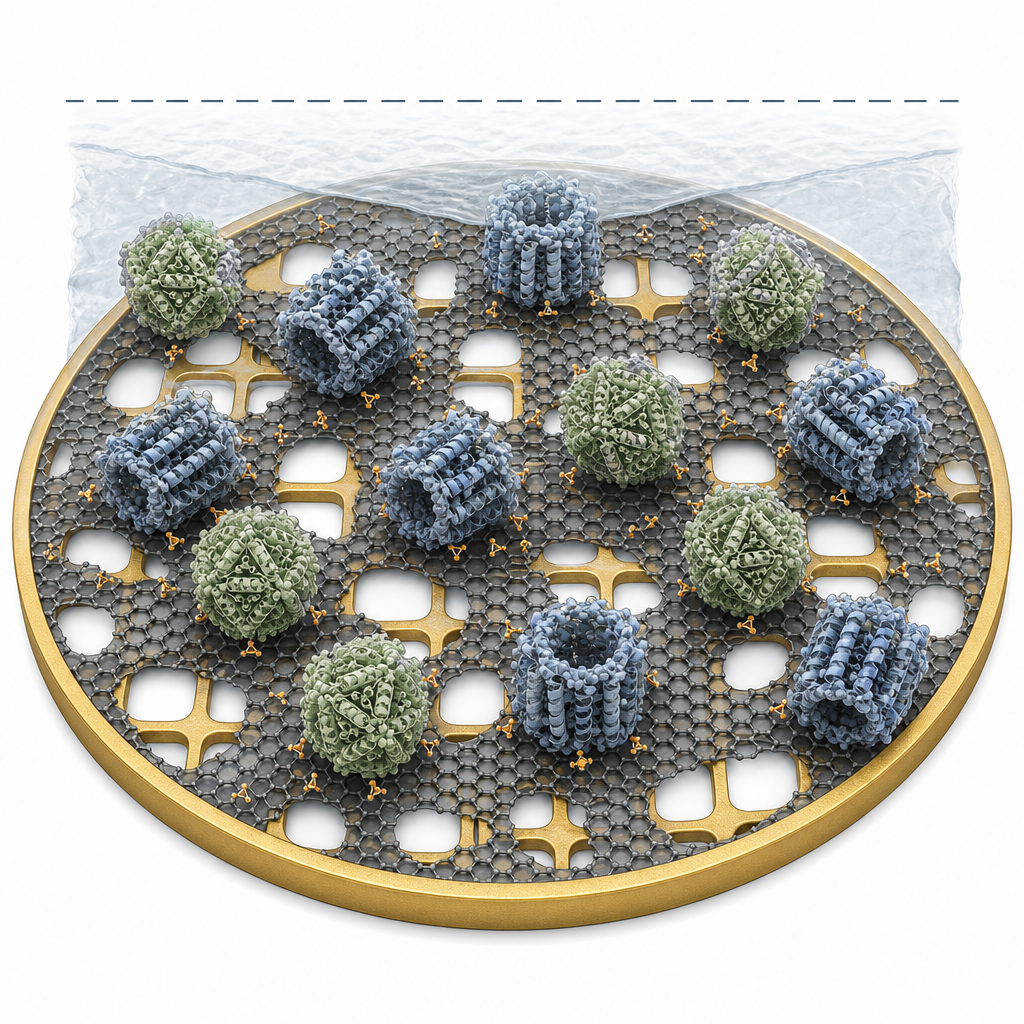
The EG-grid produced striking gains across multiple benchmark proteins. For GroEL at 1.5 mg/mL, the EG-grid yielded 158,485 usable particles from 500 micrographs and a 1.99 Å reconstruction — clearly resolving Phe aromatic rings — versus only 20,061 particles and 2.81 Å resolution from a Quantifoil control. The average number of particles per image used in the final map (NPPI-final) was 315 on the EG-grid versus 36 on Quantifoil, with an 88.9% final/initial particle ratio and a Rosenthal-Henderson B-factor of 74.1 Ų. ClO2·-oxidized grids stored under N2 for three months still produced 2.06 Å GroEL maps. For SARS-CoV-2 spike protein, a dilute 0.1 mg/mL solution gave a 3.10 Å map from 1163 micrographs. β-galactosidase reached 1.81 Å and mouse apoferritin 1.29 Å, demonstrating atomic-resolution capability. The hard target glyceraldehyde 3-phosphate dehydrogenase (GAPDH), known for severe preferred orientation, reached 2.16 Å from only 241 micrographs. Cryo-electron tomography confirmed that particles sit on the graphene surface roughly 160 Å away from the air–water interface, explaining the homogeneity gains.
The EG-grid platform reduces the protein concentration required by up to an order of magnitude, shortens data collection campaigns, and recovers structures of proteins that suffer from orientation bias on conventional supports. Immediate beneficiaries include structural virologists studying spike variants and neutralizing antibody complexes, membrane protein groups working with scarce samples, and drug discovery teams running medium-throughput cryoEM screens. The reactive epoxide handle is also a launching point for further functionalization with NTA, SpyCatcher, antibodies, or aptamer baits, opening on-grid affinity capture workflows. The authors point to broader applications of the photoactivated ClO2· chemistry for surface oxidation of other 2D materials and polymers.
For researchers reproducing or extending this work, the choice of starting graphene matters: the paper highlights ACS Material's Trivial Transfer Graphene as a route that bypasses copper etching and PMMA cleanup. ACS Material's Trivial Transfer Series and CVD Graphene on Copper Foil product lines support both pathways described in the paper, making the EG-grid fabrication accessible to groups without specialized graphene-transfer infrastructure. Combined with standard Quantifoil grids and a ClO2·/ECH workstation, the workflow is reproducible at the bench scale shown in the study.How ACS Material products were used
- Trivial Transfer® Graphene (Trivial Transfer Series) — “a much easier and quicker method is to use Trivial Transfer Graphene™ (ACS Material), which can be transferred to water directly without polishing, etching, and washing”
Product Performance in this StudyTrivial Transfer Graphene from ACS Material is cited as a convenient alternative source of CVD graphene that can be deposited directly onto Quantifoil grids without the PMMA polishing, copper etching, and washing steps required for graphene-on-copper foil. This simplified workflow enables fabrication of the oxidized and epoxidized graphene grids used to dramatically improve cryoEM particle density and orientation.
Related product categories
Frequently asked questionsWhy is Trivial Transfer Graphene useful for cryoEM grid fabrication?
Trivial Transfer Graphene allows CVD graphene to be deposited onto Quantifoil grids directly from a water bath, eliminating the PMMA mechanical polishing, ammonium persulfate copper etching, and repeated washing steps required when starting from graphene-on-copper foil. The authors of this Scientific Reports study explicitly cite it as a faster route to clean, suspended monolayer graphene supports suitable for high-resolution single particle cryoEM.
How does the epoxidized graphene grid improve cryoEM resolution?
The epoxide groups on the EG-grid covalently or strongly adsorb protein particles to the graphene surface, holding them roughly 160 Å away from the air–water interface where denaturation occurs. This raises particle density per image from about 36 to over 300, broadens orientation distributions, and lowers the Rosenthal-Henderson B-factor, enabling 1.29 Å apoferritin and 1.99 Å GroEL reconstructions from far fewer micrographs.
What proteins were successfully reconstructed using the EG-grid?
The team reconstructed apoferritin at 1.29 Å, β-galactosidase at 1.81 Å, GroEL at 1.99 Å (from only 500 micrographs), GAPDH at 2.16 Å, V1-ATPase, and the SARS-CoV-2 spike trimer at 3.10 Å from a dilute 0.1 mg/mL sample using 1163 micrographs. Each target benefitted from improved particle density and reduced preferred-orientation bias relative to Quantifoil holey carbon controls.