-
Trivial Transfer Graphene for FP Pressure Sensors - Beihang, 2016
Jul 09, 2026 | ACS MATERIAL LLCLi, C. et al. (2016). Measurement of the adhesion energy of pressurized graphene diaphragm using optical fiber Fabry–Perot interference. *IEEE Sensors Journal*. https://doi.org/10.1109/jsen.2016.2536783
IEEE Sensors Journal · 2016
Beihang University used ACS Material Trivial Transfer Graphene to measure adhesion energies of 0.275-0.286 J/m² on zirconia via Fabry-Perot interference.
About this research
Researchers at Beihang University used Trivial Transfer Graphene (TTG) supplied by ACS Material to fabricate suspended multilayer graphene diaphragms on optical fiber ferrules and measured the van der Waals adhesion energy between graphene and zirconia substrates as 0.286 J/m² for ~7-layer films and 0.275 J/m² for ~13-layer films using a Fabry-Perot (FP) interferometric method. The study, published in IEEE Sensors Journal in 2016, demonstrated a simple in-situ technique that ties pressure-deflection behavior of pressurized graphene drums to the equilibrium balance between adhesion and strain energy, yielding values that cross-correlate at 0.999 with prior blister-test and AFM measurements.
Understanding the adhesion between graphene and its supporting substrate is critical for graphene-based micro- and nano-electromechanical sensors. Surface forces at the nanoscale strongly clamp graphene membranes to sidewalls and substrates, creating prestress that governs resonance frequency, deflection sensitivity, and the linear operating range of pressure transducers. Earlier measurements relied on pressurized blister tests, AFM indentation with microsphere tips, or double-cantilever fracture testing, each requiring elaborate sample preparation. As researchers integrate graphene into MEMS/NEMS pressure sensors, acoustic transducers, and resonators, an in-device adhesion metric that captures the actual sensor configuration is more useful than ex-situ sample analysis. This paper addresses that gap by extracting adhesion energy directly from the working FP cavity, an approach that the authors argue can be generalized to other two-dimensional materials.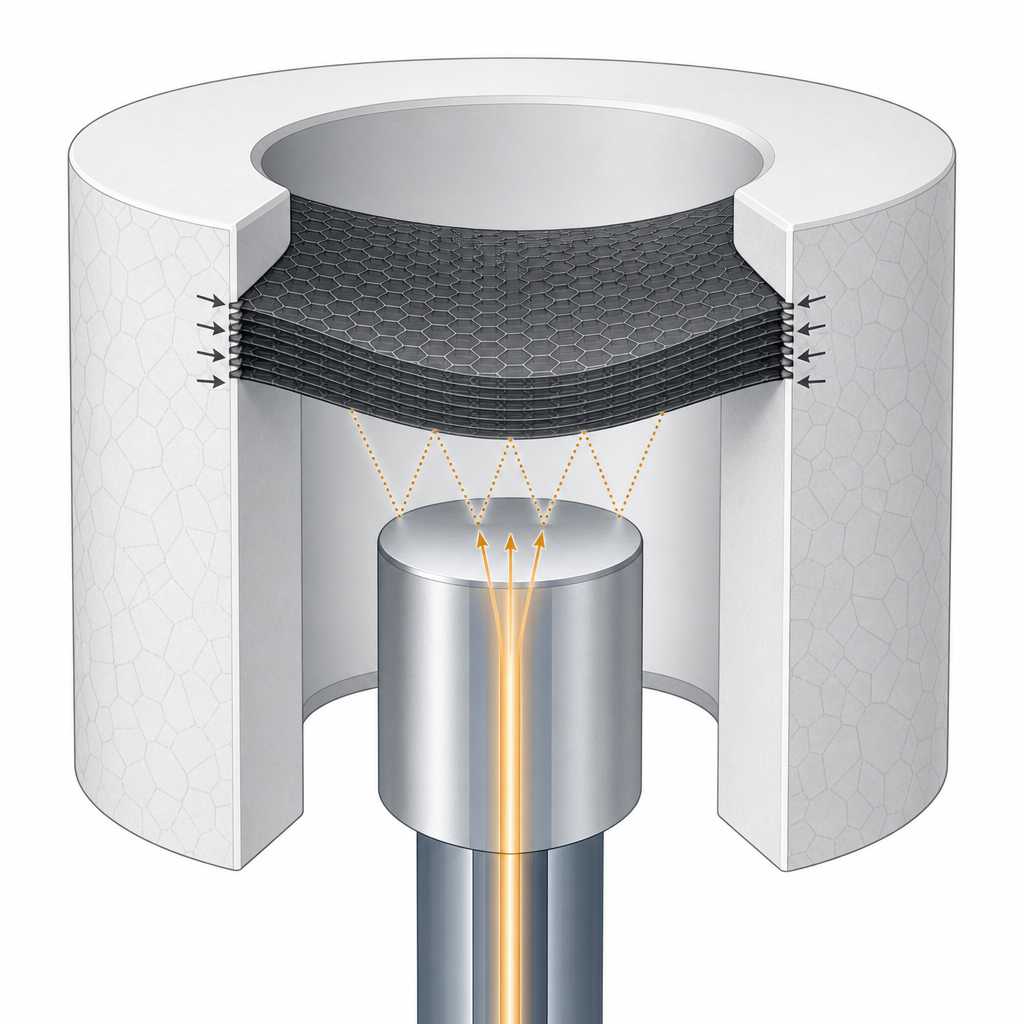
The ACS Material Trivial Transfer Graphene product served as the active diaphragm. Per the Methods section, "the graphene membrane was grown by chemical vapor deposition (CVD) on a 20-μm thick Cu foil deposited on a polymer substrate (ACS Material®)." Two commercial TTG thicknesses, 6–8 layers and 10–15 layers, were transferred onto the endface of a 125-μm-bore zirconia ferrule, where van der Waals forces pinned the graphene to the sidewalls and created a low-finesse Fabry-Perot cavity between the suspended graphene and the cleaved single-mode fiber tip. The reflectance of the diaphragms was determined by fitting interference spectra acquired with an AQ6370C optical spectrum analyzer, yielding average reflectivities of 0.652% for the 6–8 layer film and 1.49% for the 10–15 layer film, close to theoretical values of 0.727% and 1.72% predicted from the graphene complex refractive index. The transfer process drew on the same protocol the group previously published for forming FP cavities on fiber tips.
The FP sensors were evaluated in an anechoic chamber with a calibrated MP201 reference microphone (50.7 mV/Pa) at 1 m from a loudspeaker, illuminated by a 1550 nm tunable laser and read out through an optical circulator and photodetector. The ~13-layer device showed a frequency response flat to within 7.5 dB from 1 to 20 kHz, with a measured acoustic deflection sensitivity of 2.22 nm/Pa at 16 kHz, in excellent agreement with the theoretical 2.25 nm/Pa derived from a prestress of 0.1 GPa. The ~7-layer device gave 1.66 nm/Pa measured versus 1.69 nm/Pa theoretical at a prestress of 0.2 GPa. Applying the derived equation Γ = σ₀·t/2 and the full pressure-deflection model, the authors extracted adhesion energies of 0.275 J/m² (~13 layers) and 0.286 J/m² (~7 layers) on ZrO₂, matching theoretical values of 0.277 and 0.287 J/m² reported for graphene on SiO₂. When the same framework was applied to literature blister-test data on SiO₂, the calculated adhesion energies for 1- to 5-layer graphene (0.443, 0.339, 0.321, 0.311, 0.299 J/m²) cross-correlated at 99.88% and 99.96% with the values reported by He et al. and Koenig et al. The linear operating limit Pc was estimated at ~60 Pa for the ~13-layer device and ~90 Pa for the ~7-layer device.
The technique provides a route to characterize graphene-substrate adhesion inside the actual sensor geometry, which is useful for designing MEMS pressure sensors, fiber-tip acoustic transducers, hydrophones, and resonator-based sensors where prestress and adhesion strongly shape the dynamic response. The framework extends to other 2D materials such as hexagonal boron nitride and transition metal dichalcogenides on amorphous or crystalline ceramic substrates, and could inform the design of suspended-membrane photodetectors, NEMS resonators, and ultrasonic transducers. The authors note that further work is needed to optimize the linear pressure range and clarify how substrate crystallinity (crystalline ZrO₂ versus amorphous SiO₂) modulates conformality and effective adhesion.
For researchers working on suspended-membrane devices, the work illustrates how Trivial Transfer Graphene from ACS Material can be applied directly to fiber-optic ferrules without bespoke transfer rigs and still deliver predictable mechanical behavior. Trivial Transfer Graphene and related CVD graphene products are available through ACS Material for groups developing pressure sensors, acoustic transducers, drum resonators, and 2D heterostructure devices on non-planar or specialty substrates where clean, ready-to-deposit graphene films simplify the fabrication workflow.How ACS Material products were used
- Trivial Transfer® Graphene (TTG) (Trivial Transfer Series) — “The graphene diaphragm was prepared from a commercial Trivial Transfer Graphene (TTG) sample in which the graphene membrane was grown by chemical vapor deposition (CVD) on a 20-µm thick Cu foil deposited on a polymer substrate (ACS Material®, www.xfnano.com).”
Product Performance in this Study
The TTG sample supplied the multilayer CVD graphene used as the suspended diaphragm in the Fabry-Perot sensor. Two thickness ranges (6-8 layer and 10-15 layer) were used to build sensors that yielded acoustic sensitivities of 1.66 and 2.22 nm/Pa and adhesion energies of 0.286 and 0.275 J/m² respectively, in excellent agreement with theoretical predictions.
Related product categories
Frequently asked questions
What is the adhesion energy of multilayer CVD graphene on zirconia?
Using a Fabry-Perot optical fiber interferometer, researchers at Beihang University measured the van der Waals adhesion energy between multilayer CVD graphene (from ACS Material Trivial Transfer Graphene) and a zirconia ferrule substrate as 0.286 J/m² for ~7-layer films and 0.275 J/m² for ~13-layer films. These values closely match the theoretical adhesion energies of 0.287 and 0.277 J/m² reported for graphene on amorphous SiO₂.
Why is graphene-substrate adhesion important for pressure sensors?
At the nanoscale, van der Waals forces clamp suspended graphene to the sidewalls of its support, creating prestress that determines diaphragm deflection sensitivity, fundamental frequency, and the linear operating pressure range. Knowing the adhesion energy is essential to predict and optimize the performance of graphene MEMS/NEMS pressure sensors, fiber-tip Fabry-Perot acoustic sensors, and drum-type resonators, because it directly enters the load-deflection equations.
How is Trivial Transfer Graphene used to build a Fabry-Perot pressure sensor?
Trivial Transfer Graphene supplied as CVD graphene on copper foil with a polymer support is floated onto a target substrate after copper etching. In this study a multilayer film was transferred onto the 125 μm bore of a zirconia ferrule, forming a suspended diaphragm that acts as one mirror of a low-finesse Fabry-Perot cavity, with a single-mode fiber tip as the other mirror, read out by a 1550 nm tunable laser.