-
Trivial Transfer Graphene for Ion Biosensor Arrays - MIT, 2022
May 26, 2026 | ACS MATERIAL LLCXue, M. et al. (2022). Integrated biosensor platform based on graphene transistor arrays for real-time high-accuracy ion sensing. *Nature Communications*. https://doi.org/10.1038/s41467-022-32749-4
Nature Communications · 2022
MIT researchers built a 16×16 graphene transistor biosensor array using ACS Material Trivial Transfer Graphene to detect K+, Na+, and Ca2+ ions in real time.
About this research
Researchers at the Massachusetts Institute of Technology used ACS Material Trivial Transfer Graphene to fabricate a 16×16 electrolyte-gated field-effect transistor (EGFET) array that performs real-time, high-accuracy detection of potassium, sodium, and calcium ions in complex electrolytes, artificial urine, artificial eccrine perspiration, and human serum. Reported in Nature Communications in 2022, the platform integrates more than 200 working graphene sensors per chip, a custom printed-circuit-board readout system, and machine-learning inference. The work demonstrates that device-to-device variation—usually a liability in 2D-material electronics—can be turned into a calibration and classification asset when the sensor count is large enough and statistical methods are applied.
Ion-selective biosensors are central to wearable sweat sensors, point-of-care diagnostics, and electrolyte-imbalance screening for kidney, parathyroid, and cardiac conditions. Graphene field-effect transistors are attractive transducers because of their high carrier mobility, chemical inertness, mechanical flexibility, and large surface-to-volume ratio. However, almost all prior graphene ion sensors report only a handful of devices, leaving reproducibility and lot-to-lot reliability unaddressed. The MIT team takes the opposite approach: rather than chasing perfect uniformity, they integrate hundreds of devices on a single 4-inch glass wafer and use redundancy plus algorithms to extract reliable signals from intrinsically non-uniform sensors. This strategy is broadly relevant to wearable health monitors, multiplexed bioanalytical arrays, and any application where 2D-material variability has limited commercialization.
The graphene channel material was supplied as PMMA-coated ACS Material Trivial Transfer Graphene™ in 1 cm × 1 cm pieces. After patterning Ti/Au row contacts, depositing a 30 nm Al2O3 interlayer dielectric, and laying down the second Ti/Au level on a 200 μm Corning willow glass wafer, the PMMA/graphene stack was laminated across the full array. The chip was baked at 60 °C for 30 min and 130 °C for 2 h to promote PMMA reflow and adhesion, soaked in acetone to remove PMMA, and annealed at 350 °C under 400 sccm Ar / 7000 sccm H2 to remove polymer residue. Raman mapping confirmed monolayer character with a weak D band and uniform 2D/G ratio, and individual 30 × 30 μm channels were then isolated by oxygen plasma. Three ion-selective membranes—containing valinomycin (K+), sodium ionophore X (Na+), and calcium ionophore II / ETH 129 (Ca2+)—were deposited either by spin coating or by jet-valve droplet dispensing onto specific regions of the array.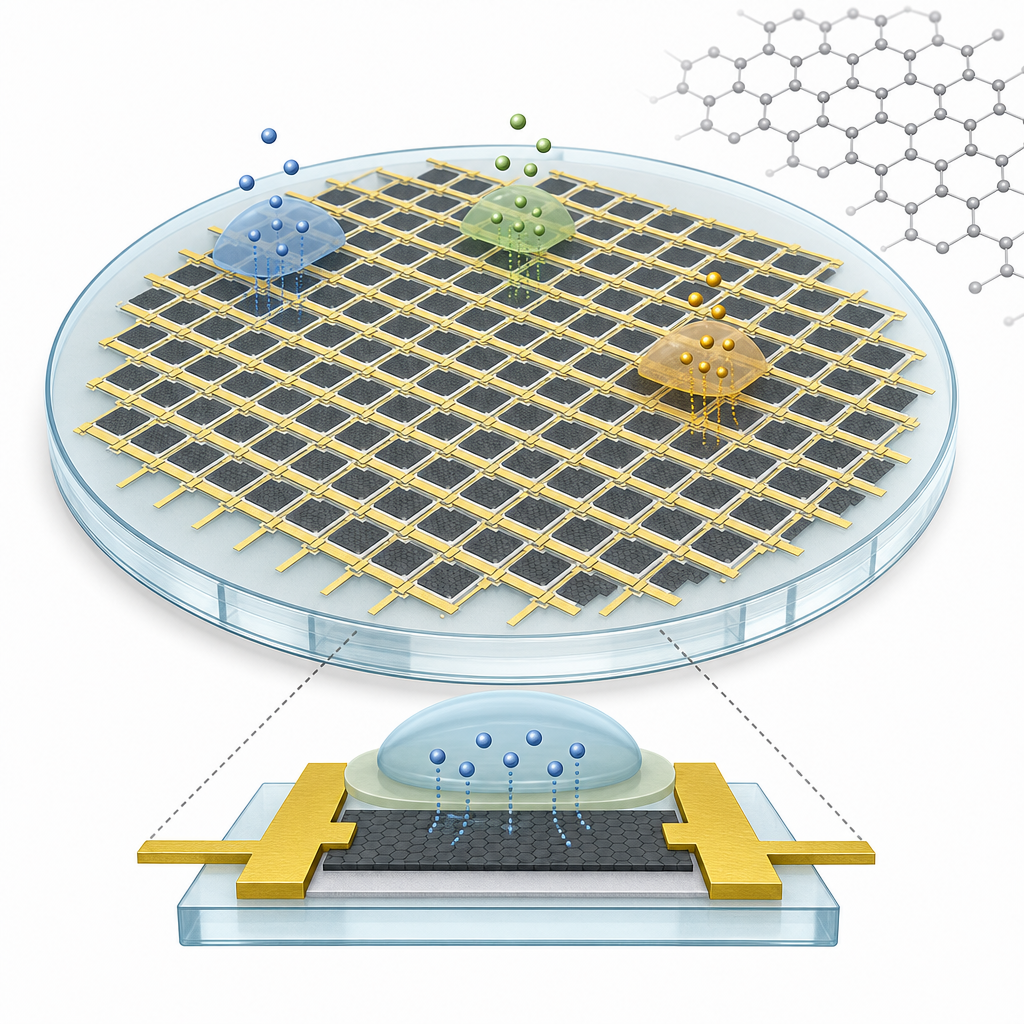
The sensor chips achieved an average pixel yield above 80%, providing more than 200 functional EGFETs per chip. Averaged Dirac-point shifts gave near-ideal Nernstian sensitivities of −54.7 ± 2.90 mV/decade for K+, −56.8 ± 5.87 mV/decade for Na+, and −30.1 ± 1.90 mV/decade for Ca2+ across the 10 µM–100 mM range. Response times were 7.4 ± 1.3 s for K+, 5.9 ± 3.3 s for Na+, and 5.1 ± 1.1 s for Ca2+, comparable to or faster than commercial ion-selective electrodes. Reversibility, quantified as the percentage difference between forward and backward slopes, averaged below 10% even though individual devices could deviate by more than 80%. Sensitivity drift over a six-month period was negligible. A Profile-Matching Calibration scheme exploited device-to-device variation in I–V curves to reconstruct unknown Ca2+ concentrations from a single reference solution, producing a fitted slope of 0.969 and R² of 0.996 against nominal concentrations. A Random Forest classifier trained on multiplexed data from all three ISMs classified ion type and predicted K+, Na+, and Ca2+ concentrations in mixed solutions; reducing the device pool from the full chip to 1/8 lowered accuracy by more than 20 percentage points, directly demonstrating the value of high-density integration.
The combination of large-area transfer graphene, scalable photolithography, and machine-learning data fusion points toward portable, low-cost diagnostic patches for electrolyte imbalance, kidney function, and sweat analysis. The methodology generalizes to other analytes by swapping the ionophore or functional layer, and the same architecture can host aptamer-, antibody-, or enzyme-based receptors for glucose, cortisol, neurotransmitters, and disease biomarkers. The authors specifically note that re-training the Random Forest on patient-derived biofluid data could enable disease-specific classifiers, opening a path toward clinical translation of 2D-material biosensors.
For groups developing graphene-based EGFETs, chemiresistors, or transparent flexible sensors, reliable wafer-scale graphene transfer remains a critical bottleneck. ACS Material Trivial Transfer Graphene supplies single-layer CVD graphene on a polymer support that can be applied directly to non-standard substrates such as glass, polymers, or pre-patterned electrodes, as the MIT team did here. The same product, along with related CVD graphene on copper, SiO2, quartz, and PET substrates, is available through ACS Material for researchers building multiplexed ion sensors, FET biosensors, and wearable electronic platforms.How ACS Material products were used
- Trivial Transfer® Graphene (Trivial Transfer Series) — “Graphene coated with poly(methyl methacrylate) (PMMA) (ACS Materials Trivial Transfer Graphene™ 1 cm × 1 cm) was transferred on the substrate to cover the entirety of the array.”
Product Performance in this StudyThe Trivial Transfer Graphene served as the active channel material for all 256 electrolyte-gated field-effect transistors in the 16×16 sensor array. Raman characterization confirmed single-layer graphene with minimal defects, and the resulting sensor array achieved near-Nernstian ion sensitivities and excellent reversibility across more than 200 working devices.
Related product categories
Frequently asked questionsWhy is Trivial Transfer Graphene used for biosensor field-effect transistor arrays?
Trivial Transfer Graphene is single-layer CVD graphene supported on a polymer carrier that can be laminated onto non-standard substrates such as glass, plastic, or pre-patterned electrode wafers without a separate transfer step. In the MIT study, it covered an entire 4-inch glass wafer carrying 256 pre-fabricated Ti/Au contact sites, enabling scalable fabrication of more than 200 working electrolyte-gated graphene transistors per chip.
How does a graphene ion-selective transistor detect potassium, sodium, and calcium?
The graphene channel is coated with an ion-selective membrane containing a neutral ionophore such as valinomycin, sodium ionophore X, or calcium ionophore II. When the target cation diffuses into the membrane, the resulting Nernstian potential shifts the gate voltage seen by graphene, moving its Dirac point. Measuring this shift yields sensitivities near 55–60 mV/decade for monovalent ions and 30 mV/decade for divalent calcium.
What sensitivity and stability can large-area graphene transistor arrays achieve for ion sensing?
The MIT array achieved −54.7 mV/decade for K+, −56.8 mV/decade for Na+, and −30.1 mV/decade for Ca2+ after averaging over more than 200 sensors. Response times were 5–7 seconds, reversibility better than 10%, and sensitivity drift was negligible over six months. Reducing the device count to 1/8 of the chip lowered machine-learning classification accuracy by over 20 percentage points.