-
Trivial Transfer Graphene for Liquid STEM of ORAI1 - University of Saarland, 2020
Jun 08, 2026 | ACS MATERIAL LLCAlansary, D. et al. (2020). Detecting single ORAI1 proteins within the plasma membrane reveals higher-order channel complexes. *Journal of Cell Science*. https://doi.org/10.1242/jcs.240358
University of Saarland · Journal of Cell Science · 2020
Researchers at the University of Saarland used ACS Material Trivial Transfer multilayer graphene to enable liquid-phase STEM imaging of single ORAI1 channels.
About this research
Researchers at the University of Saarland used ACS Material Trivial Transfer multilayer graphene as a liquid enclosure to image single ORAI1 calcium channel proteins in intact HEK293 cells by liquid-phase scanning transmission electron microscopy (STEM), demonstrating that ORAI1 assembles into higher-order oligomers consistent with hexamers rather than dimers at rest. The work, led by Niels de Jonge and Barbara A. Niemeyer with collaborators at INM – Leibniz Institute for New Materials, combined quantum dot (QD) labeling of an extracellular HA tag with statistical pair-correlation analysis to settle a long-standing debate over the resting stoichiometry of this store-operated Ca2+ channel. The graphene cap was essential: it kept the cells hydrated inside the microscope vacuum while remaining thin enough for nanometer-scale STEM resolution.
ORAI1 channels mediate store-operated calcium entry (SOCE), a signaling pathway central to immune cell activation, gene transcription, and many physiological responses. Crystallographic studies of Drosophila Orai indicate a hexameric channel, while earlier optical and FRET-based work has suggested dimeric or tetrameric resting states. These disagreements arise partly because crystallography requires protein extraction and fluorescence methods lack single-molecule spatial resolution. A technique that visualizes individual ORAI1 proteins in the native plasma membrane is therefore needed. Liquid-phase STEM provides this capability, but it requires a method to keep biological samples wet under high vacuum without sacrificing resolution. Multilayer graphene fulfills this role by forming a vacuum-tight, electron-transparent seal over the specimen, opening new opportunities for membrane protein stoichiometry research.
In the experimental workflow, HEK CRI1 cells (CRISPR-edited to remove endogenous ORAI1 and ORAI2) were grown on silicon nitride microchips, transfected with HA-tagged ORAI1 constructs, fixed, and labeled in two steps with biotinylated anti-HA Fab followed by streptavidin-conjugated QD565 or QD655. After a second glutaraldehyde fixation, samples were covered with three-to-five-layer Trivial Transfer graphene from ACS Material (Pasadena, CA). The graphene–PMMA stack was floated off its polymer support on a sodium chloride saturated water solution, scooped onto an NaCl crystal, baked at 100°C, rinsed in acetone to strip the PMMA, cut to size, and finally floated onto the microchip carrying the labeled cells. The dried graphene formed a hydrated pocket between itself and the SiN window, allowing STEM imaging at 200 kV with pixel sizes of 0.8 nm and electron doses of 16–253 e−/Å2 — within tolerable radiation damage limits.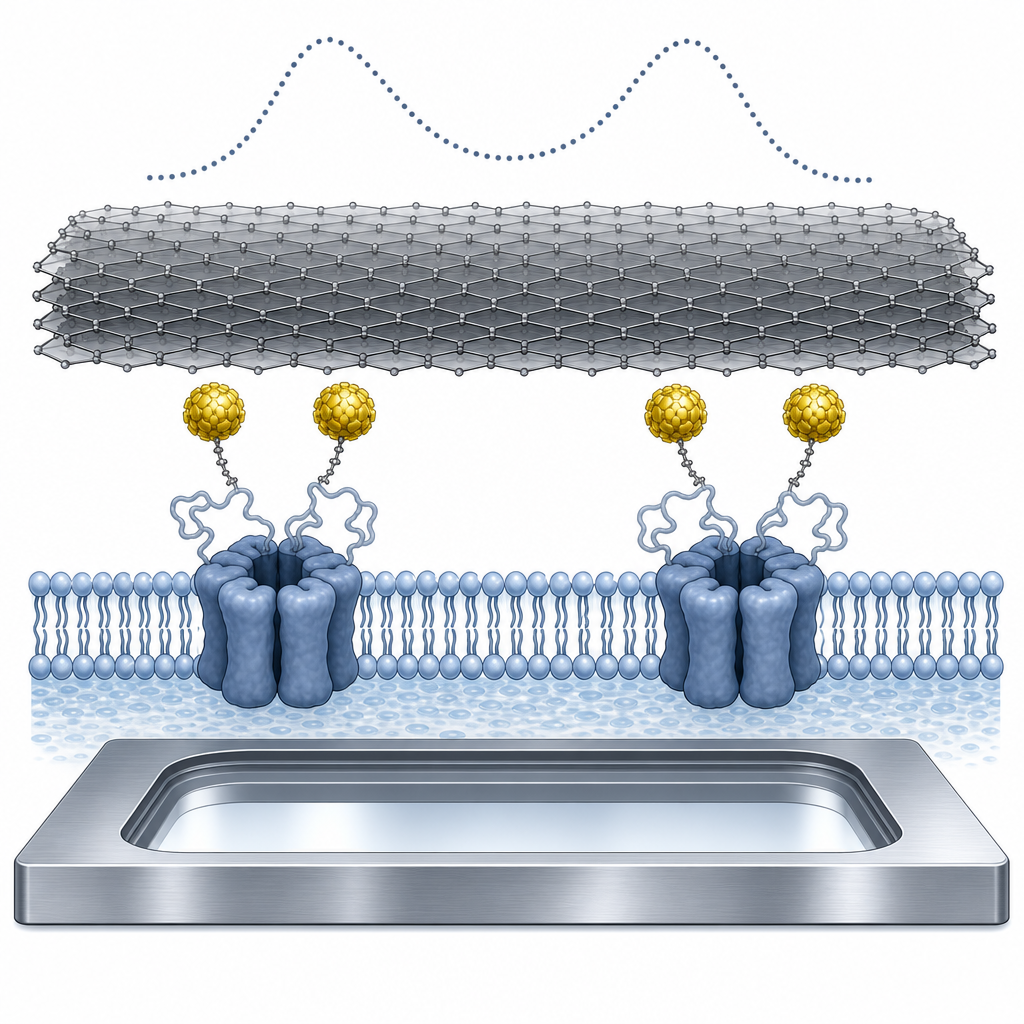
The imaging revealed high-density QD labeling of ORAI1 across the plasma membrane. Removing the N223 glycosylation site (N223A mutant) increased label density by 74%, and switching from QD655 to the smaller spherical QD565 (5 nm core, 12 nm total diameter) nearly doubled detection again, yielding 304 labels/µm2 — a 240% improvement over the original glycosylated construct labeled with QD655. Pair correlation function g(r) analysis showed a clear peak at r ≈ 18 nm and elevated g(r) values between 10 and 30 nm, indicating non-random clustering of QDs at the spacing expected for adjacent ORAI1 subunits. The decisive evidence came from three concatenated dimer constructs: a double-HA-tagged (HA-O1–O1-HA) dimer and two single-tagged variants. The single-tagged dimers — which cannot produce a labeled pair if ORAI1 were dimeric at rest — nonetheless showed pair signals indistinguishable in shape from the double-tagged dimers, with label densities of 112 and 149/µm2. This is only possible if ORAI1 assembles in higher-order oligomers, most consistently hexamers, allowing two QDs to bind even when only one subunit per dimer is HA-tagged. Blue Native PAGE confirmed a single high-molecular-mass complex larger than a dimer.
The ability to image single membrane proteins in their native lipid environment has broad applications. The same graphene-enclosure STEM workflow can be applied to GPCRs, receptor tyrosine kinases (the team has previously used it to study HER2 dimerization), ion channels, and viral envelope proteins, providing stoichiometric information unavailable from crystallography or fluorescence microscopy alone. For drug discovery, knowing whether a target channel is dimeric, tetrameric, or hexameric in resting cells influences pharmacological models and binding assays. For structural biology, the method bridges the gap between purified protein crystal structures and the more complex cellular reality. Follow-up work from this group is expected to address STIM1–ORAI1 coupling kinetics and the assembly of activated channels at ER–plasma membrane junctions.
For researchers planning similar liquid-phase electron microscopy or van-der-Waals encapsulation experiments, the multilayer Trivial Transfer Graphene used in this study is available from ACS Material as part of the Trivial Transfer Series, along with monolayer Trivial Transfer Graphene and Trivial Transfer hexagonal boron nitride. The product's polymer-supported delivery format, compatibility with NaCl-crystal pickup, and reliable three-to-five-layer thickness made it suitable as a vacuum-tight, electron-transparent cover for hydrated mammalian cells on silicon nitride microchips, supporting reproducible single-molecule imaging in biological liquid cells.How ACS Material products were used
- Trivial Transfer® Graphene (multilayer) (Trivial Transfer Series) — “Trivial transfer multilayer graphene was purchased from ACS Material, Pasadena, CA.”
Product Performance in this StudyThe Trivial Transfer multilayer graphene served as a vacuum-tight, electron-transparent capping layer that kept HEK293 cells hydrated during liquid-phase STEM imaging. It preserved native protein conformations while permitting high-resolution detection of QD-labeled ORAI1 channels, enabling quantitative single-protein mapping.
Related product categories
Frequently asked questionsHow does multilayer graphene enable electron microscopy of hydrated cells?
Multilayer graphene is vacuum-tight yet only nanometers thick, so it can seal a thin layer of buffer over biological samples on a silicon nitride microchip while remaining nearly transparent to a 200 kV electron beam. This lets cells stay hydrated inside the high vacuum of a scanning transmission electron microscope, preserving native protein conformations and allowing nanometer-resolution imaging of individual labeled membrane proteins.
Why is the resting stoichiometry of ORAI1 channels important?
ORAI1 channels mediate store-operated calcium entry, controlling immune cell activation, transcription, and many physiological responses. Knowing whether resting ORAI1 is dimeric, tetrameric, or hexameric shapes models of how STIM1 binds and gates the channel, affects pharmacological screening strategies, and reconciles disagreements between crystallographic, FRET, and concatemer-based functional studies of the calcium release-activated calcium current.
What does the pair correlation function reveal about quantum dot labeling?
The pair correlation function g(r) measures how often two labeled positions occur at a given separation relative to a random distribution. A value of g(r) above one at a specific distance indicates clustering, while g(r) near one means random placement. In this ORAI1 study, a g(r) peak near 18 nm showed that quantum dot labels preferentially bound in pairs, consistent with higher-order ORAI1 oligomers.