-
Trivial Transfer Graphene for LP-TEM Liquid Cells - FAU Erlangen-Nuremberg, 2022
Jun 03, 2026 | ACS MATERIAL LLCFritsch, B. et al. (2022). Radiolysis‐Driven Evolution of Gold Nanostructures–Model Verification by Scale Bridging In Situ Liquid‐Phase Transmission Electron Microscopy and X‐Ray …. *Advanced Science*. https://doi.org/10.1002/advs.202202803
Electron Devices (LEB) Department of Electrical, Electronic and Communication Engineering Friedrich‐Alexander‐Universität Erlangen‐Nürnberg Cauerstraße 6 91058 Erlangen Germany · Advanced Science · 2022
FAU Erlangen-Nuremberg used ACS Material Trivial Transfer graphene to build liquid cells for in situ LP-TEM and XRD study of radiolysis-driven gold nanostructures.
About this research
Researchers at Friedrich-Alexander-Universität Erlangen-Nürnberg used ACS Material's 6–8 layer Trivial Transfer graphene to fabricate graphene-supported microwell liquid cells (GSMLCs) that enabled scale-bridging in situ observation of radiolysis-driven gold nanostructure evolution by liquid-phase transmission electron microscopy (LP-TEM) and X-ray diffraction (XRD). The study introduces an intuitive, open-source tool that translates arbitrary chemical reaction sets into kinetic models of radiation chemistry, and applies it to irradiated tetrachloroauric acid (HAuCl4) solutions. The model comprises 42 chemical species distributed over 184 reactions and quantitatively predicts the interplay of aqueous, gold-, and chlorine-containing species during irradiation. Crucially, the simulations reveal that no universal threshold dose rate governs gold nucleation, contradicting earlier reports, and that oxidative etching depends on both precursor concentration and dose rate.
This research matters because LP-TEM has become a key in situ technique across catalysis, energy storage, soft-matter studies, and virology, providing direct views of nonclassical crystallization and self-assembly at the nanoscale. However, the ionizing electron beam itself drives radiolysis that perturbs the Gibbs free energy landscape and can both grow and etch the very structures being observed. Most prior LP-TEM studies relied on incomplete radiation-chemistry descriptions, often modeling only pure or deaerated water and ignoring the coupled gold and chlorine chemistry of HAuCl4. Without accurate beam-effect modeling, observations risk misinterpretation. The same concern extends to liquid-cell XRD and other techniques using ionizing radiation in liquids, making robust, accessible kinetic modeling essential for designing and interpreting in situ experiments correctly.
The ACS Material Trivial Transfer graphene was central to the experimental platform. According to the Experimental section, liquid encapsulation was performed using 6–8 layer trivial-transfer graphene transferred onto holey carbon-coated gold TEM grids (Quantifoil, PLANO), forming the graphene-supported microwell liquid cells with a well depth of about 100 nm. The graphene membranes served as electron-transparent windows that confine the aqueous HAuCl4 specimen during imaging on a Philips CM30 (S)TEM operated at 300 kV with a 4 frames-per-second frame rate. Beyond transparency, the authors highlight that the electrical conductivity of the graphene membranes significantly mitigates radiolysis effects, allowing gold nanostructure formation to serve as a benchmark for successfully sealed graphene-based liquid cells. The graphene also acts as a charge-dissipation surface, producing seed particles that enable observation of growth and etching. Complementary experiments at 1 mM HAuCl4 used silicon nitride-windowed cells (Protochips Poseidon Select E-Chip) on a Thermo Fisher Titan3 Themis 300, while the multilayer graphene cells supported the majority of growth and etching observations across the dose-rate range studied.
The key results validate the kinetic model against experiment. For a 20 mM HAuCl4 solution, steady-state radiolysis concentrations are reached within a few milliseconds, with elementary Au and the gold dimer Au2Cl6^2− storing nearly 100% of the gold atoms. Gold growth events were observed at electron-flux densities as low as 540 e−(nm² s)−1 and even 4.74 e−(nm² s)−1, well below the previously reported threshold of 2–3 × 10³ e−(nm² s)−1, demonstrating that no universal threshold applies. To probe the threshold at extreme low dose rates, a 20 mM HAuCl4 solution was exposed to a Cu Kα X-ray beam at roughly 1 Gy s−1 — about nine orders of magnitude below the lowest LP-TEM dose rate — and still produced gold microplatelets with three- and sixfold fcc symmetry, confirmed by ex situ XRD Bragg peaks. In situ XRD over 42 h showed steadily increasing gold diffraction intensity, with gold detectable after the first scan. Fifteen LP-TEM observations classified as growth, etching, or both followed the simulated Au0 steady-state trend. Critical radii rcrit measured for 17 nanoparticles averaged 5.1, 3.4, and 1.9 nm for 1, 10, and 20 mM HAuCl4 solutions respectively, a factor-of-two change matching predicted shifts in chemical potential Δμ.
This work enables more reliable, quantitatively interpretable in situ liquid-phase studies across materials science. By providing an open-access tool that handles arbitrary solution chemistries and any ionizing radiation source, the authors give the LP-TEM, liquid-cell XRD, and operando communities a means to predict and tailor redox processes, distinguish genuine sample behavior from beam artifacts, and design experiments that exploit rather than merely suffer from radiolysis. Application areas include nanoparticle synthesis, catalysis, energy materials, and corrosion science. The demonstrated ability to tune the Gibbs free energy landscape and critical radii via dose rate and precursor concentration points toward controlled, beam-directed nanostructure fabrication and the study of dynamic equilibria for extracting material-specific parameters.
For researchers building their own liquid cells, the graphene window is the enabling component, and the multilayer Trivial Transfer graphene used here is available from ACS Material for similar van der Waals encapsulation and 2D-material transfer work. The paper shows that conductive multilayer graphene windows reduce radiolytic artifacts and support reproducible gold nucleation benchmarks, which is useful guidance for anyone setting up graphene-based LP-TEM platforms. The product served strictly as the liquid-cell membrane substrate, and its value here lies in transparency, sealing reliability, and charge dissipation rather than in any chemical role in the reaction.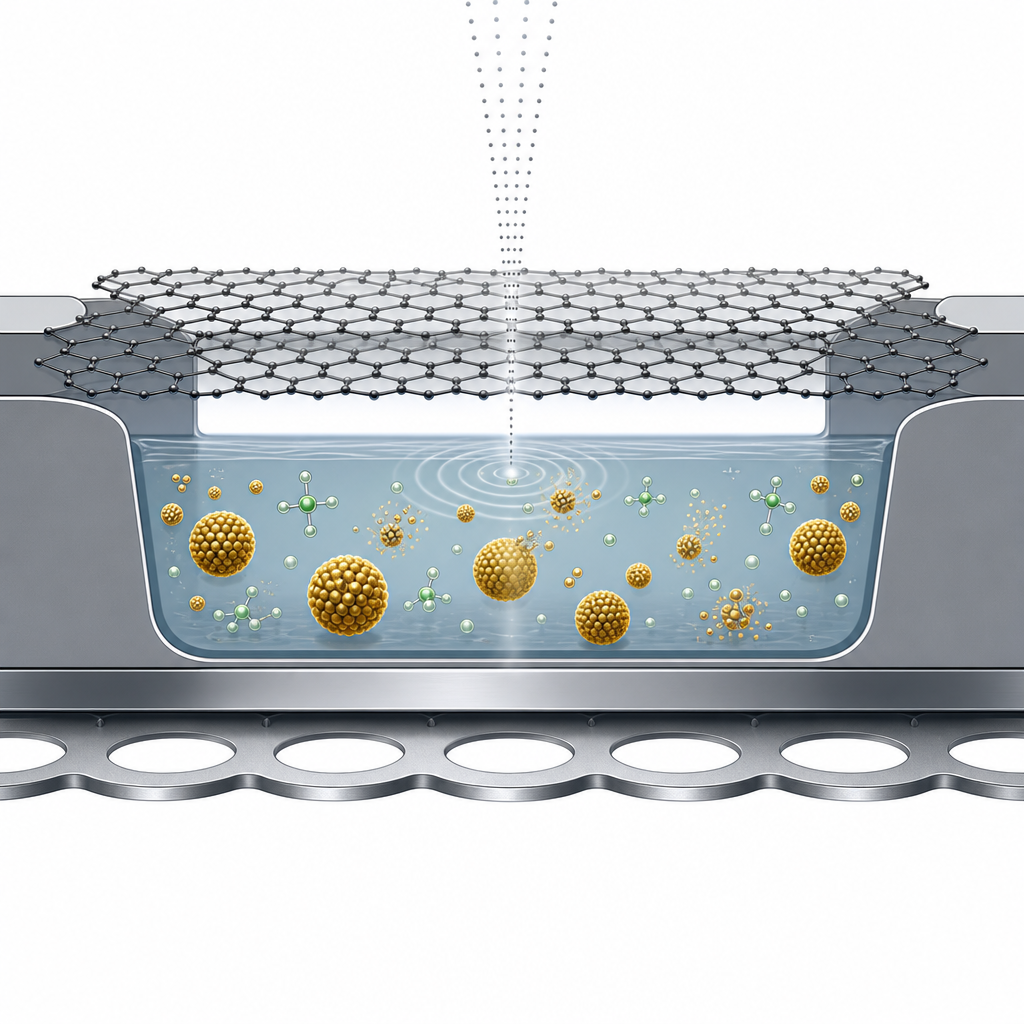
How ACS Material products were used
- Trivial Transfer® Graphene (6–8 layer) (Trivial Transfer Series) — “Liquid encapsulation was performed using 6–8 layer trivial-transfer graphene (ACS Material) transferred onto holey carbon-coated gold TEM grids (Quantifoil, PLANO).”
Product Performance in this Study
The trivial-transfer graphene formed the windows of the graphene-supported microwell liquid cells (GSMLCs) used for LP-TEM. The graphene membranes provided electron transparency and, due to their electrical conductivity, mitigated radiolysis effects and enabled reproducible gold nanostructure growth/etching observations.
Related product categories
Frequently asked questions
What is Trivial Transfer graphene used for in liquid-phase TEM?
In this study, 6–8 layer Trivial Transfer graphene from ACS Material formed the electron-transparent windows of graphene-supported microwell liquid cells. Transferred onto holey carbon gold TEM grids, it sealed the aqueous HAuCl4 specimen for imaging at 300 kV. The conductive multilayer graphene also mitigated radiolysis and provided charge dissipation, enabling reproducible observation of gold nanostructure growth and etching.
Why do graphene liquid cells reduce radiolysis effects in electron microscopy?
The authors attribute reduced radiolytic artifacts to the electrical conductivity of the graphene membranes, which helps dissipate charge that would otherwise build up on insulating windows such as silicon nitride. This conductivity limits local concentration gradients and beam-induced charging, so gold nanostructure formation in graphene cells serves as a benchmark for a well-sealed, low-artifact liquid cell platform.
Is there a threshold dose rate for gold nucleation in LP-TEM?
The kinetic simulations and experiments in this work indicate no universal threshold dose rate exists. Gold growth was observed at electron-flux densities as low as 4.74 and 540 e−(nm² s)−1, and even X-ray irradiation at about 1 Gy s−1 produced gold. Apparent thresholds in silicon nitride cells likely arise from diffusion and membrane charging rather than intrinsic solution kinetics.