-
Trivial Transfer Graphene for Pt Single-Atom HER - BJUT, 2021
Jun 12, 2026 | ACS MATERIAL LLCTian, Y. et al. (2021). Fast synthesis of Pt single-atom catalyst with high intrinsic activity for hydrogen evolution reaction by plasma sputtering. *Materials Today Energy*. https://doi.org/10.1016/j.mtener.2021.100877
Materials Today Energy · 2021
Beijing University of Technology used ACS Material Trivial Transfer Graphene to support fast plasma-sputtered Pt single-atom catalysts achieving high HER activity.
About this research
Researchers at Beijing University of Technology demonstrated that ACS Material's Trivial Transfer Graphene could be used to confirm single-atom platinum dispersion in a plasma-sputtered Pt/TiO2-x hydrogen evolution reaction (HER) catalyst that reached a mass activity of 39.1 A/mg Pt and a turnover frequency of 39.6 H2 s-1 at 50 mV overpotential. The work combined plasma sputtering with single-atom catalyst synthesis to deposit Pt atoms onto a TiO2-x support in a layered, sandwich-like architecture. Aberration-corrected scanning transmission electron microscopy and EXAFS confirmed that Pt existed as isolated, positively charged single atoms bonded to oxygen, with no metallic Pt-Pt agglomeration. The headline advantage is speed: a single catalyst layer could be formed in roughly one minute, shortening synthesis to minutes or even seconds.
This research matters because platinum remains the benchmark HER electrocatalyst in acidic media but is scarce and expensive. In conventional nanoparticle catalysts, only the surface atoms participate while buried atoms are wasted - the so-called 'useless loading' problem. Downsizing toward subnanometer clusters and single atoms maximizes atomic utilization, but traditional wet-chemical routes to single-atom catalysts are slow and complex. The field needs scalable, low-energy, low-waste methods that retain high intrinsic activity. Electrocatalytic hydrogen evolution underpins green hydrogen production by water electrolysis, a central technology for decarbonizing energy. By achieving ultra-low Pt loading with high activity through a dry, ambient-temperature, zero-chemical process, this study addresses both cost and manufacturability barriers that have hampered the industrial deployment of platinum HER catalysts.
Within this study, ACS Material's Trivial Transfer Graphene (described as 'one-step transfer of multilayer graphene') functioned as a reference 2D substrate. The Methods state plainly that the multilayer graphene was 'a product of ACS MATERIAL of the United States.' The authors used a three-target plasma sputtering coater with a Pt target (99.999%) and a TiO2-x target to alternately deposit support and active metal. High-purity argon was the sputtering gas at 20 Pa working pressure, with a Pt sputtering current of 5 mA and a sputtering duration of only 1 second. These initial Pt sputtering conditions were chosen specifically so that Pt could be dispersed as single atoms on multilayers of two-dimensional graphene, drawing on prior reports of Pt single-atom dispersion on graphene by plasma sputtering. In other words, the Trivial Transfer Graphene provided the well-characterized 2D platform on which the single-atom dispersion regime was established, before the team transferred the same plasma-sputtering protocol to the practical TiO2-x support deposited on glassy carbon.
The quantitative results are strong. ICP-MS measurements put Pt loading at approximately 1.69 wt% with a mass loading of only 0.072 mg Pt/cm2, far below conventional electrodes. At 50 mV overpotential in 0.5 M H2SO4, the Pt/TiO2-x catalyst delivered a mass-specific activity of 39.1 A/mg Pt - 11.04 times that of commercial 20% Pt/C - and a turnover frequency of 39.6 H2 s-1, about 3.6 times higher than 20% Pt/C. Mass activity climbed to 177.7 and 386.9 A/mg at 0.1 and 0.15 V vs. RHE. The HER overpotential at 10 mA/cm2 was 95 mV, comparable to 20% Pt/C and superior to 5% Pt/C. The Tafel slope was 26.5 mV/dec, lower than 32.3 and 34.3 mV/dec for 20% and 5% Pt/C. Charge transfer resistance at 50 mV was 3.5 ohm versus 6 ohm for 20% Pt/C. Durability was excellent: after 3,000 CV cycles, the current density of Pt/TiO2-x dropped only 6.5% at 0.1 V vs. RHE, compared with 30.3% for 20% Pt/C, with the Pt0 fraction increasing only 4.33%. DFT calculations identified Pt sites bonded to support oxygen as the active centers, with a near-thermoneutral hydrogen adsorption free energy of about -0.06 eV.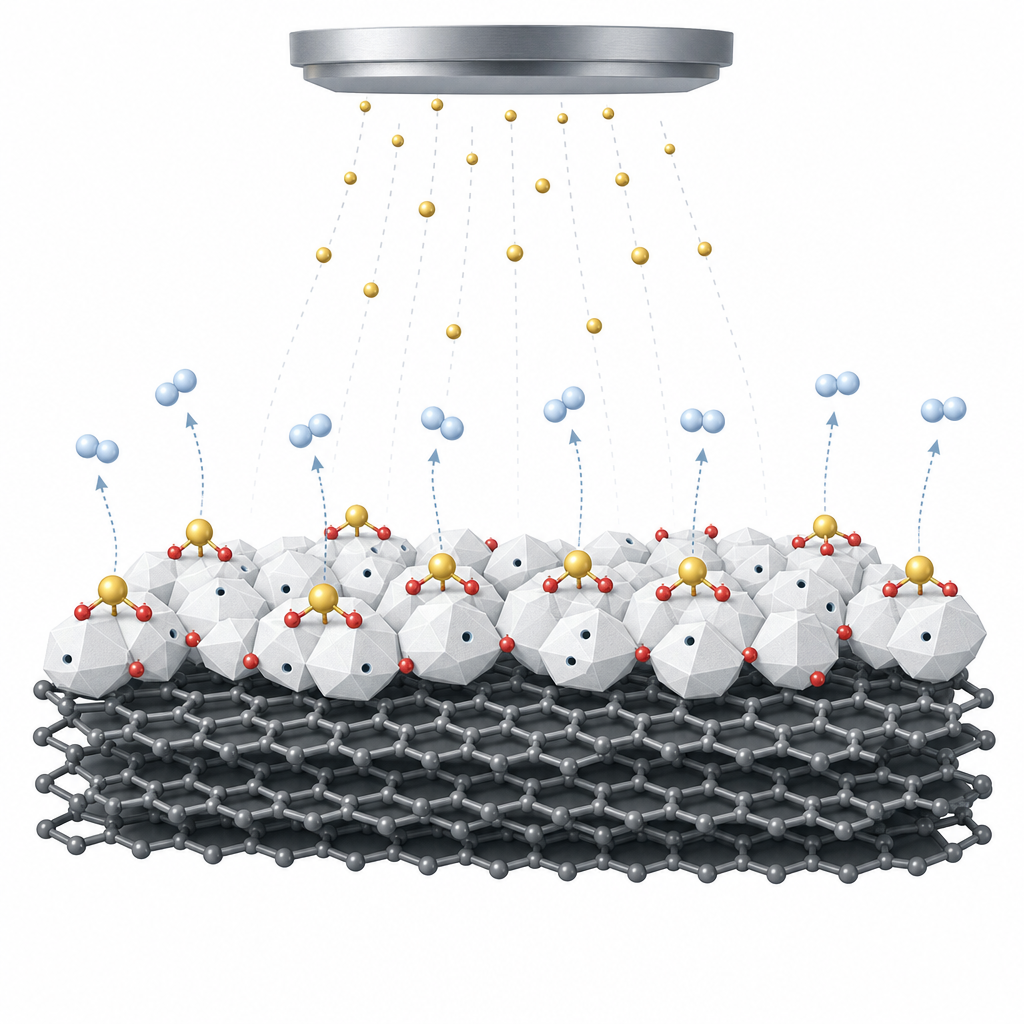
This research enables faster, lower-cost routes to supported single-atom and cluster catalysts for hydrogen evolution and potentially the oxygen reduction reaction, fuel cells, and broader electrocatalysis. The plasma-sputtering approach is adhesive-free and can deposit catalysts directly onto glassy carbon, carbon paper, copper mesh, silicon, stainless steel, and titanium foil, which suits flexible and integrated electrode architectures. The authors point toward extending the method to non-noble metals and alloy catalysts, and to scaling high-density single-atom dispersion with practical loadings. For green hydrogen, water electrolysis, and electrocatalytic device manufacturing, a dry, rapid, low-energy synthesis that cuts precious-metal use while preserving intrinsic activity is directly relevant to industrial adoption.
For researchers working on 2D-material-supported catalysts, the study illustrates how a reliable, transferable multilayer graphene platform underpins single-atom dispersion studies. The Trivial Transfer Graphene used here is available from ACS Material for groups developing single-atom electrocatalysts, 2D heterostructures, and related electrode systems. The product's clean, one-step transfer onto target substrates makes it a practical reference support when verifying atomic-scale metal dispersion, as demonstrated by the AC-STEM and EXAFS confirmation in this work. Its role here was supporting rather than central, but it provided the validated 2D substrate that anchored the catalyst design strategy.How ACS Material products were used
- Trivial Transfer® Graphene (multilayer) (Trivial Transfer Series) — “One-step transfer of multilayer graphene (Trivial Transfer Graphene) is a product of ACS MATERIAL of the United States.”
Product Performance in this StudyMultilayer Trivial Transfer Graphene from ACS Material served as a model 2D support to verify that Pt could be dispersed as single atoms under the chosen plasma-sputtering conditions, paralleling reference work where Pt single atoms were sputtered onto graphene.
Related product categories
Frequently asked questionsHow was Trivial Transfer Graphene used in this single-atom catalyst study?
The multilayer Trivial Transfer Graphene from ACS Material served as a reference two-dimensional substrate to establish the plasma-sputtering conditions under which platinum disperses as single atoms. The initial Pt sputtering parameters were chosen so Pt could form single atoms on multilayer graphene, and this validated protocol was then applied to deposit Pt single atoms onto the practical TiO2-x support.
Why is plasma sputtering useful for making Pt single-atom HER catalysts?
Plasma sputtering enables ambient-temperature, adhesive-free, zero-chemical deposition with very low energy use. It shortens catalyst synthesis from hours to minutes or even seconds, with about one minute per catalyst layer. It also disperses platinum as isolated single atoms, maximizing atomic utilization and avoiding the wasted buried atoms of conventional nanoparticle catalysts.
How does the Pt/TiO2-x catalyst compare with commercial Pt/C for hydrogen evolution?
At 50 mV overpotential in 0.5 M H2SO4, the Pt/TiO2-x catalyst delivered a mass activity of 39.1 A/mg Pt, 11.04 times that of 20% Pt/C, and a turnover frequency of 39.6 H2 s-1, about 3.6 times higher. Its Tafel slope was 26.5 mV/dec versus 32.3 mV/dec, and after 3,000 cycles its current density dropped only 6.5% compared with 30.3% for 20% Pt/C.