-
Trivial Transfer Graphene for THz DNA Biosensor - Zhejiang University, 2021
Jun 05, 2026 | ACS MATERIAL LLCZhou, R. et al. (2021). Label-free terahertz microfluidic biosensor for sensitive DNA detection using graphene-metasurface hybrid structures. *Biosensors and Bioelectronics*. https://doi.org/10.1016/j.bios.2021.113336
Biosensors and Bioelectronics · 2021
Zhejiang University built a label-free THz microfluidic biosensor using ACS Material Trivial Transfer Graphene, detecting 100 nM E. coli O157:H7 DNA.
About this research
Researchers at Zhejiang University developed a label-free terahertz (THz) microfluidic biosensor built around ACS Material's CVD-grown Trivial Transfer Graphene, achieving sensitive detection of E. coli O157:H7 DNA at concentrations as low as 100 nM. The device combines a metallic complementary asymmetry split-ring (CASR) metasurface with a transferred monolayer graphene film inside a quartz microfluidic cell. By flowing small liquid volumes through the graphene-metasurface region, the platform boosts the interaction between THz waves and biomolecules while suppressing water absorption, enabling real-time, reusable, and selective biosensing in aqueous environments without any drying step.
This research matters because metasurface-assisted THz biosensing is constrained by the strong THz absorption of water, which historically forced researchers to dry samples before measurement—an obstacle for biological analytes that exist in aqueous media. Specific, sensitive detection of trace molecules in highly absorptive liquids remains an open challenge in the THz range. The work addresses food-safety and clinical needs by targeting foodborne pathogen DNA, where rapid, label-free, amplification-free detection is valuable. Graphene's large specific surface area, tunable Drude-like THz photoconductivity, and biocompatibility make it an attractive functional layer, and pairing it with a resonant metasurface inside a microfluidic chip points toward practical THz lab-on-a-chip systems for pesticides, antibiotics, DNA, and proteins.
The ACS Material product was central to the sensing layer. The Methods state that "Monolayer graphene grown by CVD method (Trivial Transfer Graphene) was bought from ACS Material (Medford, MA, USA)." A 10 mm × 10 mm monolayer graphene film was gently released onto a water surface and left for at least two hours, then transferred onto the CASR metasurface by aligning the graphene with the ring structure. The hybrid was baked at 100 °C for 20 minutes, after which acetone removed the supporting PMMA layer, leaving a clean graphene-on-metasurface stack ready for assembly into the microfluidic cell. Raman spectroscopy verified film quality, showing a high-intensity 2D peak near 2684 cm⁻¹ and a lower-intensity G peak near 1589 cm⁻¹, with an I2D/IG ratio greater than 2 and a single Lorentzian 2D shape, confirming high-quality single-layer graphene. The conductive monolayer strongly attenuated the metasurface resonance—damping the 0.65 THz peak transmittance from 61% to 19%—establishing the graphene as the active, tunable element of the transducer.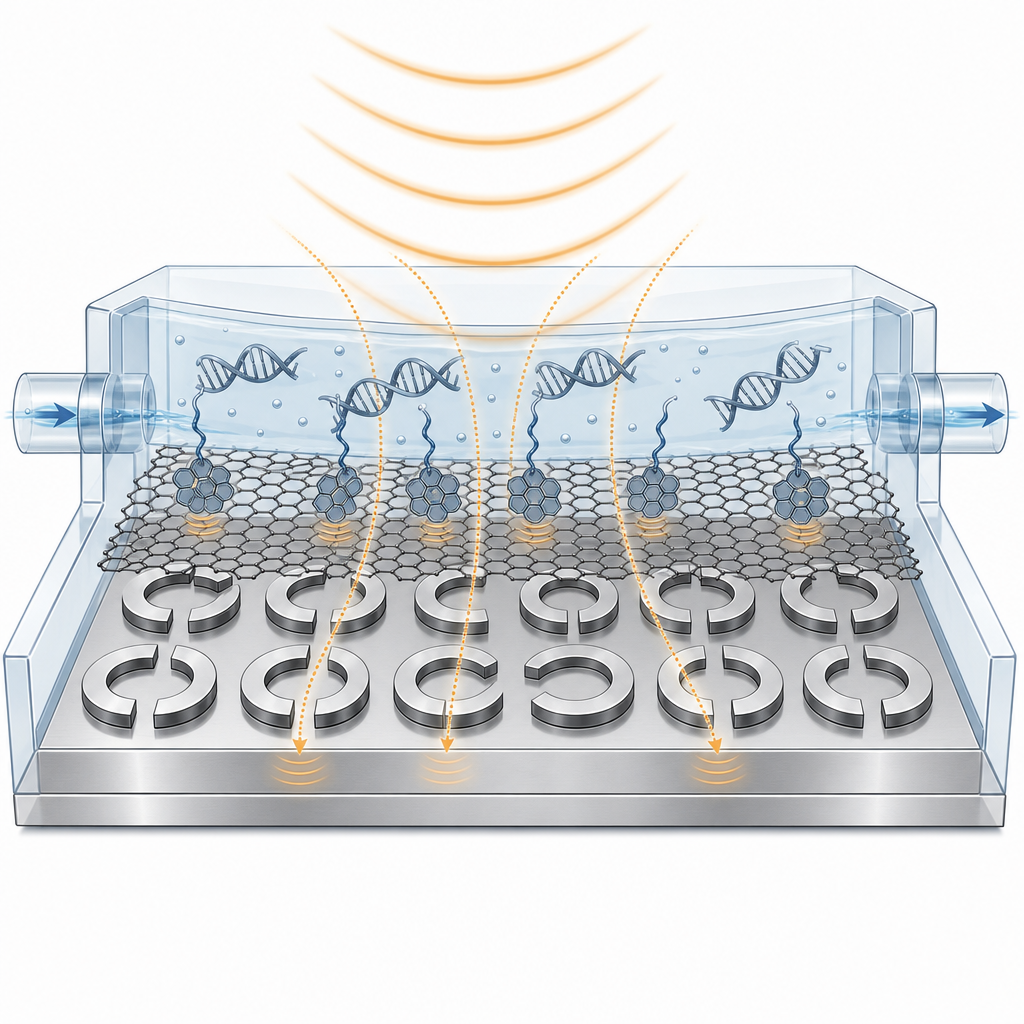
Key results quantify the performance gains from the hybrid design. FDTD simulations showed transmittance falling as the graphene Fermi level shifted from 0 to −100 meV: the 0.39 THz peak dropped from 89% to 13% and the 0.65 THz peak from 89% to 23%, far exceeding the weaker attenuation of plain SiO2-graphene (89% to 56% at 0.65 THz). Using doxycycline hydrochloride (DCH) as a model antibiotic, the CASR-graphene cell detected concentrations from 0.1 to 10,000 mg/L, with the resonance difference D-value rising from 0.09 to 0.23 and a successful detection at just 0.1 mg/L—better than prior THz microfluidic reports. Raman G-peak shifts from 1592.9 to 1582.4 cm⁻¹ across 0–20 mg/mL DCH confirmed charge-transfer doping of graphene as the sensing mechanism. For DNA biosensing, pyrene-modified aptamer probes immobilized on graphene via π–π stacking enabled selective recognition of the Eae gene of E. coli O157:H7 across 0.1–100 µM, verified by AFM height images (probe features 30–50 nm tall, hybridization regions 50–80 nm). The biosensor showed high selectivity against single-base-mismatched DNA and genes from S. enterica, L. monocytogenes, and V. parahemolyticus, with a 0–100 nM DNA signal RSD of 3.2% well above the 0.8% system noise. The cell also proved reusable after water rinsing.
This platform enables convenient, low-cost, label-free liquid-phase THz biosensing for food safety, pathogen screening, and biomedical diagnostics. The authors point to several extensions: optimizing array geometry for more confined electromagnetic fields, using dual-layer graphene to amplify chemical signal acquisition, and applying deep convolutional neural networks with frequency-band optimization to extract more informative THz features. They also note that alternative nanomaterials such as aligned carbon nanotube films and smart hydrogels could replace or complement graphene in future THz devices. Collectively the work advances the development of THz microfluidic lab-on-a-chip systems and offers a route to studying interfacial photoelectric behavior of 2D nanomaterials in liquid environments.
For researchers pursuing similar 2D-material THz sensors, transistors, or optoelectronic devices, the transferable CVD monolayer graphene used here—ACS Material's Trivial Transfer Graphene—is available through ACS Material's Trivial Transfer Series. The paper's verified Raman quality metrics and reproducible transfer onto a patterned metasurface illustrate that the film integrates cleanly into device fabrication, supporting its use as a functional active layer for sensitive, tunable THz biosensing applications.How ACS Material products were used
- Trivial Transfer® Graphene (Trivial Transfer Series) — “Monolayer graphene grown by CVD method (Trivial Transfer Graphene) was bought from ACS Material (Medford, MA, USA).”
Product Performance in this StudyThe CVD monolayer graphene was transferred onto the CASR metasurface to form the hybrid sensing layer. Raman analysis (I2D/IG > 2, single Lorentzian 2D peak) confirmed high-quality single-layer graphene, and its tunable THz photoconductivity drove the sensitivity enhancement enabling detection of 100 nM DNA.
Related product categories
Frequently asked questionsHow does graphene improve terahertz biosensor sensitivity?
Monolayer graphene exhibits a tunable Drude-like THz photoconductivity, so its Fermi level shifts when target molecules adsorb through non-covalent chemical doping. This shift changes the THz transmittance of the graphene-metasurface stack. In this study, transferring CVD graphene onto a CASR metasurface damped the 0.65 THz resonance from 61% to 19% and enabled detection of trace antibiotics and DNA that bare metasurfaces could not resolve.
What is CVD monolayer graphene used for in THz DNA detection?
In this work CVD monolayer graphene served as the active sensing layer of a microfluidic THz biosensor. Pyrene-modified aptamer probes attached to the graphene via π–π stacking, allowing selective recognition of E. coli O157:H7 DNA. Hybridization shifted the graphene Fermi level and altered THz transmission, enabling label-free detection of DNA across 0.1–100 µM and down to 100 nM.
Why is monolayer graphene quality important for THz sensing performance?
High-quality single-layer graphene provides large surface area, uniform conductivity, and a strong, predictable THz response. Raman analysis here confirmed quality with an I2D/IG ratio above 2 and a single Lorentzian 2D peak. Clean monolayer film ensured the metasurface resonance was strongly and reproducibly modulated, which is essential for reliable, reusable detection of trace biomolecules in liquid.