-
Trivial Transfer Graphene for Ultrafast Dynamics - Caltech, 2016
Jun 02, 2026 | ACS MATERIAL LLCHu, J. et al. (2016). Rippling ultrafast dynamics of suspended 2D monolayers, graphene. *Proceedings of the National Academy of Sciences*. https://doi.org/10.1073/pnas.1613818113
California Institute of Technology · Proceedings of the National Academy of Sciences · 2016
Caltech researchers used ACS Material's Trivial Transfer Graphene to reveal ultrafast rippling dynamics of suspended monolayer graphene with UEC and first-principles simulations.
About this research
Researchers at the California Institute of Technology used Trivial Transfer Graphene supplied by ACS Material LLC to directly observe rippling dynamics in suspended monolayer graphene, reporting an ultrafast 5 ps in-plane lattice expansion followed by a 50 ps thermal contraction driven by out-of-plane phonon modes. Published in the Proceedings of the National Academy of Sciences in 2016 by Hu, Vanacore, Cepellotti, Marzari, and Zewail, the study combines ultrafast electron crystallography (UEC) with first-principles Boltzmann transport simulations to quantitatively elucidate how femtosecond optical excitation modulates the intrinsic ripples that stabilize 2D crystals.
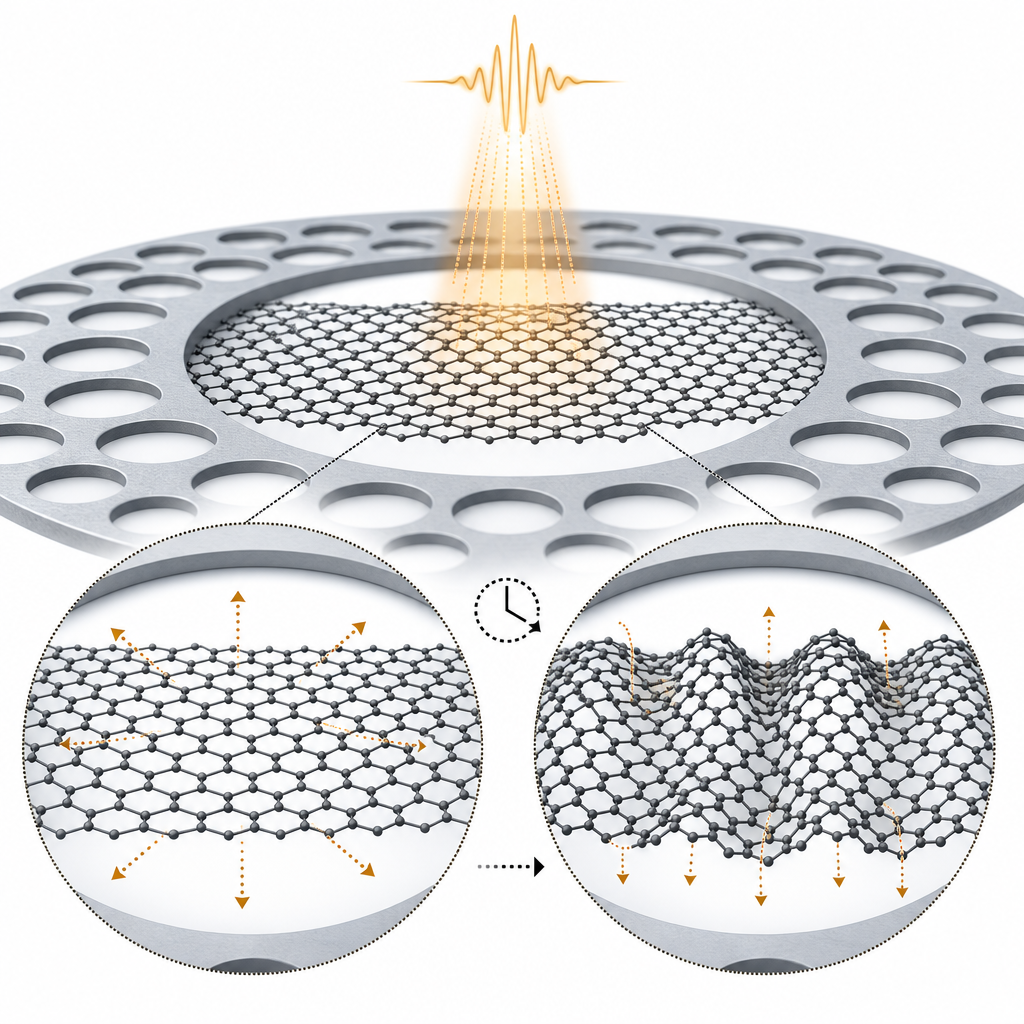
Ripples are widely recognized as an intrinsic feature of two-dimensional materials and are responsible for their structural stability, electron-hole charge redistribution, and electronic transport. Because ripples induce effective magnetic fields and modify local potentials, they limit carrier mobility: theoretical mobilities above 200,000 cm²/Vs are projected for a perfect 2D lattice, while experimental values for monolayer graphene at low temperature are an order of magnitude smaller. Controlling rippling in space and time is therefore a powerful route to tune transport, magnetoresistance, and chemical activity in graphene and other 2D systems. Static and quasi-static strain engineering had been demonstrated previously, but the real-time atomic-scale dynamics of ripple modulation under ultrafast optical excitation had not been resolved before this work.
The ACS Material Trivial Transfer Graphene product enabled the entire experiment. The authors describe placing a PMMA-coated CVD monolayer on the surface of a soluble polymer (Trivial Transfer Graphene, purchased from ACS Material LLC) and floating it off in deionized water, then collecting it on a 2000-mesh circular-aperture TEM grid with 6.5 μm holes. After drying at 50 °C and 100 °C to flatten wrinkles and improve adhesion, the PMMA was dissolved in acetone, rinsed with ethanol, and finally annealed at 400 °C under Ar/H₂ flow to minimize residue. The resulting suspended monolayer was verified by Raman spectroscopy and by the diffraction-intensity ratio of first- to second-order spots (~1 for monolayer). The authors directly compared their Trivial Transfer-derived sample with a commercial alternative and found the Trivial Transfer route yielded markedly lower PMMA contamination, which was essential for clean Bragg signatures in the 20 keV UEC measurements.
UEC was used to record diffraction patterns as a function of pump-probe delay following a 120 fs, 800 nm laser pulse at 2 kHz. The second-order Bragg-intensity transients followed single-exponential decay with characteristic times of 7–18 ps, decreasing with increasing fluence and consistent with the in-plane Debye-Waller factor at lattice temperatures up to 2,400 K, near the thermal stability limit of suspended CVD graphene. By extracting the Brillouin-zone area to bypass transient electric-field artifacts, the team isolated the strain dynamics of the unit cell. They observed a positive in-plane expansion peaking at ~5 ps, attributed to non-thermal longitudinal and transverse acoustic phonons that decay from optical phonons and stretch the lattice. This was followed by a 50 ± 10 ps contraction associated with the gradual population of out-of-plane ZA modes, whose strongly negative Grüneisen parameters drive graphene toward its known negative thermal expansion coefficient. First-principles density-functional perturbation theory in Quantum ESPRESSO, coupled with exact diagonalization of the three-phonon scattering matrix, reproduced both the Debye-Waller relaxation times within a factor of ~1.5 and the cross-over from positive to negative lattice pressure.
The ability to flatten and re-enhance ripples on picosecond time scales has direct implications for ultrafast photoelectronics. The authors estimate that at the maximum experimental expansion, the resistivity contribution from out-of-plane phonons drops by more than an order of magnitude in roughly 5 ps, suggesting a conceptual ultrafast optical switch in suspended graphene. Because ripples are ubiquitous in 2D crystals such as MoS₂, WS₂, and hexagonal boron nitride, the methodology is expected to transfer broadly to studies of TMDs, h-BN, and van der Waals heterostructures, with applications in flexible electronics, strain-engineered band-gap devices, and pseudo-magnetic field engineering.
For researchers reproducing this kind of suspended-2D experiment, sample cleanliness is the dominant variable: PMMA residue introduces strong background scattering that obscures Bragg dynamics. ACS Material's Trivial Transfer Graphene, used here as the starting material, is available for groups working on suspended graphene devices, ultrafast diffraction, TEM imaging, and 2D heterostructure assembly. The product's role in enabling a clean monolayer on a 2000-mesh TEM grid demonstrates its suitability for atomic-scale dynamic studies of fragile 2D systems.How ACS Material products were used
- Trivial Transfer® Graphene (Trivial Transfer Series) — “the sample was then placed on the surface of a soluble polymer (so-called "Trivial Transfer Graphene," purchased from ACS Material LLC).”
Product Performance in this Study
Trivial Transfer Graphene provided the suspended CVD monolayer graphene that served as the central sample in the ultrafast electron crystallography experiments. The transfer method allowed clean suspension of monolayer graphene on a 2000-mesh TEM grid with minimal PMMA residue, enabling reliable diffraction signals and rippling dynamics measurements.
Related product categories
Frequently asked questions
How was Trivial Transfer Graphene used to prepare suspended monolayer samples for ultrafast electron crystallography?
A PMMA layer was spin-coated onto a CVD monolayer, and the stack was floated off the soluble support polymer of Trivial Transfer Graphene in deionized water. The film was captured on a 2000-mesh TEM grid with 6.5 μm holes, baked at 50 °C and 100 °C to flatten wrinkles, soaked in acetone to remove PMMA, and annealed at 400 °C under Ar/H₂ to minimize residue.
What rippling dynamics does suspended graphene exhibit after femtosecond optical excitation?
Suspended monolayer graphene first undergoes a roughly 5 ps in-plane lattice expansion driven by non-thermal longitudinal and transverse acoustic phonons, which flattens intrinsic ripples. A slower 50 ps thermal contraction then follows as out-of-plane ZA phonon modes become populated, restoring and even enhancing the rippling because of graphene's strongly negative ZA-mode Grüneisen parameters.
Why is sample cleanliness important for ultrafast electron diffraction on suspended graphene?
PMMA and polymer residues scatter electrons and create background signal that obscures monolayer Bragg reflections. In this study, the Trivial Transfer Graphene route produced markedly cleaner suspended films than a commercial 2000-mesh alternative, allowing the researchers to resolve subtle picosecond changes in Bragg intensity and Brillouin-zone area required to extract Debye-Waller and strain dynamics.