-
Trivial Transfer Graphene Grids for CryoEM - WEHI, 2025
Jun 25, 2026 | ACS MATERIAL LLCPeriasamy, A. et al. (2025). Structure of an ex vivo Drosophila TOM complex determined by single-particle cryoEM. *IUCrJ*. https://doi.org/10.1107/s2052252524011011
IUCrJ · 2025
Researchers used ACS Material Trivial Transfer Graphene to coat cryoEM grids and solve a 3.3 A Drosophila TOM complex structure by single-particle cryoEM.
About this research
Researchers at The Walter and Eliza Hall Institute of Medical Research, in collaboration with the Max Planck Institute of Biophysics and the Australian National University, used ACS Material Trivial Transfer Graphene to coat cryoEM grids and determine a 3.3 A resolution single-particle cryoEM structure of the translocase of the outer membrane (TOM) complex purified ex vivo from Drosophila melanogaster. This is the first reported structure of a transgenic protein expressed and purified directly from Drosophila tissue. The graphene-coated grids increased particle density when only submilligram quantities of low-concentration membrane-protein sample were available. The resulting model contains transgenic Tom40 co-assembled with four endogenous subunits, Tom22, Tom5, Tom6 and Tom7, in a two-pore chevron architecture.
Mitochondrial precursor proteins are encoded in the nucleus, synthesized on cytoplasmic ribosomes, and imported through the TOM complex, the principal protein-import pore of the outer mitochondrial membrane. Understanding TOM structure is central to mitochondrial biology because the complex governs protein import, monitors mitochondrial health, and signals mitophagy. Recently identified pathological mutations in Tom40 and Tom7 link the complex to progeria, developmental disorders and Alzheimer's-related neuroinflammation. Most well resolved TOM structures came from human and fungal sources, leaving a gap for higher-eukaryote models that connect structure with genetics. Drosophila offers a genetically tractable multicellular organism in which expression can be targeted to specific tissues, allowing structure to be correlated directly with physiological function and disease phenotypes - a capability that immortalized cell lines, whose proteomes drift over time, cannot easily provide.
The graphene support played a defined role in specimen preparation. Following the protocol of D'Imprima et al. (2019), Quantifoil R1.2/1.3 grids were washed in chloroform and coated with a single layer of ACS Material Trivial Transfer Graphene by flotation. The grids were then heated to 150 C for 30 min to anneal the graphene layer, washed in acetone for 1 h to dissolve the protective PMMA layer, rinsed in 2-propanol, dried in a nitrogen stream and stored under vacuum. Just before vitrification, 0.5 CMC fluorinated fos-choline-8 was added to the sample, and 3 microlitres was applied to the copper side of each glow-discharged graphene-coated grid. Grids were blotted for 3 s at 100% humidity and 4 C and flash-frozen in a Vitrobot Mark IV. Because the protein concentration was low, the in-house graphene back-coating was specifically chosen to improve particle density on the grids. The authors note that interaction of the protein with the graphene support produced orientational bias - the flat faces of TOM became preferred orientations - so roughly half of the micrographs were collected at a 28-degree stage tilt to compensate for the resulting anisotropic resolution.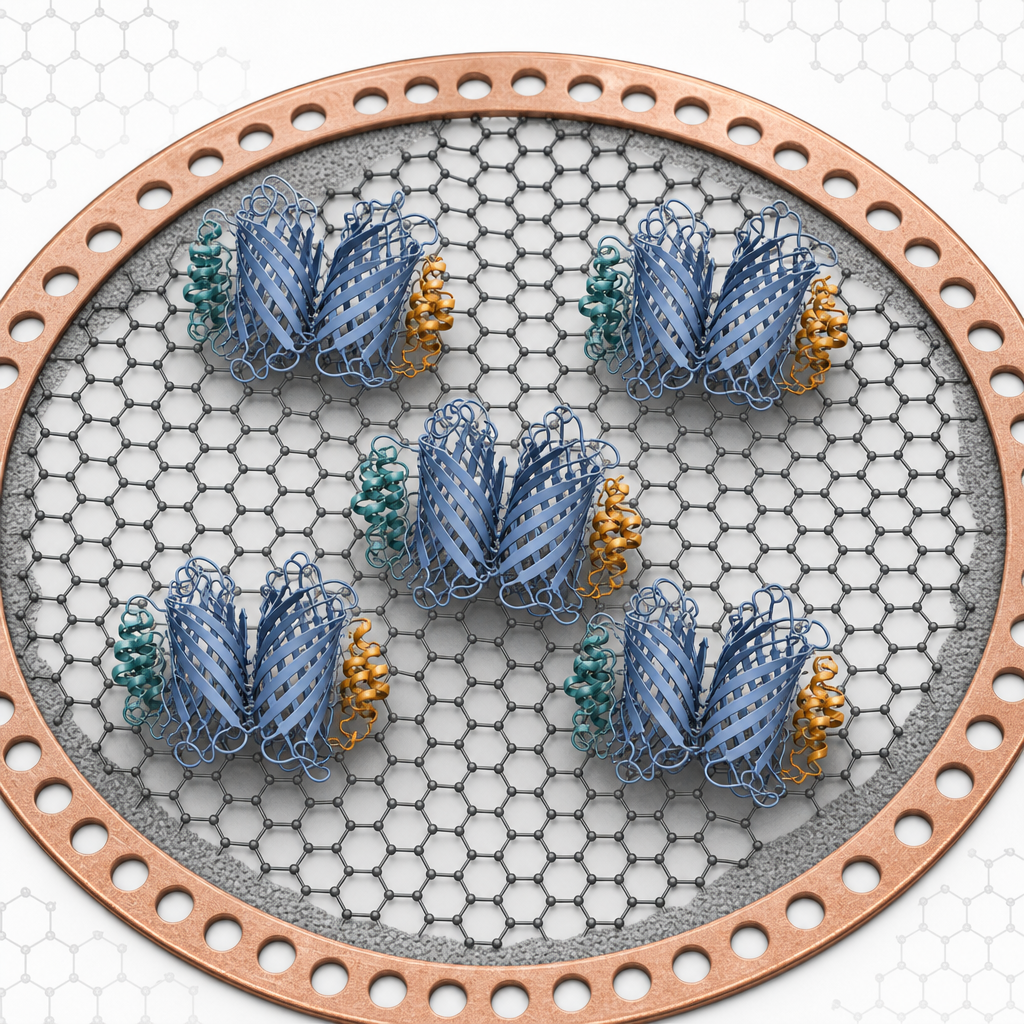
The structural campaign yielded substantial quantitative results. Approximately 20,000 flies provided 1 g of total membranes, with about 100 ml of flies needed per gram. Co-expression of the oncogenic transcription factor Myc under the GMR promoter raised transgenic Tom40 expression and suppressed photoreceptor apoptosis, increasing viable eye tissue. Tagged Tom40 assembled predominantly into a roughly 480 kDa band corresponding to the TOM complex. Four cryoEM data sets totaling 25,017 micrographs were recorded on a Titan Krios at 300 kV with a Gatan K3 camera, at 0.83 A pixel size and a total dose of 55 e/A2; 11,990 micrographs were taken at 28-degree tilt. Topaz picking yielded 2.2 million particles; 914,780 best particles were classified, and a final subset of 198,185 particles refined with C2 symmetry to 3.49 A, improved to 3.35 A by local refinement and 3.34 A after real-space refinement in Phenix. The Tom40 barrel comprises 19 antiparallel beta-strands, with two barrels inclined at about 20 degrees. The Drosophila Tom40 model showed an r.m.s.d. of 1.18 A over 236 C-alpha atoms relative to human Tom40, confirming close structural conservation, while local differences in lipid binding at the Tom6-Tom40 and Tom22-Tom40 interfaces reflect subtle evolutionary change.
This work enables a new route for structural biology: purifying intact membrane-protein complexes directly from a genetically engineered multicellular model organism. Because expression can be tissue-targeted and combined with genetic screens, imaging and lipidomics, researchers can correlate structure with disease phenotypes in vivo. The approach is well suited to studying quality-control pathways, cell death and neurodegeneration that are conserved between Drosophila and humans. The authors mapped four disease-associated mutations to the Tom40-Tom7 interface, providing a structural framework for interpreting progeria, developmental retardation and Alzheimer's-linked variants. They also detected co-purifying mitochondrial proteins such as Cox-II, hinting at the discovery of new mitochondrial assemblies through extraction from Drosophila membranes. As cryoEM advances allow structure determination from submilligram protein amounts, this expression strategy may broaden.
For researchers working on membrane proteins and cryoEM, this study illustrates the practical value of a single-layer graphene support for boosting particle density when sample is scarce. The Trivial Transfer Graphene used here is available from ACS Material to laboratories pursuing similar cryoEM specimen-preparation workflows. The paper is candid that graphene supports can induce preferred-orientation bias, which the team addressed with tilted data collection - useful guidance for anyone adopting graphene-coated grids for challenging low-concentration targets.How ACS Material products were used
- Trivial Transfer® Graphene (Trivial Transfer Series) — “Quantifoil R1.2/1.3 grids (Quantifoil Micro Tools) were washed in chloroform and coated with a single layer of trivial transfer graphene (ACS Materials) by flotation.”
Product Performance in this StudyThe trivial transfer graphene coating increased particle density on cryoEM grids at low sample concentrations, enabling structure determination, though protein interaction with the graphene support introduced orientational bias that required tilted data collection to resolve.
Related product categories
Frequently asked questionsWhy use graphene-coated grids for cryoEM of low-concentration membrane proteins?
Graphene support films increase particle density on cryoEM grids when only submilligram amounts of dilute protein are available. In this study, in-house graphene back-coated copper grids improved particle density for the ex vivo Drosophila TOM complex, which was present at low concentration, allowing single-particle data collection that would otherwise have lacked sufficient particles per micrograph.
How is Trivial Transfer Graphene applied to a cryoEM grid?
Quantifoil R1.2/1.3 grids are washed in chloroform and coated with a single layer of trivial transfer graphene by flotation. The grids are heated to 150 C for 30 min to anneal the graphene, washed in acetone for one hour to dissolve the protective PMMA layer, rinsed in 2-propanol, dried in a nitrogen stream, and stored under vacuum until use.
What is the drawback of graphene supports in single-particle cryoEM?
Graphene supports can cause preferred-orientation bias because the protein interacts with the graphene surface. For the Drosophila TOM complex, the flat faces became preferred orientations, producing anisotropic resolution. The authors compensated by collecting a large data set with roughly half the micrographs recorded at a 28-degree stage tilt to fill in missing orientations.