-
Trivial Transfer Graphene on Si3N4 Waveguides - INL Lyon, 2019
Jul 01, 2026 | ACS MATERIAL LLCDemongodin, P. et al. (2019). Ultrafast saturable absorption dynamics in hybrid graphene/Si3N4 waveguides. *APL Photonics*. https://doi.org/10.1063/1.5094523
Université de Lyon, Institut des Nanotechnologies de Lyon (INL) UMR 5270, École Centrale de Lyon 1 , 69134 Écully, France · APL Photonics · 2019
INL Lyon researchers used ACS Material Trivial Transfer graphene on Si3N4 waveguides to reveal ultrafast saturable absorption with a 150 fs carrier lifetime.
About this research
Researchers from Université de Lyon, Institut des Nanotechnologies de Lyon (INL) UMR 5270, École Centrale de Lyon used Trivial Transfer® graphene purchased from ACS Material to build hybrid graphene/Si3N4 waveguides and, in this 2019 APL Photonics study, demonstrated ultrafast saturable absorption with a phenomenological carrier lifetime of 150 fs. By probing peak powers spanning more than three orders of magnitude (0.6 W to 600 W coupled peak power) and pulse durations from 2 ps down to ~0.2 ps, the team isolated graphene's nonlinear absorption signature on a low-nonlinearity Si3N4 platform. The result is a quantitative, model-supported picture of how graphene saturable absorption can be engineered into integrated photonic circuits.
Graphene is a well-established saturable absorber that has powered passively mode-locked fiber lasers for over a decade, yet bringing this functionality onto chip-based platforms has remained challenging. Most prior demonstrations were conducted on silicon waveguides where the host material's own nonlinearities (two-photon absorption, Kerr self-phase modulation, free-carrier effects) obscure graphene's intrinsic response. Disentangling the saturable absorption signature from third-order refractive contributions is critical for designing integrated mode-locked lasers, photonic neural networks, and programmable nanophotonic processors. Silicon nitride, with its wide bandgap and absence of two-photon absorption at telecom wavelengths, offers a much cleaner platform for evaluating graphene's true nonlinear behavior, particularly its dynamics under sub-picosecond excitation, which had previously been underexplored.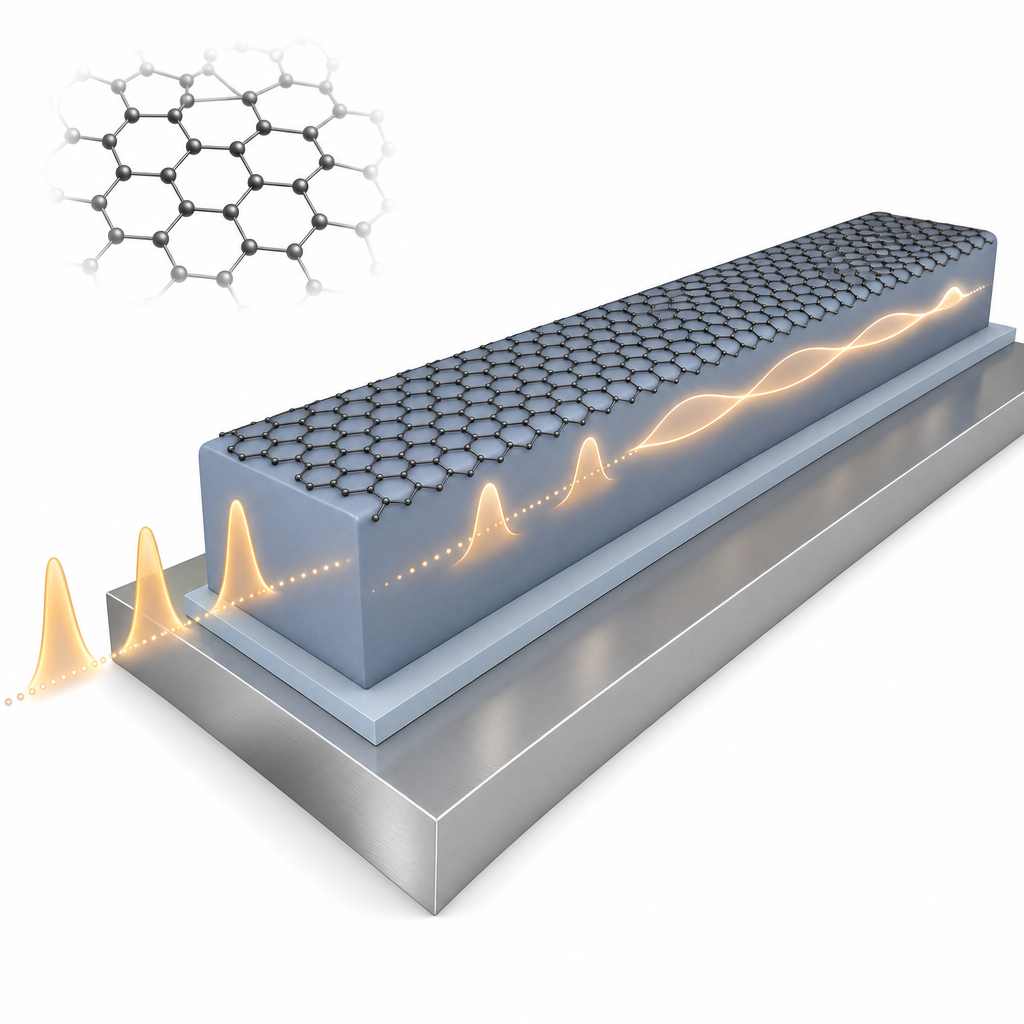
The Si3N4 waveguides (1.5 µm × 0.66 µm cross section, 2 cm long) were planarized using selective chemical-mechanical polishing so that the top surface was exposed flat in air with no remaining topography. This geometry both maximized evanescent coupling between the guided TE mode and the 2D layer and provided an ideal flat surface for mechanical graphene transfer. The team then transferred ACS Material's Trivial Transfer® graphene onto the chip, producing a series of waveguides covered with variable graphene interaction lengths of 0.5, 1.4, 2.3, and 3.2 mm, plus a graphene-free reference. Raman spectroscopy after transfer confirmed monolayer character through the AG/A2D intensity ratio, while the absence of a D peak attested to low defect density. Modal loss measurements across 1440–1640 nm yielded a Fermi level near −0.3 eV, corresponding to a p-doping of ~9 × 10¹² cm⁻², consistent with CVD graphene processed through this transfer route.
Linear characterization showed an average graphene-induced propagation loss of 126 dB/cm with an excellent linear fit (R² = 0.991), confirming homogeneous coverage at the millimeter scale. Under nonlinear excitation with 0.2 ps pulses at 1547 nm, normalized transmission rose by more than a factor of two as coupled pulse energy increased from 0.15 to 150 pJ (0.6–600 W peak power). The reference waveguide without graphene showed a flat response, unambiguously attributing the rise to graphene saturable absorption. The shortest waveguide (0.5 mm graphene) exhibited a roll-off above 100 pJ, attributed to a non-saturable absorption component, while waveguides with 1.4, 2.3, and 3.2 mm graphene gave nearly identical responses because the effective interaction length saturated near 0.345 mm. By varying the EDFA pump current to independently control pulse duration at fixed pulse energy, the authors observed that shorter pulses produced stronger transmission rise, signaling that the dynamics are governed by the temporal distribution of photons. Fitting a nonlinear Schrödinger model with carrier-density-dependent absorption yielded a saturation carrier density Nsat = 1.3 × 10¹⁶ m⁻², a non-saturable fraction of 60% (αNS = 75 dB/cm), and a phenomenological excited-carrier lifetime τc = 150 fs. Spectral broadening from third-order refractive nonlinearity was negligible, suggesting that saturable absorption and Kerr effects can be treated relatively independently in low-dispersion Si3N4 hybrid waveguides.
These findings have direct implications for chip-scale nonlinear photonics. The demonstrated saturable absorber could be exploited in fully integrated mode-locked lasers, all-optical signal regenerators, and pulse shapers built on the mature, low-loss Si3N4 platform. The extracted parameters, especially Nsat and τc, give designers an experimentally calibrated handle for predicting how graphene-covered waveguides will respond to short optical pulses in advanced photonic integrated circuits, including chip-based photonic neural networks and programmable nanophotonic processors. The clean separation between saturable absorption and nonlinear refraction also informs strategies to reduce non-saturable losses, for example by improving graphene quality, controlling edge defects, and mitigating thermal effects in millimeter-scale devices.
For researchers pursuing similar 2D-material/waveguide integration, the polymer-supported Trivial Transfer® graphene used in this study is available from ACS Material and is designed for clean transfer onto patterned photonic chips and arbitrary planar substrates. The paper itself confirms that the product yields monolayer coverage with low defect density (no Raman D peak) and homogeneous optical properties across millimeter-length devices, making it a practical choice for nonlinear photonics, optoelectronic modulators, and chip-scale saturable absorbers.How ACS Material products were used
- Trivial Transfer® Graphene (Trivial Transfer Series) — “Trivial transfer graphene, purchased from ACS Materials®, was transferred onto the chip.”
Product Performance in this StudyThe Trivial Transfer graphene was mechanically transferred onto planarized Si3N4 waveguides, where it formed the saturable absorbing layer. Raman characterization (AG/A2D ratio, absence of D peak) confirmed monolayer thickness and good quality, and linear loss measurements yielded a homogeneous propagation loss of 126 dB/cm, enabling a clean study of graphene's saturable absorption.
Related product categories
Frequently asked questionsHow does graphene act as a saturable absorber on Si3N4 waveguides?
When optical pulses propagate through a graphene-covered Si3N4 waveguide, photons populate the conduction band of graphene at the Dirac cone. Once the upper band fills, Pauli blocking forbids further interband absorption, so transmission rises with increasing pulse energy. In this study, transmission more than doubled as coupled peak power rose toward 600 W, with a saturation carrier density of 1.3 × 10¹⁶ m⁻².
Why use Si3N4 instead of silicon to study graphene's nonlinear response?
Silicon exhibits strong two-photon absorption and Kerr self-phase modulation at telecom wavelengths, which mask graphene's intrinsic nonlinear signature. Si3N4 has a wider bandgap, no two-photon absorption at 1547 nm, and a relatively weak Kerr response. This makes it a cleaner platform on which the saturable absorption and refractive contributions of graphene can be measured and modeled unambiguously across a wide range of peak powers.
What is the carrier relaxation time of graphene on a Si3N4 waveguide?
Fitting nonlinear Schrödinger simulations to the measured transmission as a function of pulse duration yielded a phenomenological excited-carrier lifetime of 150 fs. This timescale captures both intraband and interband relaxation processes that empty the upper Dirac band after photoexcitation. It explains why shorter sub-picosecond pulses produced stronger saturable absorption at the same pulse energy, since photons arrive faster than carriers can recombine.