-
Trivial Transfer Graphene on ZnO for Co Catalysis - University of Strasbourg, 2014
Jul 01, 2026 | ACS MATERIAL LLCLuo, W. et al. (2014). Single-Layer Graphene as an Effective Mediator of the Metal–Support Interaction. *The Journal of Physical Chemistry Letters*. https://doi.org/10.1021/jz500425j
University of Strasbourg · The Journal of Physical Chemistry Letters · 2014
University of Strasbourg researchers used ACS Material Trivial Transfer Graphene as an ultrathin interlayer on ZnO(0001) to control cobalt-support interactions.
About this research
Researchers at the University of Strasbourg, together with collaborators at the University of Maria Curie-Sklodowska, used ACS Material Trivial Transfer Graphene to demonstrate that a single layer of CVD-grown graphene can act as an effective mediator of the metal-support interaction between cobalt and a ZnO(0001) single crystal. The paper, published in The Journal of Physical Chemistry Letters in 2014, shows that the graphene interlayer suppresses cobalt oxidation by the reactive oxide and changes Co morphology from flat, easily oxidized particles into highly dispersed nanoparticles. This reframes graphene not just as a support or a corrosion barrier, but as a transparent, electron-conductive promoter that can decouple bulk and surface properties of an oxide support.
Metal-oxide interfaces are central to microelectronics, photovoltaics, gas sensors, and heterogeneous catalysis. Reactive supports like ZnO and TiO2 strongly influence the electronic state and morphology of supported metals, which is desirable for some functions but problematic for others. In cobalt-catalyzed Fischer-Tropsch synthesis and glycerol carbonylation, for example, strong Co-support interaction drives formation of mixed cobalt-support oxides that are difficult to reduce and cause irreversible deactivation. Bulk and surface support properties are usually coupled, so tuning interfacial chemistry without modifying bulk transport, optical absorption, or mechanical stability is challenging. The authors address this gap by inserting an atomically thin graphene layer between the active metal and the oxide.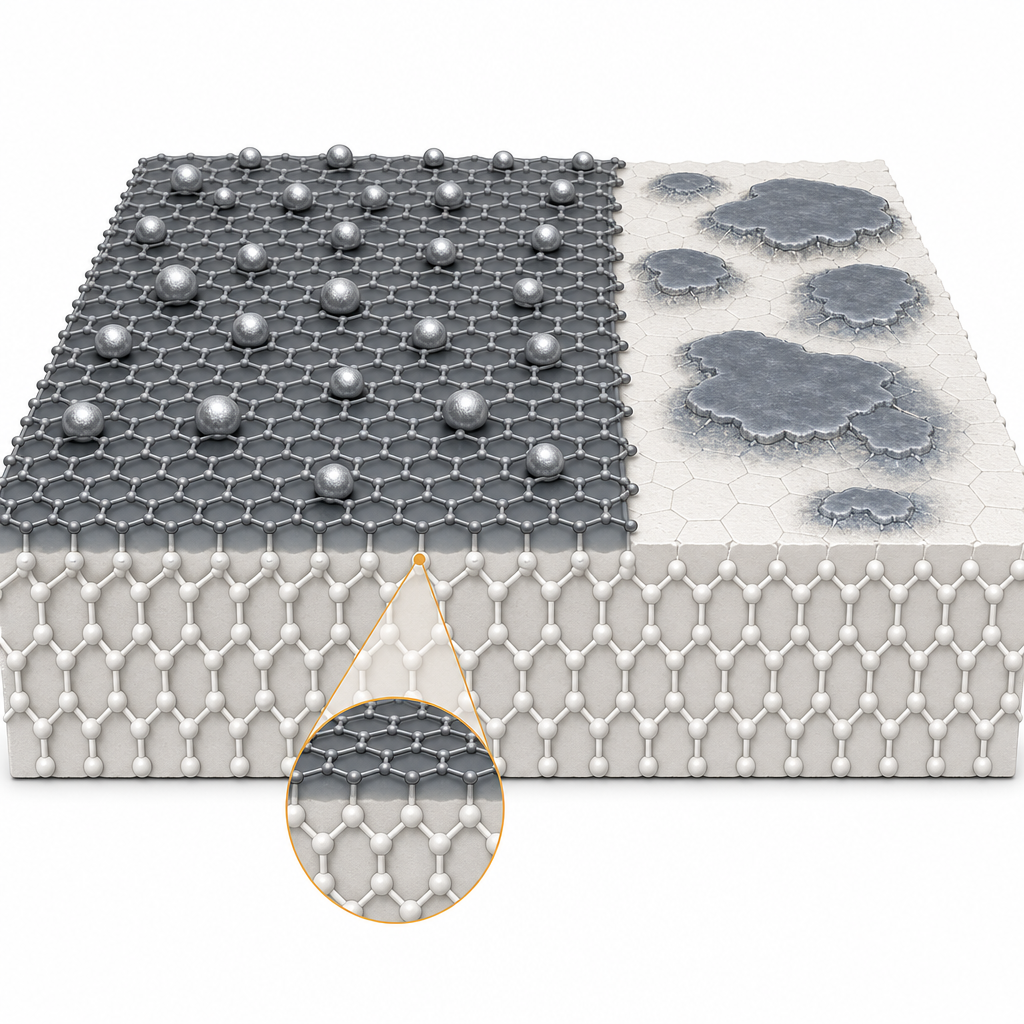
The ACS Material product used was Trivial Transfer Graphene: CVD-grown single-layer graphene supported on a 0.5 µm poly(methyl methacrylate) handle, supplied as 1 × 1 cm² coupons. The Methods section states verbatim that "CVD-grown single-layer graphene (Trivial Transfer Graphene, 1 × 1 cm2, ACS material) was transferred onto the UHV-cleaned ZnO (0001) single crystal in atmosphere based on a slightly modified procedure previously reported by Suk et al." After transfer, residual PMMA was removed by UHV annealing at 350 °C for 1 hour, with cleanliness verified by XPS and Raman. The graphene-coated ZnO and a bare ZnO reference were then loaded into UHV chambers, where cobalt was deposited by e-beam evaporation. Raman spectroscopy, XPS, HREELS, AFM, and optical microscopy were used to track the graphene quality, Co oxidation state, and Co particle morphology before and after annealing.
The Trivial Transfer Graphene retained continuity over millimeter-scale areas with low defect density after transfer, as confirmed by Raman ID/IG ratios and optical microscopy. On bare ZnO(0001), deposited cobalt formed flat particles that strongly interacted with the substrate, became readily oxidized, and redispersed upon UHV annealing. In contrast, on graphene-coated ZnO the same cobalt deposition produced highly dispersed nanoparticles that resisted oxidation but were prone to surface diffusion and agglomeration during annealing. XPS showed that the C 1s binding energy did not shift detectably upon Co deposition, consistent with limited charge transfer expected for a metal of work function near 5 eV, and consistent with the graphene remaining largely intact electronically. Raman confirmed a slight increase in graphene strain upon annealing and p-type doping from Co, while keeping defect density low. The graphene layer was remarkably stable under Co deposition and vacuum annealing. However, repeated ethanol exposure/desorption cycles produced a clear rise in the Raman ID/IG ratio, broadening of the D and G bands, and fragmentation of the continuous film into 5-20 µm flakes, showing that reactive gases can introduce defects at graphene edges.
These results are directly relevant to designing more stable supported metal catalysts, including Co-based Fischer-Tropsch and glycerol carbonylation catalysts, where mixed Co-support oxide formation drives deactivation. The same idea extends to Co/graphene and graphene/ZnO composites being explored for optoelectronics, photocatalysis, and electrochemical devices, where independent control of bulk transport and interfacial chemistry is valuable. The authors note that for industrial use, more scalable graphene-on-oxide preparation routes, such as graphene oxide precursors, and improved graphene stability under reactive atmospheres will be needed. The work motivates further studies of graphene interlayers on other reactive oxide supports such as TiO2 and CeO2.
For researchers working on 2D-material-mediated interfaces, the study illustrates the practical value of having a clean, transferable, large-area CVD graphene source. ACS Material's Trivial Transfer Graphene is available to groups exploring metal-support interactions, corrosion barriers, and 2D heterostructures on arbitrary substrates. The product enabled the work without becoming the headline claim, which is the appropriate role for a high-quality starting material: reliable enough to let the science emerge clearly.How ACS Material products were used
- Trivial Transfer® Graphene (Trivial Transfer Series) — “CVD-grown single-layer graphene (Trivial Transfer Graphene, 1 × 1 cm2, ACS material) was transferred onto the UHV-cleaned ZnO (0001) single crystal”
Product Performance in this StudyThe Trivial Transfer Graphene formed a large-area, low-defect-density interlayer on ZnO(0001) that successfully mediated the metal-support interaction between cobalt and the oxide. It prevented cobalt oxidation by ZnO and altered Co morphology to highly dispersed nanoparticles, while itself remaining stable through Co deposition and UHV annealing.
Related product categories
Frequently asked questionsHow does a graphene interlayer change cobalt deposition on ZnO?
Without graphene, cobalt deposited on ZnO(0001) forms flat particles that strongly interact with the substrate, oxidize easily, and redisperse during ultrahigh vacuum annealing. With a single layer of CVD graphene between Co and ZnO, the same deposition produces highly dispersed nanoparticles that resist oxidation. The graphene blocks direct chemical contact between Co and the reactive oxide while still allowing thermal and electronic coupling.
Why use Trivial Transfer Graphene for metal-support interaction studies?
Trivial Transfer Graphene supplies CVD-grown single-layer graphene already mounted on a PMMA handle, allowing transfer onto arbitrary substrates such as ZnO single crystals. The transferred film is continuous over millimeter-scale areas with low defect density after PMMA removal. This makes it well suited to model studies of metal-oxide interfaces where a clean, large-area, atomically thin spacer is needed between the metal and the support.
Is single-layer graphene stable under cobalt deposition and vacuum annealing?
Yes. Raman and XPS measurements showed that the single-layer graphene layer on ZnO retained low defect density during cobalt e-beam deposition and UHV annealing, with only a small strain increase and p-type doping. However, repeated ethanol exposure and desorption cycles introduced defects, fragmenting the continuous film into 5-20 micrometer flakes, indicating that reactive gases can compromise graphene stability.