-
Trivial Transfer Graphene Resonators - NUDT, 2024
Jul 08, 2026 | ACS MATERIAL LLCZheng, X. et al. (2024). Research on Fabrication of Phononic Crystal Soft-Supported Graphene Resonator. *Nanomaterials*. https://doi.org/10.3390/nano14020130
National University of Defense Technology · Nanomaterials · 2024
Researchers at the National University of Defense Technology fabricated phononic crystal soft-supported graphene resonators using Trivial Transfer Graphene to suppress energy dissipation.
About this research
Researchers at the National University of Defense Technology fabricated phononic crystal soft-supported graphene resonators using Trivial Transfer Graphene (TTG) and demonstrated a practical route to suppress phonon tunneling losses by localizing vibration energy within a central defect region. The work translates a previously published dissipation dilution theoretical model into a real fabrication process, addressing the persistent challenge of low quality factors in graphene nanomechanical resonators at room temperature. The team produced single-layer suspended graphene resonators carrying triangular-lattice phononic crystal patterns of one to ten cycles and a range of pore sizes, then designed a Fabry–Pérot optical excitation and detection platform to characterize them. The study foregrounds the fabrication difficulties — fracture, deformation and low yield — and systematically optimizes each step.
Graphene nanomechanical resonators are attractive sensitive elements for aviation and aerospace sensing because their single-atom thickness gives extremely high mass and force sensitivity, wide frequency response, fast response, low power consumption and good biocompatibility. They are promising for low-voltage measurement, molecular and atomic mass detection, and biosensing. However, the quality factor of graphene resonators at room temperature is generally low, which limits performance and broader adoption. The dominant energy loss mechanism is phonon tunneling (anchoring) loss at the fixed support boundary, where shear forces and bending moments radiate elastic waves into the substrate. While dissipation dilution and soft clamping have raised quality factors of silicon nitride resonators dramatically, applying these concepts to atomically thin graphene requires new fabrication strategies. Phononic crystal structures offer a phonon bandgap that exponentially suppresses elastic-wave propagation, providing a direct way to confine vibration energy and reduce anchoring loss.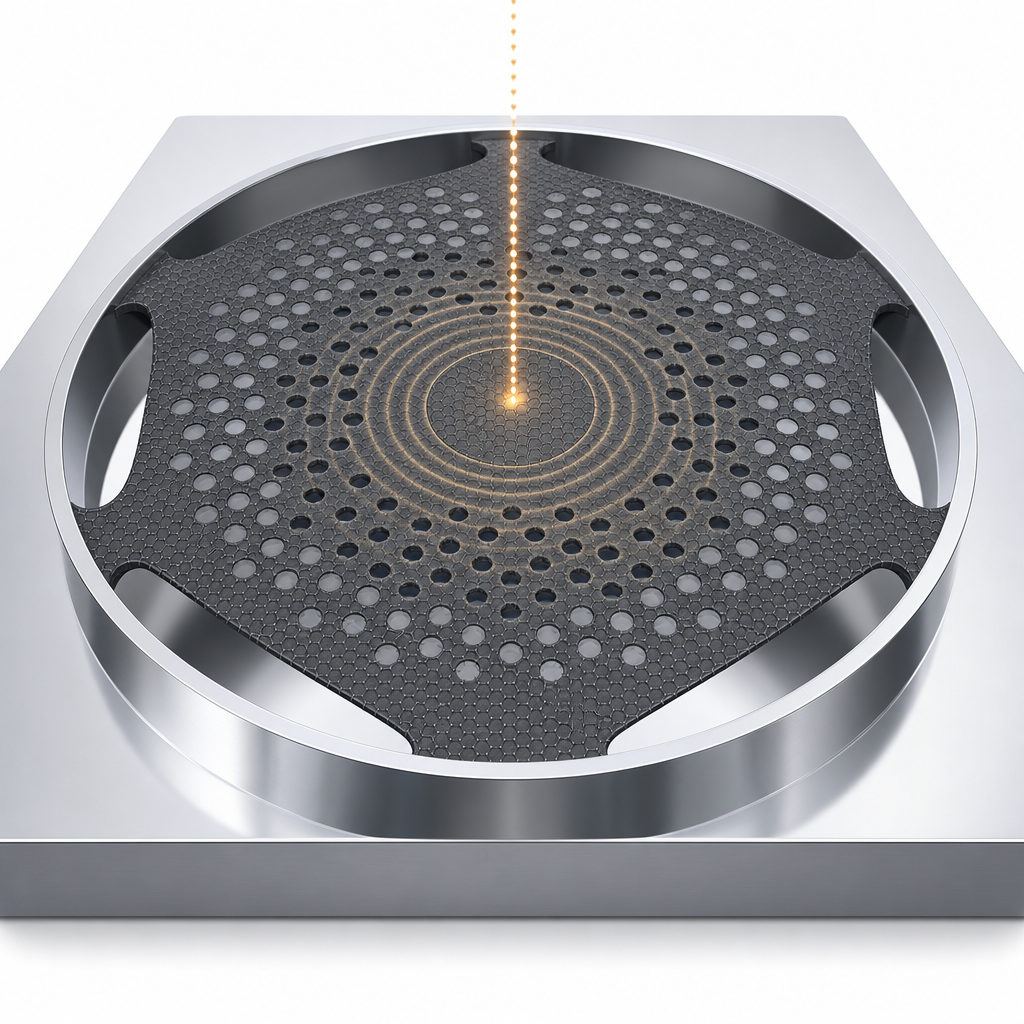
Trivial Transfer Graphene was central to the fabrication workflow. The authors chose TTG specifically because, compared with traditional CVD copper-based graphene, it eliminates PMMA spin-coating and copper-etching steps, reduces the number of operating steps, reduces graphene wrinkles, and avoids inorganic residue from copper etching. In the process flow, TTG was released into deionized water, allowed to stand for two hours, and wet-transferred onto a perforated silicon substrate (300 µm thick) that had been patterned by UV lithography and deep reactive plasma etching to create suspension cavities. The graphene was then dried through a gradual step-by-step heating schedule (50–100 °C for 5 min each, then 150 °C for 10 min) to remove moisture and let the PMMA layer melt and flatten, reducing wrinkles. PMMA was subsequently removed by a back float method and by high-temperature vacuum annealing to suspend the graphene, after which focused ion beam (FEI Scios Dual Beam, Ga ion) etching carved the phononic crystal patterns into the suspended membrane.
The key results center on yield optimization across the workflow. Using the back float method, several 6–8-layer graphene sheets were suspended over 60 µm holes and more than ten over 50 µm holes. The high-temperature annealing route (optimized at 12 °C/min heating, 500 °C, 20 min) gave clear pore-size-dependent success: 0% at 300 µm, 8.3% at 200 µm, 16.7% at 150 µm, 40.7% at 100 µm, 68.8% at 80 µm, 72% at 60 µm, 89.8% at 50 µm, 91.2% at 40 µm, 93.2% at 30 µm and 95–99% at 5–20 µm. Simulations showed the edge normalized curvature of graphene exceeds its interior by three orders of magnitude (versus one order for silicon nitride), confirming concentrated boundary dissipation. FIB etching succeeded only after reducing the membrane to a single layer; the optimal parameters were 30 kV beam voltage, 10 pA beam current, 20,000× magnification and three etching cycles. Single-layer graphene from the back float method etched more cleanly than annealed graphene, which carried higher stress and surface contamination. Finite element modeling of a six-cycle, 2.5 µm pore-size resonator showed that as laser spot radius decreases and power increases (1–10 mW, 0.1–2.5 µm), both the central temperature (up to ~470 K) and fundamental frequency rise, with the f–r0 curve more nonlinear than f–P.
This research enables higher-quality-factor graphene nanomechanical resonators for ultrasensitive mass and force sensing, pressure sensing, and resonant sensors in aviation and aerospace, as well as humidity and biosensing applications. The demonstrated phononic-crystal soft-clamping approach, previously realized only on thicker silicon nitride, is now shown to be fabricable on atomically thin graphene. The authors point to several follow-up directions: using lighter H ions instead of Ga ions for cleaner etching of thin graphene, adopting critical point drying to raise the PMMA-removal yield, building a physical optical excitation and detection platform, and conducting experimental verification that the phononic crystal soft support measurably raises the quality factor.
For researchers working on suspended 2D-material devices, this paper illustrates why a clean, transfer-ready graphene source matters: Trivial Transfer Graphene reduced wrinkles and contamination and removed the copper-etch step, improving membrane integrity through delicate suspension and FIB steps. Trivial Transfer® Graphene is available from ACS Material for groups fabricating nanomechanical resonators, suspended membranes, and other devices that demand low-residue, easily transferable graphene films.How ACS Material products were used
- Trivial Transfer® Graphene (Trivial Transfer Series) — “The graphene selected in this article is one-step transfer graphene (Trivial Transfer Graphene, TTG) 9. Compared with traditional CVD copper-based graphene, this product eliminates the steps of spin-coating PMMA and etching copper, reduces the operating steps, reduces the number of graphene wrinkles, and avoids the problem of inorganic residue in the copper-etching step.”
Product Performance in this StudyTrivial Transfer Graphene served as the suspended resonator membrane, simplifying fabrication by removing PMMA spin-coating and copper-etching steps and reducing wrinkles and inorganic residue. It was successfully suspended and FIB-etched into phononic crystal resonators.
Related product categories
Frequently asked questionsWhy was Trivial Transfer Graphene chosen instead of CVD copper-based graphene for resonator fabrication?
Trivial Transfer Graphene (TTG) was selected because it eliminates the PMMA spin-coating and copper-etching steps required for traditional CVD copper-based graphene. This reduces the number of operating steps, lowers the number of graphene wrinkles, and avoids inorganic residue left behind by the copper-etching process, all of which help preserve membrane integrity during suspension and focused ion beam etching.
How does pore size affect the suspension success rate of graphene membranes?
Smaller pore sizes give much higher suspension success rates. Using high-temperature annealing on 6–8-layer graphene, success was 0% at 300 µm, rising to 40.7% at 100 µm, 89.8% at 50 µm, 93.2% at 30 µm, and 95–99% at 5–20 µm. Smaller holes reduce the unsupported membrane area, lowering the chance of fracture during the release process.
What focused ion beam parameters work best for etching single-layer suspended graphene?
For single-layer suspended graphene, the optimal FIB parameters were a 30 kV ion beam voltage, 10 pA beam current, 20,000x magnification, and three etching cycles. These represent the minimum current and voltage settable on the FEI Scios Dual Beam instrument. More than three cycles caused central holes to over-expand and tore the film, so three cycles balanced pattern completion with membrane survival.