-
V2O5 Nanosheet/RGO Cathode for Li-Ion Batteries - CAEP, 2013
Jun 05, 2026 | ACS MATERIAL LLCCheng, J. et al. (2013). Self-Assembled V2O5 nanosheets/Reduced graphene oxide hierarchical nanocomposite as a high-Performance cathode material for lithium ion batteries. *Journal of Materials Chemistry A*. https://doi.org/10.1039/c3ta12066j
Journal of Materials Chemistry A · 2013
Researchers at China Academy of Engineering Physics used ACS Material single-layer graphene oxide to build a V2O5/RGO cathode delivering 138 mAh/g at 10C.
About this research
Researchers at the China Academy of Engineering Physics, working with collaborators at Lawrence Berkeley National Laboratory, used single-layer graphene oxide purchased from ACS Material LLC to synthesize a self-assembled V2O5 nanosheets/reduced graphene oxide (RGO) hierarchical nanocomposite that performs as a high-rate cathode material for lithium-ion batteries. Published in Journal of Materials Chemistry A in 2013, the work shows that a simple one-pot solvothermal route can decorate RGO sheets with V2O5 nanosheets, yielding an electrode that delivers 138 mAh/g at 10C, 76 mAh/g at 50C, and retains 102 mAh/g after 160 cycles at 2C. The hierarchical 3-D architecture combines high surface area with continuous electronic and ionic pathways.
Lithium-ion batteries underpin modern portable electronics and are central to electric and hybrid electric vehicles, yet their wider deployment is limited by the energy and power density of available cathodes. V2O5 is attractive because it offers a theoretical capacity of about 294 mAh/g for two-lithium intercalation, roughly double that of LiCoO2, LiMn2O4 and LiFePO4, and it is abundant and cheap. In practice, however, V2O5 suffers from a low Li+ diffusion coefficient (10^-12 to 10^-13 cm^2/s), irreversible phase transitions on deep discharge and vanadium dissolution into the electrolyte. Nanostructuring shortens diffusion paths but introduces poor mechanical stability and inadequate electrical conductivity. Coupling nanostructured V2O5 with a conductive 2-D carbon scaffold is therefore one of the most direct strategies for improving rate capability and cycle life simultaneously.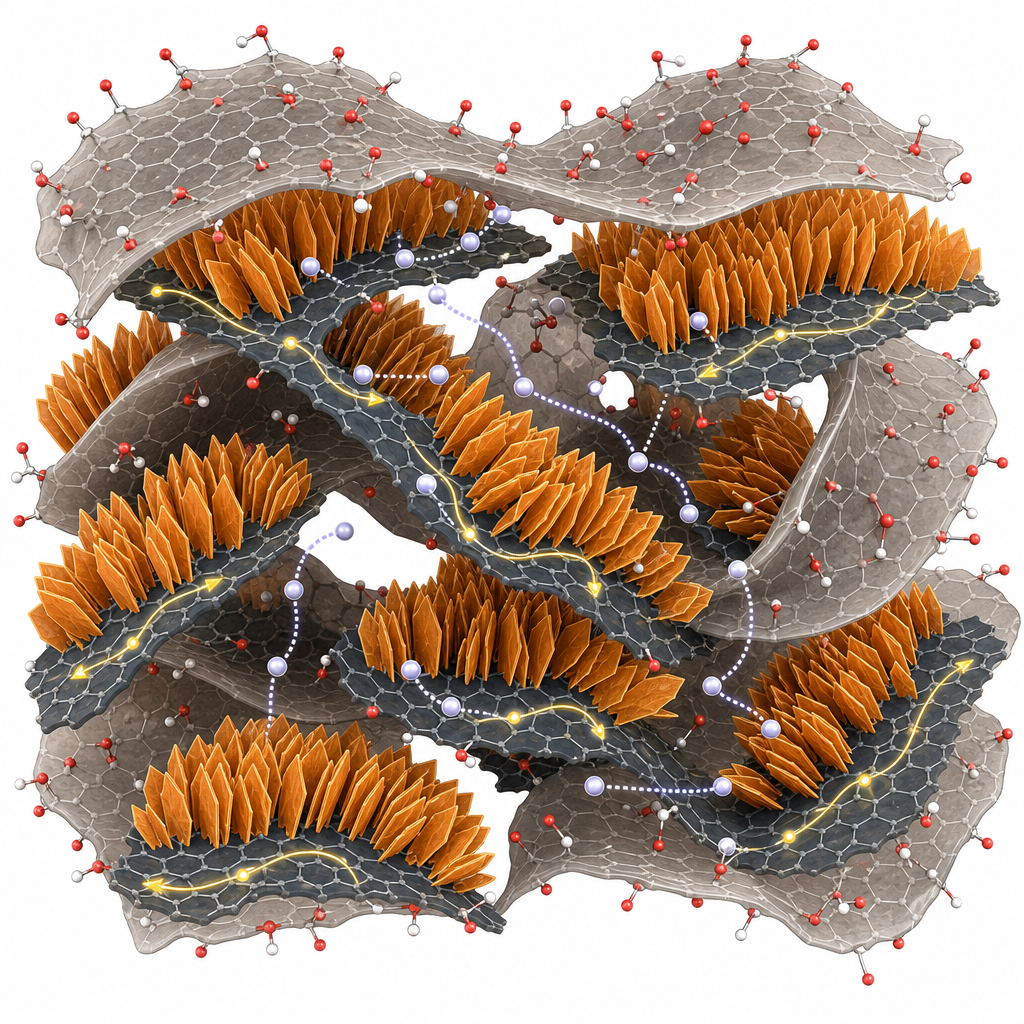
The ACS Material single-layer graphene oxide was central to the synthesis. As described in the Experimental section, the authors dispersed 18 mg of the GO sheets in 15 mL of 95% denatured ethanol by ultrasonication for 30 minutes, then added 1 mL of vanadium oxytriisopropoxide. After 10 minutes of stirring, the mixture was sealed in a 15 mL Teflon-lined stainless steel autoclave and heated at 180 C for 36 hours. Vacuum filtration, ethanol/water washing, drying at 80 C and annealing at 300 C in air partly reduced the GO to RGO and crystallized the V2O5 phase. The single-layer character and uniform dispersibility of the ACS Material GO were important because they allowed individual sheets to act as nucleation templates: V2O5 nanosheets grew directly on the basal planes and self-assembled into the 3-D hierarchical structure shown in the paper's Scheme 1. The product was characterized by XRD (PANalytical Xpert Pro), FE-SEM (JEOL 7500), HR-TEM (JEOL 2100F), TGA, BET (Micromeritics ASAP2020), Hall effect measurement and Raman spectroscopy.
Electrochemical testing used CR2032 coin cells with an 8:1:1 active material:acetylene black:PVDF electrode on aluminum foil, 1 M LiPF6 in EC/DMC (1:2) electrolyte, and Li-metal counter/reference electrodes. Cells were cycled between 2.0 and 4.0 V at room temperature. At a moderate rate of 2C, the V2O5 nanosheets/RGO composite delivered a stable discharge capacity of 102 mAh/g after 160 cycles, demonstrating good cycling stability that bulk V2O5 cannot match. Rate testing showed discharge capacities of approximately 138 mAh/g at 3000 mA/g (10C), 112 mAh/g at 6000 mA/g (20C), and 76 mAh/g at 15 A/g (50C). The ability to sustain useful capacity at a 50C rate is uncommon for V2O5 cathodes and is a direct result of the RGO scaffold providing continuous electronic percolation and the V2O5 nanosheet thickness limiting solid-state Li+ diffusion lengths. The authors attribute the gains to enhanced electron transport and Li+ diffusion enabled by the hierarchical architecture, with the conductive RGO network also acting as a mechanical buffer against repeated lithiation-induced strain.
The results are relevant to high-power lithium-ion applications, including electric and hybrid electric vehicle traction batteries, grid-scale energy storage, and pulse-power devices, where both energy density and the ability to accept and deliver charge quickly matter. The synthesis itself is generalizable: solvothermal growth of transition-metal oxides on single-layer GO is now a common route to high-rate electrodes for sodium-ion, zinc-ion and supercapacitor systems, and the same approach can be extended to MnO2, MoO3 or Fe2O3 nanostructures on RGO. Future work pointed to in the literature targets thicker electrodes, binder-free films and pairing such cathodes with engineered anodes to maintain rate performance at the full-cell level.
For researchers building 2-D-carbon-supported electrode materials, the consistency and dispersibility of the starting graphene oxide directly affect nanosheet nucleation, composite uniformity and final electrochemical performance. The single-layer graphene oxide used in this study is available from ACS Material in the Graphene Series, alongside related products such as carboxylated and aminated graphene oxide, reduced graphene oxide and graphene oxide dispersions. The product fulfilled its role as a high-surface-area conductive scaffold; the rate and cycling figures reported here reflect both the V2O5 nanostructure and the quality of the GO support.How ACS Material products were used
- Single Layer Graphene Oxide (from ACS Material LLC) (Graphene Series) — “Single-layered graphene oxide (GO) was purchased from ACS Material LLC.”
Product Performance in this Study
The single-layer GO from ACS Material was solvothermally reduced and used as the conductive 2-D scaffold on which V2O5 nanosheets self-assembled. The resulting RGO support delivered the electron transport pathway and mechanical framework that underpinned the composite's high rate capability and cycling stability.
Related product categories
Frequently asked questions
How does reduced graphene oxide improve V2O5 cathode performance in lithium-ion batteries?
Reduced graphene oxide provides a two-dimensional conductive scaffold with electronic conductivity around 10^3–10^4 S/m and a theoretical surface area of 2630 m^2/g. When V2O5 nanosheets grow on RGO, the network supplies continuous electron transport, anchors nanosheets to limit aggregation, buffers volume changes during lithiation, and shortens Li+ diffusion paths, which together raise rate capability and cycling stability.
What discharge capacity does a V2O5 nanosheet/RGO composite deliver at high C-rates?
In this study the V2O5 nanosheets/RGO composite delivered approximately 138 mAh/g at 10C (3000 mA/g), 112 mAh/g at 20C (6000 mA/g) and 76 mAh/g at 50C (15 A/g). At a moderate 2C rate the electrode retained 102 mAh/g after 160 cycles, showing that the hierarchical structure supports both high-power operation and good cycling stability.
Why is single-layer graphene oxide preferred over multilayer GO for solvothermal synthesis of metal-oxide composites?
Single-layer graphene oxide disperses uniformly in polar solvents such as ethanol, exposing the maximum basal-plane area for heterogeneous nucleation. Metal-oxide precursors can adsorb on every sheet, leading to denser and more uniform decoration after solvothermal treatment. Multilayer GO restacks and shields interior sheets, producing irregular coverage and lower effective surface area in the final composite.