-
ACS Material H-ZSM-5 for Bio-Jet Pyrolysis - University of Florence, 2016
Jun 30, 2026 | ACS MATERIAL LLCChiaramonti, D. et al. (2016). Bio-Hydrocarbons through catalytic pyrolysis of used cooking oils and fatty acids for sustainable jet and road fuel production. *Biomass and Bioenergy*. https://doi.org/10.1016/j.biombioe.2016.05.035
Biomass and Bioenergy · 2016
University of Florence researchers used ACS Material H-ZSM-5 zeolite to catalytically pyrolyze used cooking oil into bio-hydrocarbons for jet and road fuels.
About this research
Researchers at the University of Florence (RE-CORD and CREAR, Industrial Engineering Department) report a pilot-scale study in which ACS Material H-ZSM-5 zeolite was one of four catalysts screened for the catalytic pyrolysis of used cooking oil (UCO) and pure fatty acids (FAs) into bio-hydrocarbons for sustainable jet and road fuels. Operating a 1.5 kg h⁻¹ continuous pyrolysis pilot at 500 °C and atmospheric pressure, the team compared activated carbons, alumina, magnesium oxide and the strongly acidic ACS Material H-ZSM-5 zeolite. The work, published in Biomass and Bioenergy (2016), provides quantitative yield and product-quality data that benchmark how each catalyst class steers the deoxygenation of triglycerides and free fatty acids toward hydrocarbon-rich liquids suitable for further upgrading to paraffinic aviation fuel.
Lipid-based aviation biofuels are currently dominated by the HVO/HEFA route, which requires high-pressure hydrogen and noble-metal catalysts that are intolerant of contaminated feedstocks such as used cooking oil. Catalytic pyrolysis offers an alternative: it operates without hydrogen, accepts low-cost catalysts, and can be downscaled and deployed close to UCO collection points in a circular bio-economy. The challenge is selecting catalysts that maximize deoxygenation and the yield of kerosene- and diesel-range paraffins while limiting gas formation, coking and oxygenate residues. Among solid acids, H-ZSM-5 is widely used in petroleum refining for hydrocarbon isomerization and cracking, making it a natural reference point for assessing acid-catalyzed cracking pathways during lipid pyrolysis. This paper provides one of the first direct, side-by-side comparisons of H-ZSM-5 against neutral, basic and mildly acidic catalysts under identical pilot conditions on real waste oil.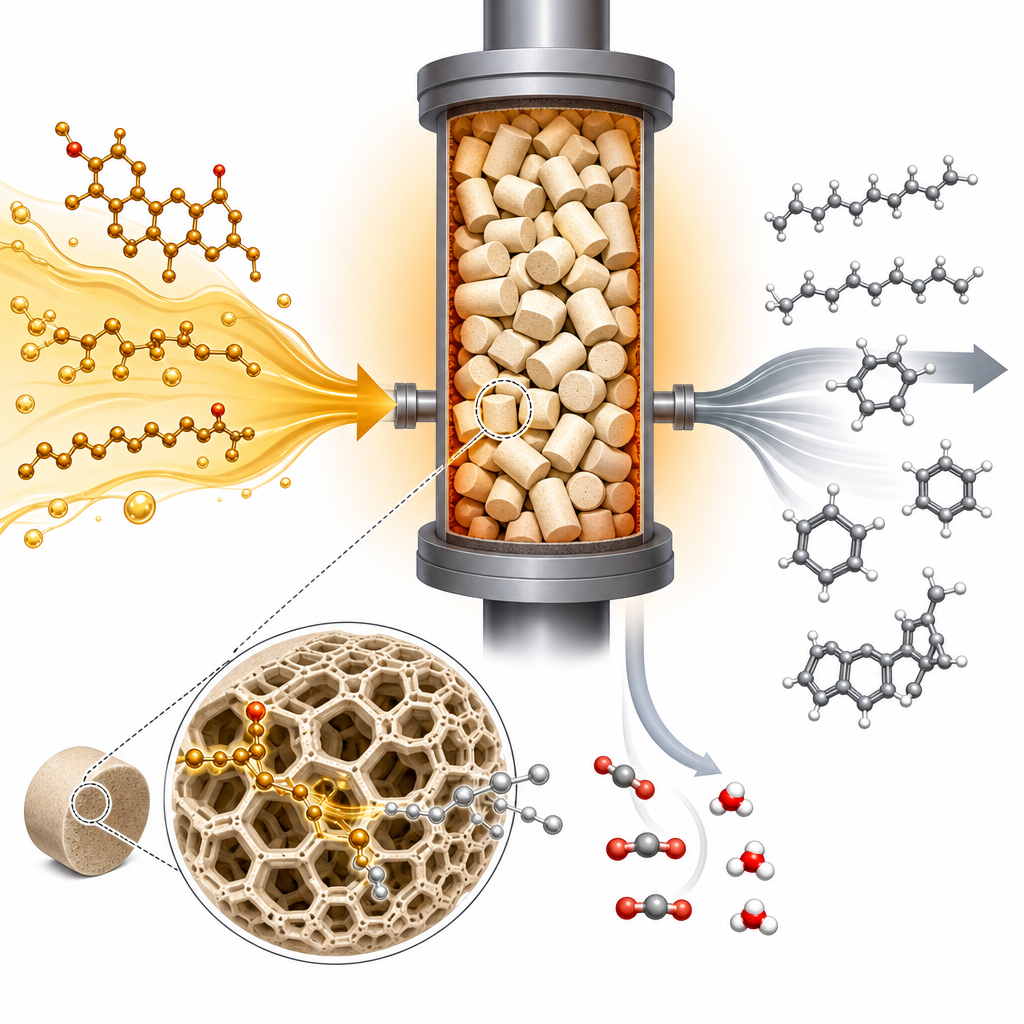
The ACS Material H-ZSM-5 used in the experiments was supplied as 2 × 2–10 mm pellets with a Si/Al ratio of 38–50, BET surface area greater than 300 m² g⁻¹, bulk density of 0.72 kg dm⁻³, and was classified as strongly acidic. It was loaded into the fixed catalytic bed downstream of the pyrolysis chamber, operating at 500 °C with a Weight Hourly Space Velocity (WHSV) of 4 h⁻¹. UCO was sourced from SILO SpA (Florence), filtered through 1 mm mesh cardboard filters, and pumped continuously to the pyrolyzer. Pyrolysis vapors passed through the catalytic bed, condensers and a water bubbler, with bio-oil collected and analyzed by LECO TruSpec elemental analysis and GC-MS/FID. The H-ZSM-5 stage allowed the authors to probe the role of strong Brønsted acidity in promoting secondary cracking and aromatization of primary pyrolysis products, in direct comparison with activated carbon, alumina and MgO under identical thermal and flow conditions.
With ACS Material H-ZSM-5, the liquid yield from UCO pyrolysis at WHSV = 4 h⁻¹ was 33.7% mass fraction, the lowest among the four catalysts, reflecting the strong cracking activity of the zeolite that shifts product distribution toward non-condensable gases. The bio-oil carried 77.90% C, 10.10% H and 11.93% O, with a notably high water content of 8.36% and a low kinematic viscosity of 1.19 mm² s⁻¹ at 40 °C. Critically, H-ZSM-5 delivered the lowest acid value of any catalyst tested, 20.45 g kg⁻¹, versus 117.73 g kg⁻¹ for the non-catalytic case, confirming effective deoxygenation through decarboxylation routes. By comparison, activated carbon gave a higher liquid yield (63.64%) and was selected for follow-on runs, where reducing WHSV to 2.5 h⁻¹ raised hydrocarbon yield from 23% to 35% mass fraction on UCO, and to 40% when feeding fatty acids. Distillation of the activated-carbon bio-oil showed 48% of the distilled fraction in the kerosene boiling range (150–250 °C), corresponding to about 30% of the total feed available for further upgrading to paraffinic jet fuel. The H-ZSM-5 result is consistent with prior literature reports that strongly acidic zeolites favor aromatic formation and gas-phase products at the expense of liquid yield, but achieve the most aggressive removal of carboxylic functionality.
The study has direct implications for waste-to-fuel circular bio-economy schemes targeting aviation and road transport. Catalytic pyrolysis of UCO and fatty acids over low-cost solid catalysts could provide a decentralized, hydrogen-free pretreatment step that delivers a largely deoxygenated intermediate to existing HVO refineries, or stands alone as a small-scale paraffinic-fuel route. The strong-acid behavior demonstrated with ACS Material H-ZSM-5 also makes it a candidate for tailored multi-stage catalyst beds that combine deep deoxygenation with downstream hydrocarbon shaping. Follow-up work flagged by the authors includes parametric optimization of temperature, WHSV, catalyst lifetime and resistance to long-term poisoning by UCO contaminants, plus reactor designs matched to the rheology and impurity profile of waste lipids.
For researchers working on biofuel catalysis, this paper provides a useful pilot-scale benchmark of how H-ZSM-5 performs against neutral and basic catalysts on a real waste feedstock. The H-ZSM-5 zeolite used here is available from ACS Material under the molecular sieves catalog as pelleted Nano H-ZSM-5 and related ZSM-5 grades, supporting researchers screening acid zeolites for catalytic pyrolysis, fatty acid deoxygenation, bio-aromatic production and related thermochemical conversion studies.How ACS Material products were used
- ACS Material H-ZSM-5 Zeolite (Molecular Sieves) — “ACS Material H-ZSM-5 | Zeolite | Pellet | 2 × 2-10 mm | Strong acidic | Si/Al ratio 38-50 | Surface area >300 m2 g−1 | Bulk density 0.72 kg dm−3”
Product Performance in this StudyThe ACS Material H-ZSM-5 zeolite served as one of four screened catalysts for the catalytic pyrolysis of used cooking oil at 500 °C. It produced the lowest overall liquid yield (33.7%) among the catalysts and the highest water content (8.36%), but markedly reduced the acid value of the bio-oil to 20.45 g/kg, reflecting strong deoxygenation activity and a tendency toward gaseous products and aromatics characteristic of strongly acidic zeolites.
Related product categories
Frequently asked questionsWhy is H-ZSM-5 used as a catalyst in pyrolysis of used cooking oil?
H-ZSM-5 is a strongly acidic aluminosilicate zeolite with a Si/Al ratio of 38–50 and a high surface area above 300 m² g⁻¹, making it highly active for cracking and deoxygenation of triglycerides and fatty acids. In this study, ACS Material H-ZSM-5 reduced the bio-oil acid value from 117.73 to 20.45 g kg⁻¹ at 500 °C, demonstrating very effective decarboxylation of waste cooking oil into hydrocarbon products.
How does H-ZSM-5 compare to activated carbon for biofuel pyrolysis?
At 500 °C and WHSV = 4 h⁻¹, ACS Material H-ZSM-5 delivered a 33.7% liquid yield with very low acid value, while activated carbon gave 63.64% liquid yield but higher acid value. H-ZSM-5 produced more gas and aromatics due to strong acid-catalyzed cracking, whereas activated carbon favored higher liquid yields. The authors selected activated carbon for further optimization but identified H-ZSM-5 as the most aggressive deoxygenation catalyst.
What is Weight Hourly Space Velocity (WHSV) in catalytic pyrolysis?
WHSV is the ratio of feedstock mass flow rate to catalyst mass, expressed in h⁻¹. It controls contact time between vapors and catalyst. In this work, lowering WHSV from 4 to 2.5 h⁻¹ over activated carbon increased the hydrocarbon yield from 23% to 35% mass fraction on used cooking oil, because longer contact promotes deeper cracking and deoxygenation of pyrolysis intermediates.