-
Al2O3 Nanoparticles for Bauxite Castables - Najafabad Branch IAU, 2017
Jun 30, 2026 | ACS MATERIAL LLCGhasemi-Kahrizsangi, S. et al. (2017). The influence of Al 2 O 3 nanoparticles addition on the microstructure and properties of bauxite self–flowing low-Cement castables. *Ceramics International*. https://doi.org/10.1016/j.ceramint.2017.04.013
Ceramics International · 2017
Adding ACS Material Al2O3 nanoparticles (0–3 wt%) to bauxite self-flowing low-cement castables improved sintering, density, and cold crushing strength at 1550 °C.
About this research
Researchers at Islamic Azad University, Najafabad Branch report in Ceramics International (2017) that substituting reactive alumina with Al2O3 nanoparticles obtained from ACS Material Advanced Co. measurably improves the microstructure and high-temperature performance of bauxite self-flowing low-cement castables. Working with Chinese high-grade bauxite aggregates, calcium aluminate cement, microsilica, and reactive alumina, the team replaced 0–3 wt% of the reactive alumina with nano-Al2O3 and tracked phase evolution, density, porosity, and cold crushing strength after drying at 110 °C and firing at 1550 °C. The work demonstrates that even small amounts of nanoscale alumina shift the in-situ ceramic reactions toward CA6 and mullite formation, densifying the refractory matrix.
Low-cement and self-flowing castables are workhorse refractories for steel ladles, tundishes, and reheating furnaces, where higher density and mechanical strength translate directly into longer service life. The conventional route relies on reactive alumina to react with calcium aluminate cement and silica during firing, forming high-melting phases such as CA2, CA6, and mullite. However, reactive alumina alone often requires temperatures above 1400 °C for CA6 formation. Reducing this temperature, decreasing residual porosity, and increasing cold crushing strength remain key engineering targets. Nanoscale alumina addresses several of these challenges simultaneously: higher specific surface area accelerates solid-state reactions, while sub-micron particles fill voids between coarse grains. This paper quantifies these effects in a self-flowing castable formulation tuned by Andreasen modulus q = 0.23.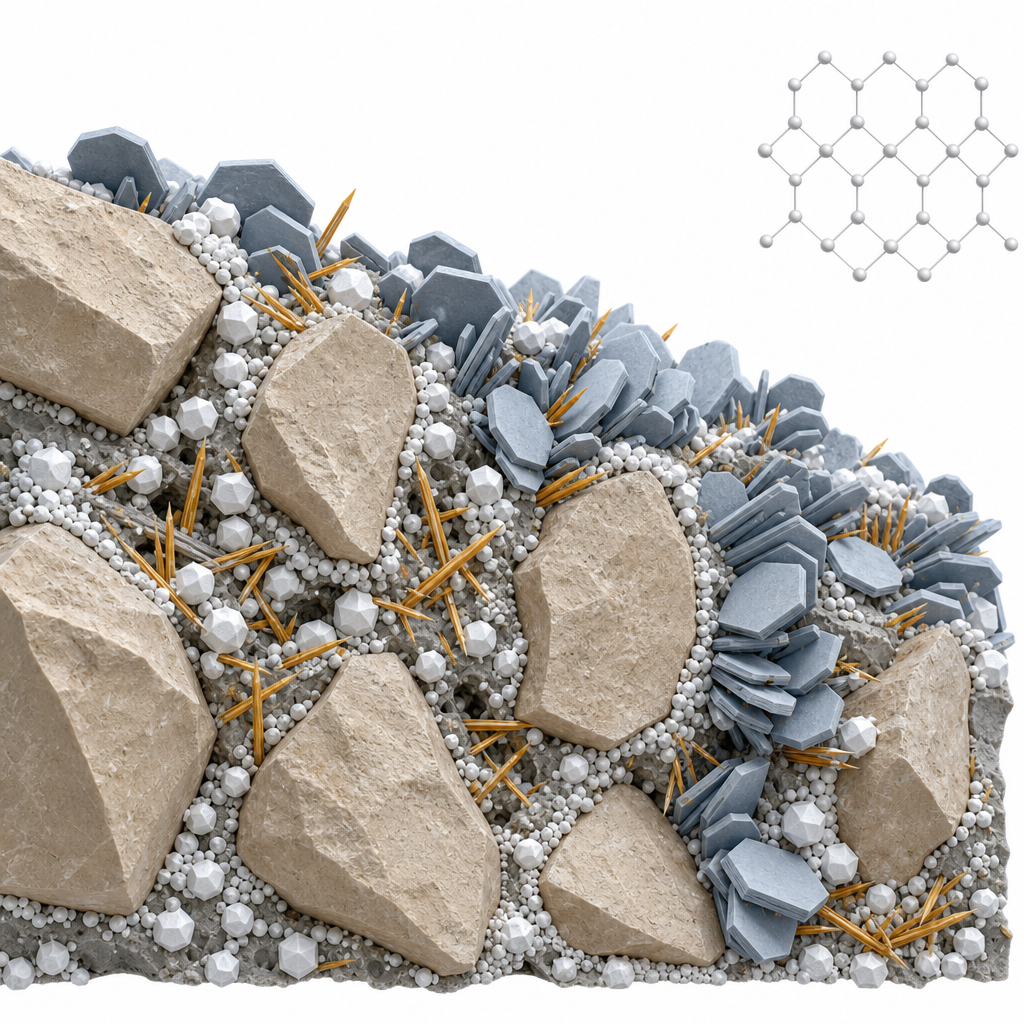
In the experimental workflow, the Al2O3 nanoparticles from ACS Material were first dry-mixed with reactive alumina and micron-sized bauxite in a mini ball crusher for 3 hours to ensure homogeneous distribution. The pre-mix was then combined with coarse bauxite (5–3, 3–1, and 1–0 mm fractions), microsilica, calcium aluminate cement, and sodium hexametaphosphate dispersant in a Hobart mixer for 3 minutes. Water content of 5–5.7 wt% was adjusted to pass the 'good ball in hand' test and to keep the self-flow value within the ASTM C 1446-99 acceptance window of 80–110%. Samples were cast without vibration into 70×70×70 mm molds, demolded after 24 hours, dried at 110 °C, and fired at 1550 °C for 3 hours. The nano-Al2O3 thus functions both as a packing aid in the green body and as a high-reactivity precursor for CA6 and mullite during firing. Phase evolution was tracked by XRD (Bruker AXS Advance, Cu Kα) and microstructure by FEI Nova Nano SEM 200.
XRD analysis after firing showed that all compositions contained Al2O3 (corundum), 3Al2O3·2SiO2 (mullite), CaO·6Al2O3 (CA6), and CaO·2Al2O3 (CA2). As nano-Al2O3 content increased from 0 to 3 wt%, CA2 peak intensities decreased while CA6, mullite, and corundum peaks intensified, confirming that excess alumina from the nanoparticles consumed CA2 to form the more refractory CA6 phase. The authors note that CA6 formation can occur at temperatures as low as 1300 °C with nano-Al2O3, well below the conventional threshold. For green bodies dried at 110 °C, increased nano-Al2O3 content slightly raised apparent porosity and lowered bulk density due to extra water retained on the high-surface-area particles. After firing at 1550 °C this trend reversed: apparent porosity decreased and bulk density increased monotonically with nano-Al2O3 content, reflecting improved void filling and enhanced sintering. Cold crushing strength followed the same densification trend, with the 3 wt% nano-Al2O3 sample exhibiting the highest mechanical strength among the compositions tested. The self-flow value remained within the acceptable 80–110% range across all batches.
These results have direct relevance to refractory manufacturers serving the steel, cement, glass, and petrochemical industries, where self-flowing low-cement castables line high-temperature vessels. By incorporating a few weight-percent of nano-Al2O3, formulators can target lower firing temperatures, denser microstructures, and higher CA6 content without altering coarse aggregate selection or installation procedures. The same approach is transferable to alumina-spinel, alumina-magnesia, and high-alumina castables where in-situ CA6 or hibonite phases govern slag resistance. Future work suggested by the authors includes evaluating thermal shock resistance, hot modulus of rupture, and slag corrosion behavior of nano-Al2O3-modified castables under service conditions.
For researchers and engineers exploring nanoparticle reinforcement of ceramics and refractories, gamma-alumina and related Al2O3 nanopowders are available from ACS Material in the Nanoparticles Series. The data in this paper provide a quantitative benchmark for how nanoscale alumina addition shifts phase chemistry and densification in cement-bonded ceramic systems, supporting formulation work in high-temperature ceramics, catalyst supports, and structural composites.How ACS Material products were used
- Al2O3 Nanoparticles (Gamma-Aluminum Oxide) (Nanoparticles Series) — “Al2O3 nanoparticles (Fig 1, Table 2; supplier; ACS Material Advanced Co.) used as an additive.”
Product Performance in this StudyAl2O3 nanoparticles from ACS Material were substituted for reactive alumina (0–3 wt%) in bauxite self-flowing low-cement castables. Their high specific surface area promoted CA6 and mullite phase formation at lower temperatures, improved sintering, reduced apparent porosity, and increased bulk density and cold crushing strength after firing at 1550 °C.
Related product categories
Frequently asked questionsHow do Al2O3 nanoparticles improve bauxite low-cement castables?
Al2O3 nanoparticles have a much higher specific surface area than reactive alumina, so they react more readily with calcium aluminate cement and silica during firing. They promote formation of CA6 (calcium hexa-aluminate) and mullite at lower temperatures (around 1300 °C), fill voids between coarse grains, and enhance sintering. The net effect after firing at 1550 °C is higher bulk density, lower apparent porosity, and improved cold crushing strength.
What is CA6 phase and why is it important in refractory castables?
CA6 is calcium hexa-aluminate (CaO·6Al2O3), a high-melting refractory phase with a melting point near 1830 °C. It forms in situ when excess alumina reacts with calcium aluminate cement and intermediate CA2 phases. CA6 contributes to thermal shock resistance and slag corrosion resistance in alumina-rich castables. Nanoscale alumina lowers the temperature at which CA6 forms, allowing denser microstructures and better mechanical performance at lower firing temperatures.
What grade of alumina nanoparticles is best for refractory castable additives?
For refractory castable applications, gamma-Al2O3 or fine alpha-Al2O3 nanoparticles with high specific surface area are most effective because reactivity scales with surface area. The Ceramics International study used Al2O3 nanoparticles from ACS Material at 0–3 wt% substitution for reactive alumina, demonstrating measurable gains in density and strength. Higher additions risk water demand and green-body porosity issues, so 1.5–3 wt% is a practical working range.