-
Benchmark Graphene Oxide Characterization - FORTH, 2025
Jul 08, 2026 | ACS MATERIAL LLCMathioudakis, G. N. et al. (2025). Comparative In-Depth investigation of benchmark graphene oxides in the perspective of their integration into industrial production processes. *Nanomaterials*. https://doi.org/10.3390/nano15130980
Institute of Chemical Engineering Sciences (ICE-HT) · Nanomaterials · 2025
FORTH researchers compared five commercial graphene oxides, including ACS Material Single Layer-H GO, using Raman, XRD, ATR-FTIR, TGA and XPS for industrial use.
About this research
Researchers at the Foundation for Research and Technology-Hellas (FORTH), Institute of Chemical Engineering Sciences (ICE-HT), benchmarked five commercial graphene oxides, including ACS Material's Single Layer-H graphene oxide (SLH), to map how their structural and chemical differences affect integration into industrial production processes. Using Raman spectroscopy, X-ray diffraction (XRD), ATR-FTIR, thermogravimetric analysis (TGA) and X-ray photoelectron spectroscopy (XPS), the team quantified defect density, oxygen-functional-group content, crystallinity, interlayer spacing and thermal stability for each material. The ACS Material SLH sample served as one of two single-layer reference grades. The central finding is that commercial GOs vary substantially in functional-group chemistry and thermal behavior, and that this variability directly governs their suitability for polymer composites, barrier membranes and electronic or energy-storage devices.
This research matters because graphene oxide is increasingly moving from lab-scale curiosities to industrial composite films, where reproducibility and predictable performance are essential. GO offers high mechanical strength, tunable surface chemistry and hydrophilicity, making it attractive for optoelectronics, energy storage, environmental remediation, transparent conductive films, biotechnology and membrane separations. However, the type and concentration of epoxide, hydroxyl, carbonyl and carboxyl groups differ between suppliers and synthesis routes, which complicates material selection. A manufacturer choosing a GO for a water-vapor-permeable roofing membrane or a polypropylene composite needs to know how the material behaves under thermal processing. By directly comparing benchmark GOs under identical characterization protocols, this study addresses a real gap: how to translate physicochemical fingerprints into informed choices for specific industrial performance targets such as barrier properties, transport efficiency or mechanical reinforcement.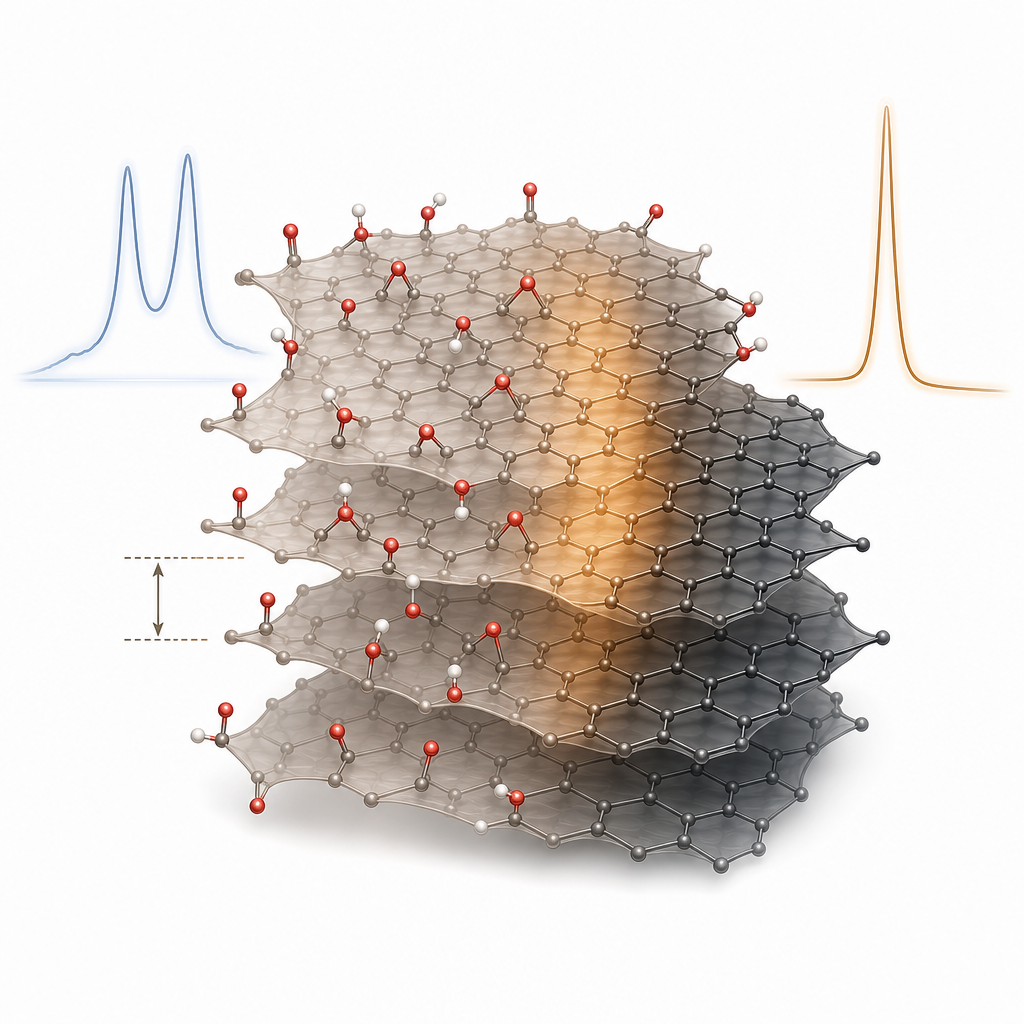
The ACS Material product was used as a received single-layer graphene oxide flake grade (catalogued as Single Layer-H, particle diameter 1-5 µm, thickness 0.8-1.2 nm). It was characterized alongside GOs from Williamblythe, Nanografi and Abalonyx without further chemical modification, so the measurements reflect the as-supplied material. Raman spectra were recorded at 514.5 nm to extract the D-to-G intensity ratio as a defect index. XRD with a Cu source identified the (001) interlayer reflection and d-spacing via Bragg's law, and a temperature-controlled XRK900 reactor chamber tracked structural evolution from room temperature to 250 °C. ATR-FTIR identified oxygen-containing groups across 4000-400 cm⁻¹, while TGA under nitrogen at 10 °C/min mapped water loss and functional-group decomposition. XPS deconvolution of the C1s peak separated sp² C-C, sp³ C-C, C-O/C-OH, C=O and COOH components and provided relative atomic concentrations. The ACS Material SLH grade fed directly into each technique, anchoring the comparative dataset for single-layer GO.
The study produced detailed quantitative metrics. The ACS Material SLH sample showed a Raman ID/IG defect index of 0.95 ± 0.03, intermediate among the five GOs (range 0.86 to 0.97). Its (001) XRD peak sat at 2θ ≈ 9.9°, giving an interlayer spacing of 8.9 Å, the second largest spacing measured, while its XRD FWHM of 0.45 indicated comparatively well-ordered domains. XPS of SLH found 38.3% C-O/C-OH, 7.0% carbonyl, 2.7% carboxyl, with an overall oxygen atomic concentration around 33.1% and a high carbon content of 65.5%, plus a trace of sulfur. ATR-FTIR showed SLH and JCP exhibiting the strongest epoxide band at 1040 cm⁻¹, while SLH carried lower carbonyl and carboxyl absorptions, consistent with the XPS data. Across all samples, TGA showed roughly 40% weight loss by 270 °C from adsorbed water and labile oxygen groups, with carbon-skeleton decomposition beginning near 500 °C. Temperature-dependent XRD revealed the (001) peak shifting toward 2θ ≈ 19.5-21.6° (d ≈ 4.1-4.5 Å) between 190 and 250 °C, demonstrating progressive reduction of GO to a reduced graphene oxide and graphite-like structure. The authors concluded SLH remains workable below about 200 °C before significant reduction.
These results enable rational selection of graphene oxide for composite and membrane manufacturing. The authors highlight breathable water-vapor-permeable membranes and vapor control layers for pitched-roof construction, where GO could replace stretched CaCO₃ micro/nano filler particles in polyolefin films, with breathability tuned by GO weight fraction. They favor the multilayer GOs (JCP, FDA, DPA) for that specific thermally demanding fabric application, while noting that single-layer grades such as the ACS Material SLH offer distinct epoxide-rich basal-plane chemistry useful for cross-linking with epoxy resins. Broader applications discussed include flexible electronics, conductive coatings, sensors, lightweight structural composites, energy-storage electrodes and separation membranes. The work points to thorough pre-use characterization as a prerequisite for reproducible industrial scale-up.
For researchers working on GO-based composites and membranes, this paper demonstrates the value of matching a graphene oxide's functional-group profile and thermal stability to the target process window. ACS Material's Single Layer Graphene Oxide Flake (H Method) is the grade benchmarked here as SLH and is available to laboratories investigating similar composite, barrier-film and electronic applications. The detailed characterization data offer a useful reference point for anyone evaluating single-layer GO grades, underscoring that supplier and synthesis route meaningfully change defect density, oxygen chemistry and reduction onset temperature.How ACS Material products were used
- Single Layer Graphene Oxide Flake (H Method) - ACS Material (SLH) (Graphene Series) — “Five different commercial GOs were procured from (a) ACS Material, Medford, MA, USA (GO, CAS: 240220, Single Layer-H)”
Product Performance in this StudyACS Material's Single Layer-H GO (SLH) showed a defect index ID/IG of 0.95, an interlayer d-spacing of 8.9 Å, low carbonyl/carboxyl content, and a high epoxide signature, with reasonable structural order (XRD FWHM 0.45). It was one of two single-layer benchmarks and remained workable below ~200 °C before reduction to rGO.
Related product categories
Frequently asked questionsWhat grade of graphene oxide did this study source from ACS Material?
The study used ACS Material's Single Layer-H graphene oxide (coded SLH), described with a particle diameter of 1-5 µm and thickness of 0.8-1.2 nm. It was procured from ACS Material in Medford, MA, USA, and analyzed in its as-received state alongside four other commercial graphene oxides using Raman, XRD, ATR-FTIR, TGA and XPS.
How does the thermal stability of graphene oxide affect its industrial use?
Graphene oxide loses water and labile oxygen groups below 180 °C and begins converting to reduced graphene oxide between roughly 190 and 250 °C, as shown by temperature-dependent XRD. About 40% weight loss occurs by 270 °C. This means GO grades like ACS Material's SLH remain workable below about 200 °C, a key constraint when blending GO into polymers processed at elevated temperatures.
Why do oxygen-containing functional groups matter when selecting graphene oxide?
Epoxide, hydroxyl, carbonyl and carboxyl groups control dispersibility, interlayer spacing, water retention and chemical bonding with polymer matrices. Carboxyl groups enhance hydrophilicity and hydrogen bonding, while basal-plane epoxides enable cross-linking with epoxy resins. The study showed these group concentrations vary widely between commercial GOs, directly affecting composite compatibility and performance.