-
Beta Zeolite for Ti-BEA Alkene Epoxidation - University of Illinois at Urbana-Champaign, 2019
May 29, 2026 | ACS MATERIAL LLCBregante, D. T. et al. (2019). Cooperative Effects between Hydrophilic Pores and Solvents: Catalytic Consequences of Hydrogen Bonding on Alkene Epoxidation in Zeolites. *Journal of the American Chemical Society*. https://doi.org/10.1021/jacs.8b12861
University of Illinois at Urbana−Champaign · Journal of the American Chemical Society · 2019
University of Illinois researchers use ACS Material Beta zeolite to build Ti-BEA catalysts and reveal silanol nests boost 1-octene epoxidation 100x.
About this research
Researchers at the University of Illinois at Urbana-Champaign, working with collaborators at Purdue University, used a commercial Beta zeolite sourced from ACS Material (initial Si/Al = 75) as one of seven parent frameworks to construct a series of Ti-substituted *BEA (Ti-BEA) catalysts, and showed that 1-octene epoxidation turnover rates rise 100-fold as silanol nest density increases. Published in the Journal of the American Chemical Society (DOI: 10.1021/jacs.8b12861), the work systematically decouples silanol-induced solvation effects from active-site electronic structure and resolves a long-standing debate about hydrophobicity in titanium silicate epoxidation catalysis.
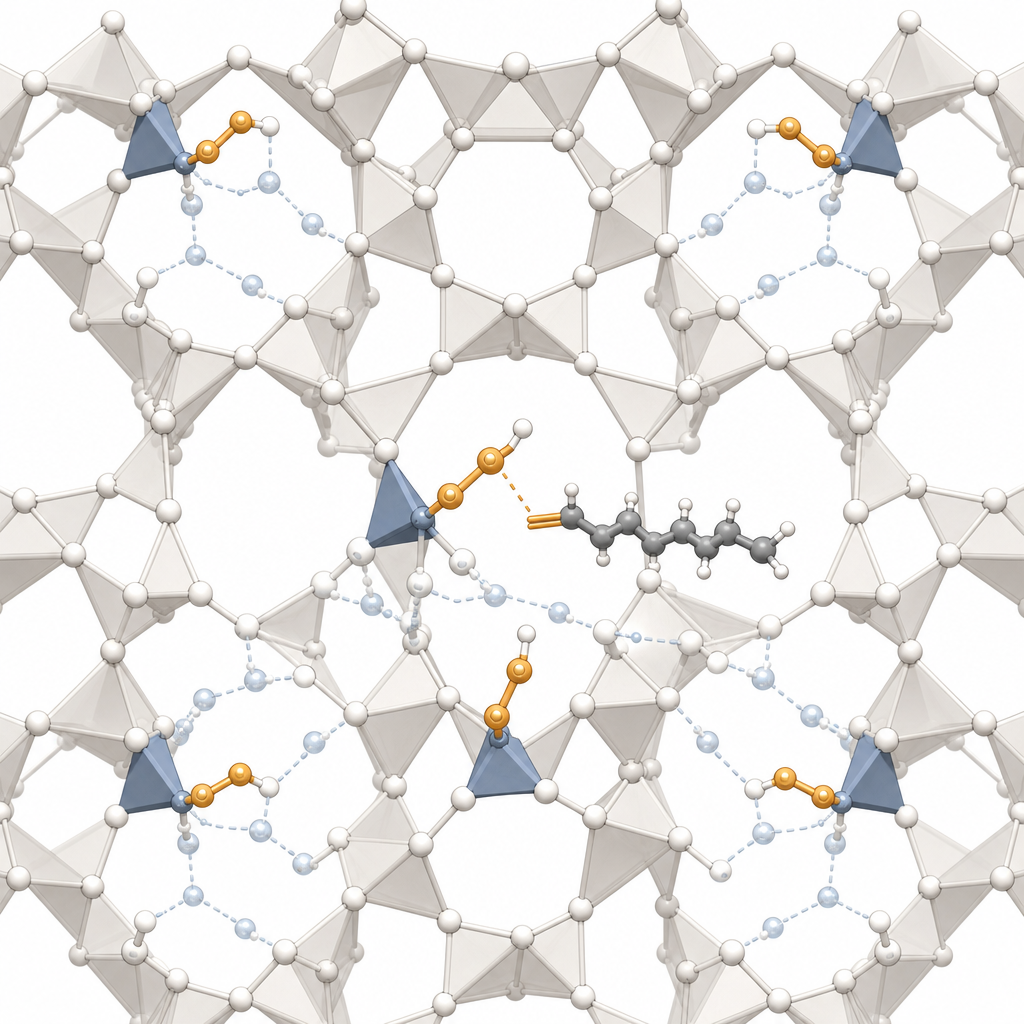
Titanium silicalite-1 (TS-1) and related Ti-zeolites are workhorse catalysts for industrial epoxidation with aqueous H2O2, including the HPPO process for propylene oxide. For decades, the field assumed that hydrophobic, defect-free pores maximize epoxidation rates and selectivity by excluding water. More recent work, however, reported the opposite trend, attributing the discrepancy variously to changes in active-site electronics, mass transport, or local reactant concentration. The lack of a controlled series with constant Ti environment and pore geometry but tunable silanol density has prevented a definitive answer. Resolving this matters for designing next-generation zeolite catalysts for liquid-phase oxidations, biomass conversion, and other reactions where water and hydrogen-bonding solvents are unavoidable.
The authors prepared Ti-BEA-X catalysts (X = initial Si/Al ratio from 12.5 to 250) by refluxing commercial Al-BEA in HNO3 to remove framework Al, then grafting Ti via TiCl4 in CH2Cl2. Commercial Al-BEA was obtained from three vendors: Zeolyst, Tosoh, and ACS Material. The ACS Material Beta zeolite (Si/Al = 75) yielded the Ti-BEA-75 sample with 0.28 wt% Ti loading, a UV-vis band gap of 4.2 eV, and 94 ± 7% catalytically active Ti atoms as quantified by in situ methylphosphonic acid titration. A fluoride-route Ti-BEA-F was also synthesized as a defect-free reference. Across the series, X-ray diffractograms confirmed retention of the *BEA framework, EDXRF gave Ti loadings between 0.15 and 0.42 wt%, and 29Si MAS NMR plus CD3CN-FTIR quantified silanol nest densities from essentially zero to about 5 (SiOH)4 per unit cell.
The headline kinetic result is dramatic: 1-octene epoxidation turnover rates on the most hydrophilic Ti-BEA (∼5 (SiOH)4 per unit cell) exceed those on defect-free Ti-BEA-F by a factor of 100, while H2O2 decomposition rates remain essentially constant across the entire series. Because decomposition is the parasitic pathway, hydrophilic Ti-BEA also delivers the highest H2O2 selectivity to epoxide, contradicting decades of conventional wisdom. CD3CN-FTIR and in situ UV-vis spectroscopy show that Lewis-acid strength of Ti centers, ligand-to-metal charge-transfer energies of Ti–OOH and Ti(η2-O2) intermediates, and the radical-clock behavior of cis-stilbene are all invariant with silanol density, ruling out electronic or mechanistic explanations. Instead, apparent activation enthalpies for epoxidation are 13 kJ mol−1 lower and apparent activation entropies 93 J mol−1 K−1 less negative on Ti-BEA-12.5 than on defect-free Ti-BEA-F. Periodic DFT and ab initio molecular dynamics, combined with two-phase thermodynamic entropy analysis, confirm that silanol nests anchor hydrogen-bonded water clusters whose disruption upon transition-state formation produces a favorable entropy gain. When water is removed (using anhydrous t-BuOOH), rates become nearly insensitive to silanol density, recovering only when small amounts of water are reintroduced.
These insights reshape catalyst design for liquid-phase oxidations. Rather than chasing maximum hydrophobicity, formulators of titanium silicate epoxidation catalysts, Sn-BEA glucose isomerization catalysts, and Baeyer–Villiger systems can deliberately engineer silanol nest densities to harness solvent-network entropy. The conceptual framework extends to any zeolite-catalyzed liquid-phase reaction with hydrogen-bond donors or acceptors as reactants or co-solvents, including biomass upgrading, propylene oxide production via HPPO, and selective alcohol oxidations. The authors point to follow-up work combining calorimetric, kinetic, and computational methods to deconvolute these excess free-energy contributions in other framework topologies.
For researchers building Ti-BEA, Sn-BEA, or other framework-substituted zeolite catalysts, well-characterized parent Al-BEA with documented Si/Al ratios is the essential starting point. ACS Material's Beta zeolite line, including the Si/Al = 75 grade used in this study, fits naturally into post-synthetic dealumination–metallation workflows of the type reported here. The relevant zeolite and molecular sieve products are available for laboratories pursuing similar structure–activity studies on liquid-phase epoxidation, isomerization, and oxidation catalysis.How ACS Material products were used
- Beta Zeolite (Molecular Sieves) — “Ti-BEA-75 | ACS Material | 75 | 0.28 | 4.2 | 94 ± 7”
Product Performance in this Study
The Al-BEA zeolite (Si/Al = 75) sourced from ACS Material served as a parent material that was dealuminated and post-synthetically modified with Ti to produce Ti-BEA-75, one of seven Ti-BEA samples spanning a range of silanol nest densities. It contributed 0.28 wt% Ti loading and 94% catalytically active Ti atoms, fitting consistently within the broader Ti-BEA series used to establish the structure–activity relationship.
Related product categories
Frequently asked questions
How do silanol nests affect alkene epoxidation rates in Ti-BEA zeolites?
Silanol nests, denoted (SiOH)4, dramatically increase 1-octene epoxidation turnover rates on Ti-BEA. Materials containing about 5 (SiOH)4 per unit cell deliver rates roughly 100 times higher than nearly defect-free Ti-BEA. The enhancement comes not from changes in Ti electronics but from entropy gained when the epoxidation transition state disrupts hydrogen-bonded water clusters anchored near silanol nests, lowering the apparent free energy of activation.
Why does H2O2 decomposition rate stay constant while epoxidation rate increases with silanol density?
H2O2 decomposition transition states hydrogen bond with confined water clusters in much the same way that Ti–OOH reactive species do, so adding more silanol-anchored water clusters does not destabilize the transition state relative to the resting state. Epoxidation transition states, in contrast, carry a hydrophobic aliphatic chain that disrupts water clusters, producing a favorable entropy change unique to the productive pathway.
What role does Beta zeolite play in synthesizing Ti-BEA catalysts?
Commercial Al-Beta zeolite serves as the parent framework for post-synthetic Ti incorporation. The aluminum is first removed by refluxing in concentrated nitric acid, generating Si-BEA with silanol nests at former Al sites. Titanium tetrachloride then grafts Ti into these vacancies. Choosing parent zeolites with different initial Si/Al ratios, such as the Si/Al = 75 Beta used here, allows controlled tuning of silanol nest density in the final Ti-BEA catalyst.