-
CNT & AgNW Neural Electrode Composites - NUI Galway, 2021
Jul 02, 2026 | ACS MATERIAL LLCKrukiewicz, K. et al. (2021). Electrical percolation in extrinsically conducting, poly(ε-decalactone) composite neural interface materials. *Scientific Reports*. https://doi.org/10.1038/s41598-020-80361-7
Scientific Reports · 2021
Researchers at NUI Galway used carbon nanotubes and silver nanowires in poly(ε-decalactone) to build soft, biocompatible neural interface electrodes.
About this research
Researchers at the National University of Ireland Galway used carbon nanotubes and silver nanowires as conductive fillers in a poly(ε-decalactone) (EDL) matrix to engineer soft, biocompatible neural interface composites that combine low electrical impedance with mechanical compliance close to neural tissue. Published in Scientific Reports (2021), the study compared three fillers — CNTs, AgNWs, and poly(hydroxymethyl 3,4-ethylenedioxythiophene) microspheres (MSP) — and identified percolation thresholds, electrochemical performance, and in vitro cytocompatibility for each. The headline outcome: EDL/CNT achieved the lowest film resistance (1.2 ± 0.3 kΩ) at only 0.1 wt% loading, while EDL/AgNW reached the highest charge storage capacity (10.7 ± 0.3 mC cm⁻²) at 10 wt%.
This research matters because chronic neural interfaces face an inherent mechanical mismatch problem: stiff platinum and gold electrodes elicit inflammatory responses and glial scarring when implanted in soft neural tissue, limiting long-term signal fidelity. Hydrogel coatings improve compliance but lack intrinsic conductivity. Intrinsically conducting polymers like PEDOT improve charge transfer but tend to be brittle and electromechanically unstable. A composite approach — dispersing high-aspect-ratio conductive nanofillers within a compliant polyester — offers a middle path, exploiting electrical percolation to retain conductivity at low filler fractions while preserving bulk mechanical softness. Demonstrating this for poly(ε-decalactone), a relatively unexplored biodegradable matrix, expands the design space for next-generation electrocorticography arrays, deep brain stimulation leads, and peripheral nerve cuffs.
The nanomaterials served as the conductive phase responsible for forming percolating networks within the insulating EDL matrix. Carbon nanotubes were loaded at very low fractions (down to 0.1 wt%) to exploit their high aspect ratio and intrinsic electron transport, producing immediate electrochemical activation. Silver nanowires were incorporated at higher loadings (2–10 wt%) where their micron-scale length enabled extended conductive pathways with the highest faradaic charge transport. PEDOT-based microspheres were used as a comparison filler representing a quasi-spherical, intrinsically conducting morphology. Composite films were drop-cast onto platinum-coated glass slides and characterized by cyclic voltammetry and electrochemical impedance spectroscopy in 0.1 M KCl (0.1 Hz–100 kHz, 40 mV AC, vs Ag/AgCl). Equivalent-circuit modeling extracted solution resistance, charge transfer resistance, interphase film resistance, and capacitive elements for each formulation.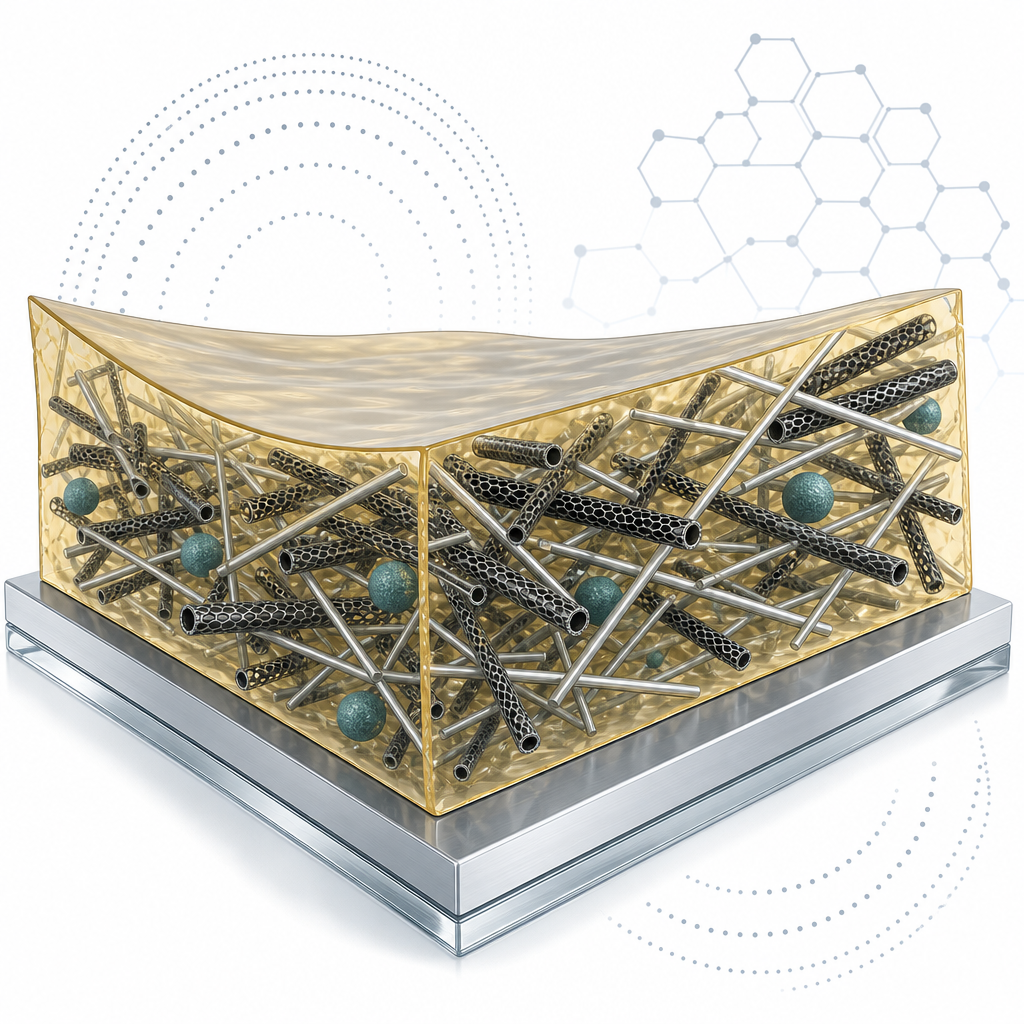
Quantitatively, pristine EDL exhibited a film resistance of 51.4 ± 14.1 kΩ, a charge storage capacity (CSC) of only 1.2 ± 0.2 mC cm⁻², and an interphase capacitance of 3.2 µF cm⁻². Adding just 0.1 wt% CNT collapsed film resistance to 1.2 ± 0.3 kΩ — a 40-fold reduction — and pushed areal non-faradaic capacitance to 420.5 µF cm⁻². EDL/AgNW at 2 wt% reached its percolation threshold with a CSC of 6.6 ± 0.4 mC cm⁻², climbing to 10.7 mC cm⁻² at 10 wt%, and dropping film resistance to 8.1 kΩ. EDL/MSP at 2 wt% delivered a CSC of 7.3 ± 1.5 mC cm⁻² and an extraordinary interphase capacitance of 1478.4 ± 92.4 µF cm⁻². In vitro testing with mixed ventral mesencephalic neural populations from embryonic Sprague–Dawley rats showed that all three composites were biocompatible and, critically, suppressed reactive astrocyte presence relative to platinum controls. By day 14, neuron percentages reached 64.0 ± 6.2% (EDL/CNT), 68.4 ± 2.0% (EDL/AgNW), and 67.7 ± 4.9% (EDL/MSP), compared with 51.2 ± 3.4% on bare Pt.
These results enable a family of implantable neural electrode coatings tailored to specific functional needs. Applications include cortical recording arrays where low impedance and high CSC improve signal-to-noise; deep brain stimulation electrodes where high interphase capacitance permits charge-balanced biphasic pulsing without faradaic damage; and peripheral or spinal nerve interfaces where mechanical compliance reduces fibrotic encapsulation. The authors point toward future in vivo validation and to tuning of filler morphology to balance capacitive vs faradaic charge injection. Beyond neural interfaces, the percolation framework demonstrated here is broadly relevant to bioelectronic sensors, soft implantable strain gauges, and electrically active tissue scaffolds.
For researchers working on soft bioelectronic interfaces, ACS Material supplies the relevant nanomaterial building blocks at research and pilot scale: multiwall and single-wall carbon nanotubes in purified and functionalized grades, silver nanowires with controlled aspect ratios, and a complementary catalog of conducting polymer feedstocks and graphene derivatives. Selecting the right filler aspect ratio and surface chemistry is decisive for hitting the percolation threshold at low loadings — a prerequisite for keeping the composite mechanically compliant — and these material choices directly determine the device-level electrochemical envelope reported in this study.How ACS Material products were used
- Multi-Walled Carbon Nanotubes (MWCNTs) (Carbon Series) — “carbon nanotubes (CNT), silver nanowires (AgNW) and poly(hydroxymethyl 3,4-ethylenedioxythiophene) microspheres (MSP) were employed as conducting fillers within a poly(ε-decalactone) (EDL) matrix”
- Silver Nanowire (Nanowire Series) — “silver nanowires (AgNW) ... were employed as conducting fillers within a poly(ε-decalactone) (EDL) matrix”
Product Performance in this StudyCNT fillers produced the lowest film resistance (1.2 ± 0.3 kΩ) at just 0.1 wt% loading, demonstrating excellent percolation and a 40-fold decrease in charge transfer resistance versus pristine EDL.
Related product categories
Frequently asked questionsWhy are carbon nanotubes effective fillers for neural interface composites?
Carbon nanotubes have very high aspect ratios, so they form a connected conductive network at extremely low loadings. In this study, just 0.1 wt% CNT in poly(ε-decalactone) dropped the film resistance from 51.4 kΩ to 1.2 kΩ — a 40-fold reduction — while keeping the matrix mechanically compliant. Low filler fractions preserve the soft mechanical properties needed for chronic neural electrode performance.
How do silver nanowires improve charge storage capacity in conductive composites?
Silver nanowires combine metallic conductivity with a high aspect ratio that promotes percolation. At 10 wt% loading in a poly(ε-decalactone) matrix, AgNW composites delivered the highest charge storage capacity measured in the study, 10.7 mC cm⁻², together with a film resistance of 8.1 kΩ. This makes AgNW composites attractive for stimulation electrodes where injecting safe biphasic charge is critical.
What is electrical percolation threshold in nanofiller composites?
The percolation threshold is the minimum filler fraction at which conductive particles form a continuous network that lets current flow across an otherwise insulating matrix. Below it, the composite behaves like the polymer. Above it, conductivity rises sharply. In this paper, CNT percolated at 0.1 wt%, while AgNW and PEDOT microspheres reached their threshold at 2 wt%, reflecting differences in particle geometry.