-
Cu-SAPO-34 vs Cu-SSZ-13 NH3-SCR Aging - University of Houston, 2015
May 29, 2026 | ACS MATERIAL LLCWang, D. et al. (2015). A comparison of hydrothermal aging effects on NH3-SCR of NOx over Cu-SSZ-13 and Cu-SAPO-34 catalysts. *Applied Catalysis B: Environmental*. https://doi.org/10.1016/j.apcatb.2014.10.020
Applied Catalysis B: Environmental · 2015
Cu-SAPO-34 built from ACS Material SAPO-34 outperformed Cu-SSZ-13 in NH3-SCR of NOx after 800 °C hydrothermal aging, retaining CHA structure and activity.
About this research
Researchers at the University of Houston, working with collaborators at Cummins Inc. and PNNL, used H-form SAPO-34 zeolite purchased from ACS Material to prepare a Cu-SAPO-34 catalyst and benchmark its hydrothermal aging tolerance against Cu-SSZ-13 in the selective catalytic reduction of NOx by NH3 (NH3-SCR). After progressive hydrothermal aging at 750 and 800 °C for 16 h under 10% H2O and 10% O2, Cu-SAPO-34 retained its chabazite (CHA) framework and most of its SCR activity, whereas Cu-SSZ-13 suffered structural collapse and significant loss of NO conversion. The study clarifies which Cu-CHA formulation is more robust for high-temperature diesel exhaust aftertreatment.
NH3-SCR is the leading technology for controlling NOx emissions from lean-burn diesel engines, but the SCR brick sits downstream of a diesel particulate filter (DPF) whose periodic regeneration exposes the catalyst to temperatures above 650 °C in the presence of steam. Such hydrothermal stress can dealuminate zeolites, sinter active Cu species, and collapse pore architectures, all of which degrade NOx conversion and selectivity. Earlier medium- and large-pore zeolites such as ZSM-5, FER, and BEA were ruled out on stability grounds, and the small-pore Cu-CHA family - Cu-SSZ-13 and Cu-SAPO-34 - emerged as the commercial standard following work by BASF and Johnson Matthey. Quantifying which of these two Cu-CHA catalysts better tolerates DPF regeneration excursions is therefore directly relevant to engine OEMs, catalyst formulators, and emissions-control researchers.
The SAPO-34 support was purchased from ACS Material with an (Al+P)/Si ratio of 5, chosen to be compositionally comparable to a PNNL-synthesized Na-SSZ-13 with a Si/Al ratio of 6 so that framework Si content would not bias the aging comparison. The Na-SSZ-13 was first ion-exchanged to the NH4 form using 0.1 M NH4NO3 at 80 °C for 8 h, washed and dried. Both the ACS Material SAPO-34 and the NH4-SSZ-13 were then loaded with Cu via solid-state ion exchange in a tube furnace at 700 °C under flowing dry air for 16 h, yielding SS-CuSAPO-34(700C) and SS-CuSSZ-13(700C) with Cu loadings of 3.97 and 4.10 wt% respectively (ICP). Hydrothermal aging was performed at 750 and 800 °C under 10% O2 and 10% H2O at GHSV 240,000 h^-1. SCR and NH3 oxidation tests used 500 ppm NO and/or 500 ppm NH3 in 10% O2 / 10% H2O at the same GHSV, with effluent monitored by an MKS MultiGas 2030 FTIR. Characterization included XRD (Siemens D5000), TEM (JEOL 2000 FX), NH3-TPD, and in-situ DRIFTS (Nicolet 6700, Harrick Praying Mantis chamber).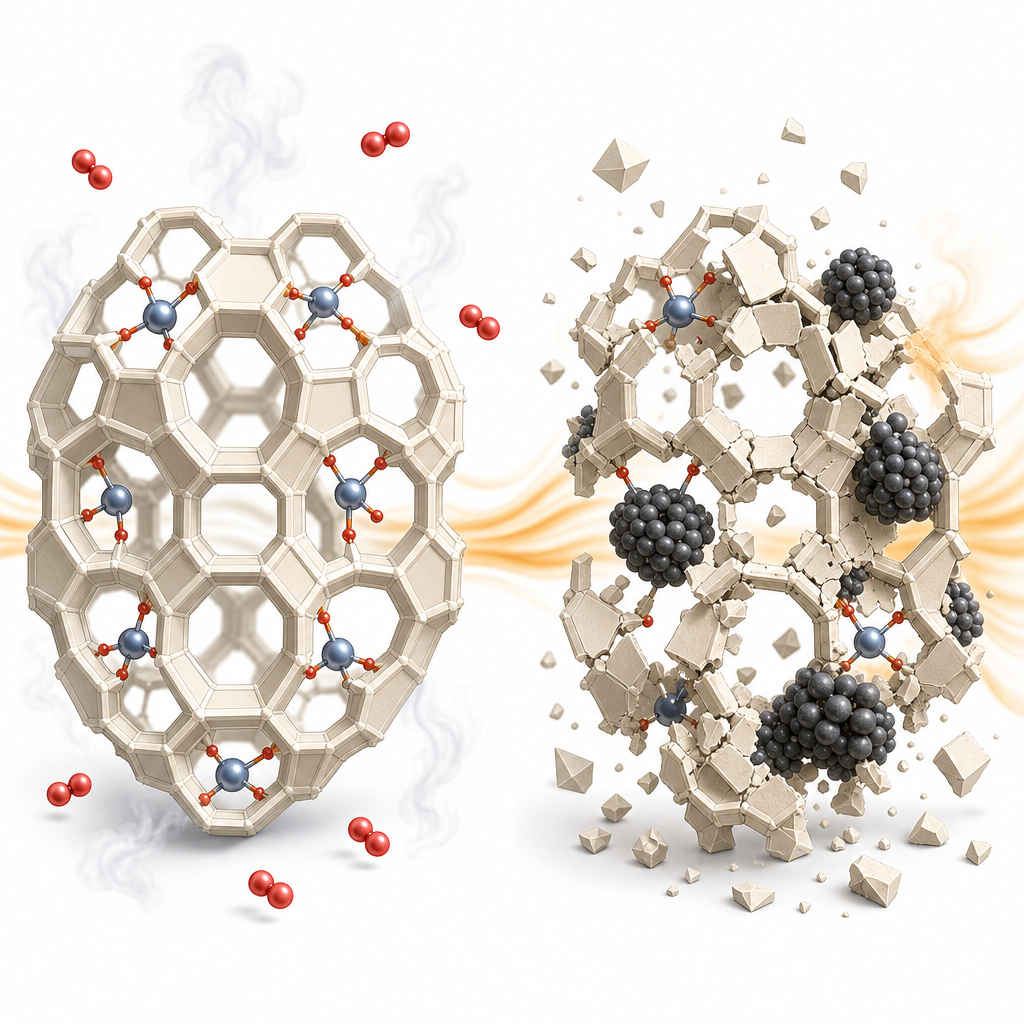 Both fresh catalysts delivered over 90% NO conversion between 300 and 450 °C with near-100% N2 selectivity and no NH3 slip. After 750 °C aging for 16 h, Cu-SSZ-13 lost activity above 400 °C while Cu-SAPO-34 actually gained low-temperature NO conversion, suggesting additional active sites form, plausibly via further solid-state ion exchange driven by the aging temperature. NH3-TPD on the aged Cu-SAPO-34 showed an increase in Lewis acid sites consistent with this picture. The decisive contrast appeared at 800 °C aging: maximum NO conversion on Cu-SSZ-13 dropped to 63% at 350 °C, a ~30% reduction versus the fresh catalyst, accompanied by NH3 slip. DRIFTS showed loss of both Brønsted and Lewis acid sites and a large reduction in exchanged Cu2+; XRD confirmed collapse of the CHA framework. Cu-SAPO-34, in contrast, retained its CHA pattern and showed only a slight drop in NO conversion with no NH3 slip. NH3 oxidation behavior also diverged: on Cu-SSZ-13, 750 °C aging boosted NH3 oxidation and NOx selectivity, indicating aggregation of isolated Cu2+ into CuO particles, while 800 °C aging suppressed NH3 oxidation because of framework collapse. Cu-SAPO-34 showed no significant change in NH3 oxidation across aging conditions.
The findings have direct implications for diesel and dual-fuel aftertreatment design, particularly when SCR catalysts are placed downstream of high-temperature DPF regeneration events. For the formulations tested, Cu-SAPO-34 is the more durable choice, retaining low-temperature SCR performance, framework integrity, and selectivity under conditions that destroy Cu-SSZ-13. The work also points to follow-on research on post-aging solid-state ion exchange as a route to engineer additional active sites in small-pore zeotypes, and on optimizing Cu loading and Si/Al stoichiometry to extend the aging window of Cu-CHA materials.
For researchers working on zeolite and SAPO-based catalysts, this study illustrates the value of starting from a well-characterized commercial support. The SAPO-34 used here is available from ACS Material in the Molecular Sieves catalog, alongside related chabazite-family materials such as SSZ-13 and SAPO-11 that support comparable NH3-SCR, MTO, and adsorption studies. Reliable, reproducible starting materials reduce a major source of variability in catalyst-aging comparisons.How ACS Material products were used
- H-form SAPO-34 zeolite support ((Al+P)/Si = 5) (Molecular Sieves) — “The H-form SAPO-34 zeolite support with an (Al + P)/Si ratio of 5 was purchased from ACS materials.”
Product Performance in this StudyThe SAPO-34 from ACS Material served as the parent support for Cu-SAPO-34, which after solid-state ion exchange showed superior hydrothermal stability compared with Cu-SSZ-13, retaining its CHA structure and SCR activity even after aging at 800 °C for 16 h.
Related product categories
Frequently asked questionsWhy is Cu-SAPO-34 more hydrothermally stable than Cu-SSZ-13 for NH3-SCR?
Under the conditions tested in this study, Cu-SAPO-34 retained its chabazite framework and SCR activity after 800 °C hydrothermal aging for 16 h, while Cu-SSZ-13 lost both. DRIFTS showed a large drop in Brønsted and Lewis acid sites and exchanged Cu2+ in aged Cu-SSZ-13, and XRD confirmed CHA framework collapse. Cu-SAPO-34 showed no such structural breakdown and even gained low-temperature NO conversion after aging.
What Si/Al and (Al+P)/Si ratios were used for the SSZ-13 and SAPO-34 in this comparison?
The Na-form SSZ-13 synthesized at PNNL had a Si/Al ratio of 6, and the H-form SAPO-34 purchased from ACS Material had an (Al+P)/Si ratio of 5. The authors selected these compositions deliberately so that framework Si content would not bias the hydrothermal stability comparison between the two small-pore Cu-CHA catalysts.
How were the Cu-SAPO-34 and Cu-SSZ-13 catalysts prepared in this study?
Both supports were Cu-loaded via solid-state ion exchange in a tube furnace at 700 °C under 350 cm3/min dry air for 16 h. The Na-SSZ-13 was first ion-exchanged to NH4 form using 0.1 M NH4NO3 at 80 °C. ICP analysis gave Cu loadings of 3.97 wt% on SAPO-34 and 4.10 wt% on SSZ-13. Hydrothermal aging used 10% H2O and 10% O2 at GHSV 240,000 h^-1 at 750 and 800 °C.