-
Cu/SAPO-34 NH3-SCR Catalysts - University of Houston, 2014
Jul 01, 2026 | ACS MATERIAL LLCWang, D. et al. (2014). NH3-SCR over Cu/SAPO-34 – Zeolite acidity and Cu structure changes as a function of Cu loading. *Catalysis Today*. https://doi.org/10.1016/j.cattod.2013.11.040
Catalysis Today · 2014
University of Houston researchers used ACS Material H-SAPO-34 zeolite to prepare Cu/SAPO-34 NH3-SCR catalysts and map how Cu loading reshapes acidity.
About this research
Researchers at the University of Houston, working with Cummins Inc., used H-form SAPO-34 zeolite purchased from ACS Material to prepare a series of Cu/SAPO-34 catalysts with copper loadings spanning 0.7-3.0 wt%, and demonstrated that isolated Cu2+ sites stabilized inside the chabazite cages are the active centers for low-temperature NH3 selective catalytic reduction (NH3-SCR) of NOx. The study tracks how the Brønsted acid site count falls monotonically with Cu loading while Lewis acid sites created by Cu ions grow linearly up to 2.0 wt% and then plateau, providing a clear chemical fingerprint of the ion-exchange limit in this small-pore zeolite. Published in Catalysis Today (2014), the paper provides one of the more systematic acidity-versus-Cu-structure maps available for SAPO-34-based SCR catalysts.
NH3-SCR is the dominant after-treatment chemistry used to control NOx emissions from heavy-duty diesel vehicles, and Cu-exchanged small-pore zeolites with the chabazite (CHA) framework - Cu-SSZ-13 and Cu-SAPO-34 - have become the commercial benchmark because they combine wide-window NO conversion (roughly 250-550 °C), high N2 selectivity, and hydrothermal stability beyond what medium-pore zeolites such as ZSM-5 and Beta can offer. However, the conventional aqueous wet ion exchange route is known to hydrolyze SAPO-34 and degrade its crystallinity. Understanding how copper enters the framework, where it sits, and how its local structure changes with loading is therefore essential for designing more durable diesel SCR catalysts, optimizing Cu utilization, and minimizing parasitic NH3 oxidation at high temperature.
The ACS Material H-SAPO-34 zeolite served as the parent support for all catalysts in the study. After calcination at 500 °C in 10% O2, one-gram batches of H-SAPO-34 were physically mixed with controlled amounts (10-50 mg) of nanosized CuO and homogenized; the gray powders were then heated in a tube furnace under 130 sccm air, ramped to 600 °C, and finally held at 800 °C for 12 h to drive solid-state ion exchange. The samples turned blue, indicating successful migration of Cu ions into the CHA cages and exchange with Brønsted protons. Final Cu loadings were verified by ICP, and the resulting catalysts were labeled SSIE-x where x is the Cu wt%. The H-SAPO-34 from ACS Material thus contributed both the acidic protons consumed during exchange and the well-defined CHA pore architecture needed to stabilize isolated Cu2+ - critical because the small 3.8 Å pore of CHA blocks dealumination pathways that destabilize other zeolite SCR catalysts.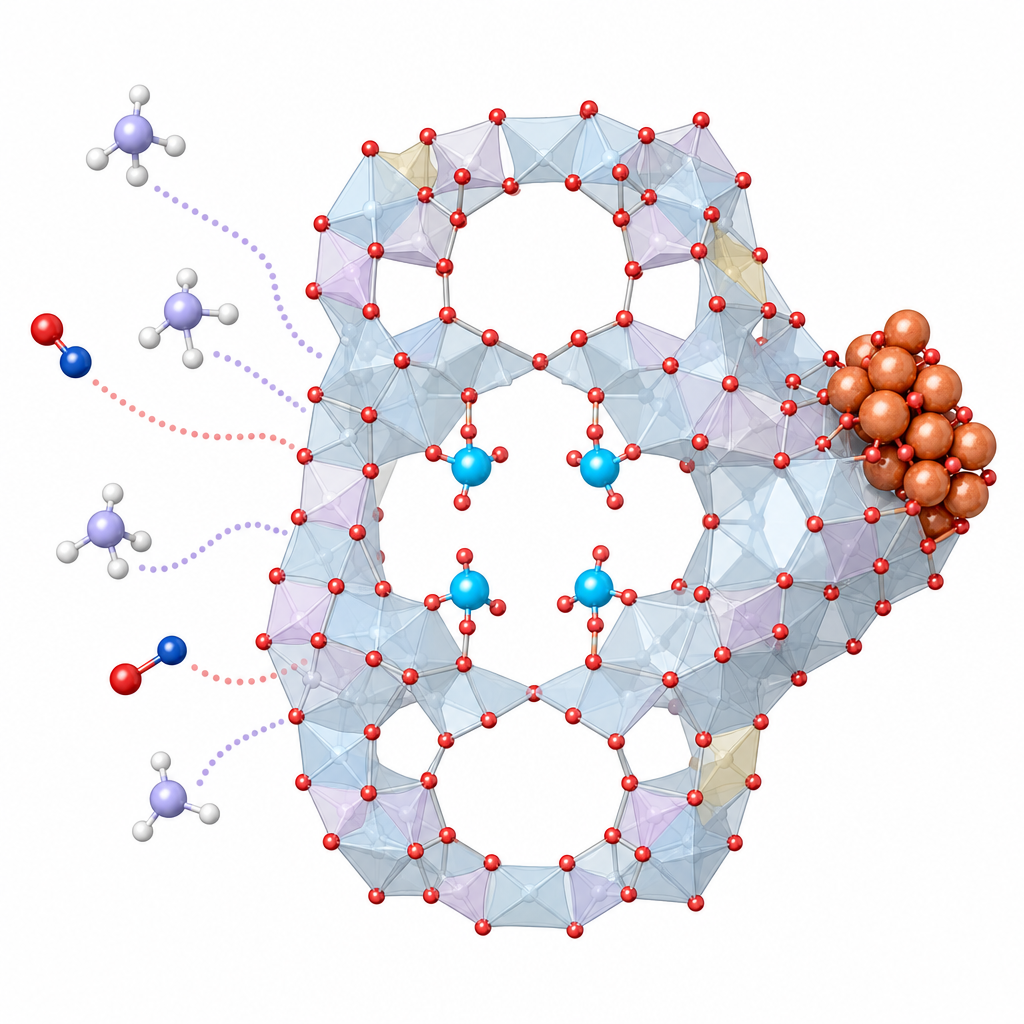
Quantitative findings build a coherent picture of Cu speciation. XRD confirmed that the CHA framework survived the SSIE process at all loadings, while distinct CuO reflections at 36.30° and 38.72° emerged in the SSIE-2.0 and SSIE-3.0 samples, signaling bulk CuO formation only at higher loadings. NH3-TPD showed a monotonic decrease in total Brønsted acid sites as Cu loading rose, consistent with stoichiometric proton replacement by Cu2+. In situ DRIFTS resolved two perturbed T-O-T skeleton vibrations and two NH3 adsorption features, indicating two distinct exchanged Cu environments. NO adsorption DRIFTS likewise revealed two Cu2+ sites: one assigned to isolated Cu2+ in the six-membered rings, the other tentatively to dimeric or oligomeric CuxOy clusters. UV-vis and H2-TPR were used to quantify the isolated Cu2+ fraction, and reaction tests correlated this population with low-temperature SCR activity, identifying isolated Cu2+ as the dominant low-temperature active site. At higher temperatures, samples with elevated Cu loading and detectable CuO showed a drop in standard SCR performance, attributed to CuxOy-promoted non-selective NH3 oxidation by O2 that depletes the reductant before it can react with NO.
The practical implications extend to diesel after-treatment system design, where Cu loading must be tuned to maximize isolated Cu2+ without overshooting into CuO cluster formation that erodes high-temperature selectivity. The same framework principles inform research on ammonia abatement, mobile emission control, stationary NOx scrubbing, and one-pot or solid-state synthesis routes that avoid the structural damage of aqueous ion exchange. The SSIE method validated here is attractive for scale-up because it eliminates wastewater and largely preserves SAPO-34 crystallinity. Follow-on directions flagged by the authors include hydrothermal aging studies, mechanistic resolution of nitrate/nitrite intermediates, and engineering Cu speciation through choice of structure-directing agents.
For researchers pursuing NH3-SCR, methanol-to-olefins, or other chabazite-based catalysis, the H-SAPO-34 used here is available from ACS Material's molecular sieves portfolio, alongside related small-pore zeolites such as SSZ-13 and SAPO-11. The paper offers a useful reference for the Cu loadings, thermal protocols, and characterization endpoints needed to convert a commercial H-SAPO-34 powder into a quantitatively well-defined Cu/SAPO-34 SCR catalyst.How ACS Material products were used
- H-form SAPO-34 zeolite (Molecular Sieves) — “The H-form SAPO-34 zeolite support used in this study was purchased from ACS materials.”
Product Performance in this StudyThe H-SAPO-34 zeolite from ACS Material served as the parent support for preparing the entire series of Cu/SAPO-34 SCR catalysts via solid-state ion exchange. The resulting catalysts displayed the high NO conversions and wide operating window expected for Cu-CHA, confirming that the supplied H-SAPO-34 retained the chabazite framework, Brønsted acidity, and ion-exchange capacity needed for active SCR catalyst synthesis.
Related product categories
Frequently asked questionsWhy is SAPO-34 preferred over ZSM-5 for NH3-SCR of diesel NOx?
SAPO-34 shares the chabazite (CHA) framework with SSZ-13, featuring a small 3.8 Å pore that prevents Al(OH)3 from migrating out and suppresses dealumination during hydrothermal aging. Cu-SAPO-34 retains high NO conversion across a 250-550 °C window and survives aging at 800 °C, whereas medium-pore zeolites such as ZSM-5 and Beta lose activity more readily under the wet, high-temperature conditions typical of diesel exhaust.
What is the role of isolated Cu2+ in Cu/SAPO-34 NH3-SCR catalysts?
Isolated Cu2+ ions stabilized in the six-membered rings of the chabazite cage are the active sites for low-temperature NH3-SCR. They activate NO and NH3 to form nitrate and nitrite intermediates that react to produce N2 and H2O. Their concentration grows linearly with Cu loading until exchange sites saturate; beyond that, additional Cu forms CuxOy clusters and CuO, which promote non-selective NH3 oxidation and degrade high-temperature performance.
How does solid-state ion exchange compare with aqueous ion exchange for preparing Cu-SAPO-34?
Solid-state ion exchange (SSIE) mixes solid CuO with H-SAPO-34 and uses prolonged high-temperature treatment (here, 800 °C for 12 h) to drive Cu2+ into the framework. Compared with aqueous wet ion exchange, SSIE avoids the irreversible hydrolysis and crystallinity loss that water can inflict on SAPO-34, generates no liquid waste, and produces catalysts with comparable or better SCR activity, making it attractive for scale-up.