-
Epoxidized Graphene Grid for CryoEM - Osaka University, 2023
Jul 02, 2026 | ACS MATERIAL LLCFujita, J. et al. (2023). Epoxidized graphene grid for highly efficient high-resolution cryoEM structural analysis. *Scientific Reports*.
Scientific Reports · 2023
Osaka University researchers used ACS Material CVD graphene and Trivial Transfer Graphene to build an EG-grid achieving 1.29 Å cryoEM resolution.
About this research
Researchers at Osaka University developed an epoxidized graphene grid (EG-grid™) for high-resolution cryo-electron microscopy using PMMA-coated CVD graphene and Trivial Transfer® Graphene supplied by ACS Material, achieving structural reconstructions down to 1.29 Å resolution for apoferritin. Published in Scientific Reports (2023), the work introduces a mild photoactivated ClO2· oxidation chemistry followed by epichlorohydrin functionalization that converts ordinary CVD graphene into a hydrophilic, protein-adsorbing support film. The EG-grid dramatically increases particle density and improves orientation distribution, allowing reliable single particle analysis from very small sample volumes and limited micrograph counts.
Specimen grid preparation remains the central bottleneck in cryoEM single particle analysis. Proteins frequently migrate to the air–water interface during vitrification, where they adopt preferred orientations or denature, degrading the achievable resolution and forcing researchers into long screening campaigns. Various functionalized supports — including NTA-graphene, SpyCatcher-graphene, and PEG-amine layers — have been reported, but each requires multi-step chemistry that can damage the graphene lattice or leave residual contamination. A general, robust, and storable functionalization route would substantially lower the barrier to high-resolution structural studies of difficult biological targets, including membrane proteins, viral antigens, and dynamic complexes relevant to vaccine and drug development.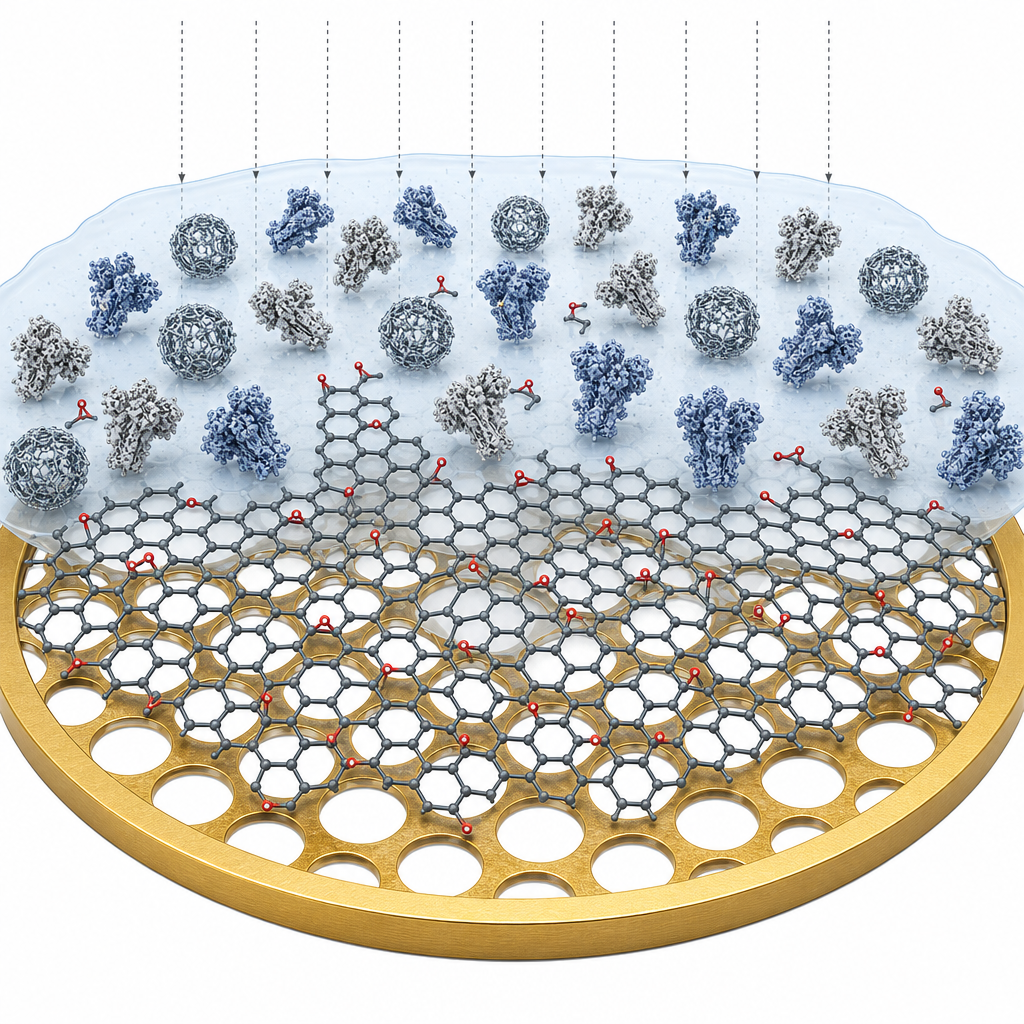
The authors prepared graphene grids using Quantifoil R1.2/1.3 Au 200 mesh substrates and two starting materials from ACS Material: PMMA-coated single-layer CVD graphene on copper foil, and Trivial Transfer Graphene. The CVD-on-Cu route requires copper etching in 0.5 M ammonium persulfate, water washing, transfer onto the Quantifoil grids, PMMA removal in acetic acid, isopropanol rinsing, and baking. The Trivial Transfer Graphene shortcut allowed direct transfer to water without polishing, etching, or washing, dramatically simplifying the workflow. After graphene deposition, grids were oxidized by photoactivated ClO2· gas generated from NaClO2 and HCl under 365 nm UV irradiation for 10 minutes inside a sealed dual-compartment glassware, with the grids shielded by aluminum foil to protect the graphene lattice from direct UV exposure. Surface chemistry was tracked by Raman, FTIR, XPS, and water contact angle measurements. The oxidized graphene was then converted to the epoxidized EG-grid via 1% epichlorohydrin treatment, and the modified grids remained functional for at least three months when stored under N2.
The EG-grid produced striking cryoEM performance gains. A density map of GroEL was reconstructed at 1.99 Å resolution from only 504 micrographs, and human glyceraldehyde 3-phosphate dehydrogenase (GAPDH) reached 2.16 Å from 241 micrographs. The SARS-CoV-2 spike ectodomain (D614G), notoriously challenging because of strong preferred orientation on conventional supports, was reconstructed at 3.10 Å resolution from 1163 micrographs using a sample concentration as low as 0.1 mg ml⁻¹. β-galactosidase reached 1.81 Å and apoferritin reached 1.29 Å, demonstrating atomic-resolution capability. Across all targets, the EG-grid increased particle density on the support and broadened the angular distribution of particle views, both of which are direct contributors to map quality. Storage tests showed that grids oxidized and stored for three months under N2 still produced high-resolution reconstructions, indicating that the chemistry is shelf-stable and compatible with standard laboratory workflows. The authors also demonstrated a fluorinated variant by reacting the EG-grid with 1H,1H-undecafluorohexylamine, opening a path to tunable surface chemistries for different protein classes.
The EG-grid approach is directly relevant to structural biology labs working on viral glycoproteins, membrane complexes, small enzymes near the 100 kDa size limit, and any target that suffers from preferred orientation or low particle density. Because the underlying graphene support is unchanged in terms of electron transparency and conductivity, the EG-grid is compatible with existing automated vitrification devices, K3-class direct electron detectors, and standard 300 kV cryoEM workflows such as those running on CRYO ARM and Titan Krios platforms. Adjacent applications include high-throughput drug-target structural screening, antibody–antigen complex determination for vaccine design, and characterization of intrinsically heterogeneous assemblies where every micrograph counts.
For research groups interested in reproducing or extending this work, the CVD graphene on copper foil and Trivial Transfer® Graphene used here are available from ACS Material as standard catalog items, supporting both the longer PMMA-transfer route and the simplified direct-transfer route described in the paper. The results provide a strong evidence base that high-quality monolayer CVD graphene is a suitable starting point for advanced grid functionalization chemistries aimed at next-generation cryoEM sample supports.How ACS Material products were used
- PMMA-coated single-layer CVD graphene on Cu foil (CVD Graphene) — “PMMA-coated single-layer CVD graphene on a Cu foil from any suppliers (ACS Material, Graphenea, SIGMA-Aldrich etc.) can be used.”
- Trivial Transfer® Graphene (Trivial Transfer Series) — “a much easier and quicker method is to use Trivial Transfer Graphene™ (ACS Material), which can be transferred to water directly without polishing, etching, and washing.”
Product Performance in this StudyThe PMMA-coated CVD graphene on copper foil from ACS Material served as the starting graphene layer that was transferred onto Quantifoil grids and subsequently oxidized and epoxy-functionalized to create the EG-grid for cryoEM imaging.
Related product categories
Frequently asked questionsWhy is CVD graphene used as a cryoEM grid support?
CVD graphene is atomically thin, electron transparent, and electrically conductive, which minimizes background scattering and beam-induced charging during cryoEM imaging. Single-layer CVD graphene on copper foil can be transferred onto Quantifoil grids and chemically functionalized to control hydrophilicity and protein adsorption. In this work, ACS Material CVD graphene served as the starting layer for the EG-grid, supporting reconstructions down to 1.29 Å resolution for apoferritin.
How does Trivial Transfer Graphene simplify cryoEM grid fabrication?
Trivial Transfer Graphene is supplied on a sacrificial polymer support that can be floated directly on water without copper etching, ammonium persulfate washing, or mechanical polishing of the back side. The authors note this provides a much easier and quicker route to deposit graphene on Quantifoil grids compared with PMMA-coated CVD graphene on copper foil, while delivering equivalent cryoEM performance once functionalized into an EG-grid.
What cryoEM resolutions did the epoxidized graphene grid achieve?
The EG-grid reconstructed apoferritin at 1.29 Å, β-galactosidase at 1.81 Å, GroEL at 1.99 Å, and human GAPDH at 2.16 Å resolution from very small micrograph sets. For SARS-CoV-2 spike protein at only 0.1 mg/ml, a 3.10 Å map was obtained from 1163 micrographs. These results demonstrate atomic-resolution single particle analysis capability with markedly improved particle density and orientation distribution.