-
Fluorographite-PDMS Coated PVDF Membranes for DCMD — Hanyang University, 2018
Jun 17, 2026 | ACS MATERIAL LLCSiyal, M. I., & Kim, J. (2018). Fluorographite-co-polydimethylsiloxane coated polyvinylidene-fluoride membrane for desalination of highly saline water with humic acid in direct contact membrane …. *Environmental Research*. https://doi.org/10.1016/j.envres.2018.07.029
Environmental Research · 2018
Fluorographite from ACS Material coated with PDMS on PVDF membranes delivered amphiphobic surfaces for DCMD desalination of 1 M NaCl brine with humic acid.
About this research
Researchers at Hanyang University (Seoul, South Korea) used fluorographite (graphite monofluoride) microcrystalline powder supplied by ACS Material to fabricate an amphiphobic fluorographite-co-polydimethylsiloxane (FGi/PDMS) coating on polyvinylidene fluoride (PVDF) flat-sheet membranes, enabling stable direct contact membrane distillation (DCMD) of highly saline feed water containing humic acid. Authors Muhammad Irfan Siyal and Jong-Oh Kim, publishing in Environmental Research (2018), demonstrate that the coated PVDF membrane treats 1 M NaCl brine spiked with humic acid (HA) while maintaining near-complete salt rejection and resisting the wetting and organic fouling that limit conventional hydrophobic MD membranes.
Membrane distillation is increasingly attractive for desalination because it can use low-grade waste or solar heat, accepts high-salinity feeds without extensive pretreatment, and theoretically achieves 100% salt rejection. However, commercial PVDF and PTFE MD membranes suffer from pore wetting and flux decline when challenged with surfactants, low surface-tension organics, or humic substances common to industrial brines and seawater. Prior work has shown that increasing surface amphiphobicity — combined hydrophobicity and oleophobicity — through fluorinated silica or omniphobic Teflon-AF coatings can mitigate fouling. The challenge is finding an amphiphobic material that is mechanically robust, easy to deposit on existing PVDF supports, and effective with realistic feed waters containing natural organic matter such as humic acid.
Fluorographite, a two-dimensional fluorinated carbon often described as the graphene analogue of PTFE, provides extremely low surface energy and very high water contact angles. In this work, the graphite monofluoride microcrystalline powder from ACS Material (CA, USA) was dispersed by 40 kHz ultrasonication together with PDMS (SYLGARD 184) in cyclohexane/n-hexane solvents to form the coating suspension. The mixture was then deposited onto a Durapore HVHP PVDF membrane (0.45 µm pore size, 95 cm² coating area) by vacuum filtration through a 110 mm ceramic Buchner funnel, with a Whatman filter paper underlay ensuring uniform flow distribution. PDMS acted as a binder anchoring the FGi platelets to the PVDF surface while preserving porosity. The coated membranes were characterized by SEM and EDX for morphology and elemental confirmation of fluorine and silicon distribution, AFM for surface roughness, FTIR for functional groups, and contact-angle goniometry using DI water as well as organic probe liquids of known surface tension. Dynamic liquid entry pressure (LEPd) was measured before and after MD operation.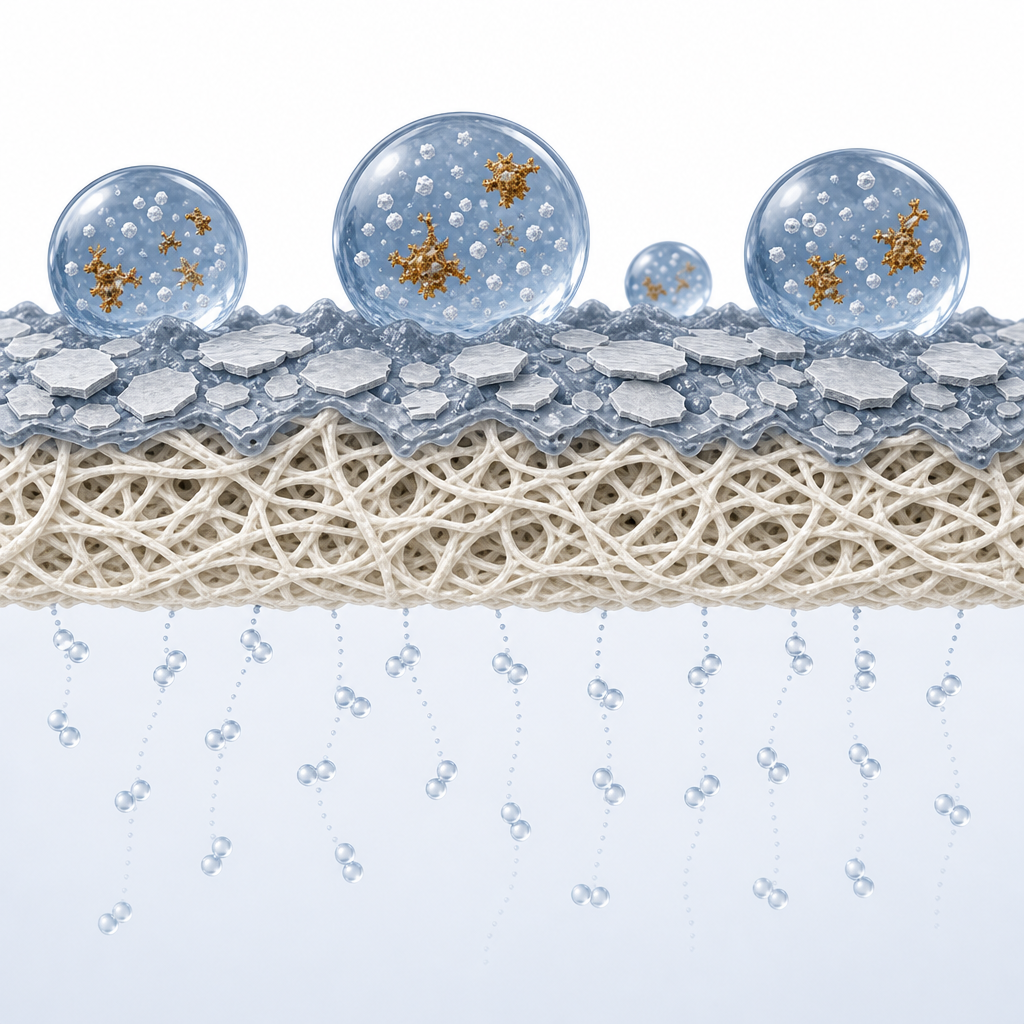
The FGi/PDMS-coated PVDF showed clear amphiphobic behavior. Surface morphology revealed a hierarchical roughness from anchored fluorographite flakes, and EDX confirmed uniform fluorine coverage. Water contact angle increased substantially relative to the virgin PVDF, and the coated surface also repelled organic probe liquids, indicating oleophobic character that virgin PVDF cannot provide. Liquid entry pressure rose accordingly, an important indicator of wetting resistance under MD operating pressures. In DCMD tests run with three feeds — DI water, 1 M NaCl, and 1 M NaCl containing humic acid — the coated membrane sustained vapor flux comparable to the uncoated control while delivering near-complete (>99.9%) salt rejection. Critically, in the humic-acid-containing feed, where prior literature reports up to 50% flux decline due to organic fouling, the FGi/PDMS coating substantially suppressed the flux drop and maintained stable permeate conductivity over the test duration. Post-MD contact-angle measurements confirmed that the amphiphobic surface chemistry survived contact with the saline organic feed, indicating durable adhesion of fluorographite to the PVDF support through the PDMS network.
The results point toward practical applications in desalination of challenging feed streams: reverse-osmosis brine concentrate, produced water from oil and gas operations, landfill leachate, and seawater rich in dissolved organic matter. By demonstrating that a simple vacuum-filtration coating of a commercial fluorographite powder can convert standard PVDF microfiltration membranes into amphiphobic MD membranes, the work lowers the barrier to scalable membrane fabrication. Follow-up directions noted by the authors include extending feed chemistry to surfactant-containing waters, longer-term fouling tests, and integration with solar or waste-heat DCMD modules.
For researchers exploring fluorinated 2D coatings, anti-wetting membranes, or low-surface-energy composites, the graphite fluoride (carbon monofluoride / fluorographite) supplied by ACS Material is available as a research-grade microcrystalline powder under the Graphene Series catalog. This study illustrates how the material performs as a coating constituent on polymeric membrane supports in a demanding desalination environment, providing a quantitative benchmark for surface energy modification and humic-acid fouling resistance that other groups can build on.How ACS Material products were used
- Graphite Fluoride (Carbon Monofluoride) / Fluorographite microcrystalline powder (Graphene Series) — “Graphite monofluoride microcrystalline powder was supplied by ACS material (CA, USA).”
Product Performance in this StudyFluorographite (FGi) supplied by ACS Material served as the active amphiphobic coating material co-deposited with PDMS on PVDF membranes. Its incorporation increased water contact angle, raised liquid entry pressure, and provided strong resistance to wetting and humic-acid fouling during direct contact membrane distillation of highly saline water.
Related product categories
Frequently asked questionsWhat is fluorographite used for in membrane distillation research?
Fluorographite, the two-dimensional fluorinated analogue of PTFE, is used as a low-surface-energy coating material to make membrane distillation (MD) membranes amphiphobic — simultaneously hydrophobic and oleophobic. Deposited with a PDMS binder on PVDF or other polymeric supports, it raises water contact angle and liquid entry pressure, suppressing pore wetting and organic fouling when treating highly saline feeds that contain humic acid, surfactants, or other low-surface-tension contaminants.
How does an amphiphobic PVDF membrane resist humic acid fouling in DCMD?
Humic acid molecules adhere to hydrophobic PVDF through hydrophobic and van der Waals interactions, causing flux declines up to 50%. An amphiphobic fluorographite/PDMS coating lowers both the polar and dispersive components of surface energy, so humic acid macromolecules and low-surface-tension organics cannot spread or wet pores. The result is sustained vapor flux, near-100% salt rejection, and stable permeate conductivity during direct contact membrane distillation of saline organic feeds.
Why is graphite monofluoride preferred over fluorinated silica for membrane coatings?
Graphite monofluoride (fluorographite) offers intrinsically low surface energy comparable to PTFE in a layered 2D form that provides hierarchical roughness when deposited as microcrystalline powder. Unlike fluorinated silica, it requires no additional silane chemistry, can be applied by simple vacuum filtration with PDMS, and brings chemical stability under hot saline operating conditions. These properties simplify membrane fabrication while delivering robust amphiphobicity and improved liquid entry pressure.