-
GNP-Derived GO Fillers for PLLA Crystallization — Iran Polymer Institute, 2019
May 29, 2026 | ACS MATERIAL LLCKarimi, S., Ghasemi, I., & Abbassi-Sourki, F. (2019). A study on the crystallization kinetics of PLLA in the presence of Graphene Oxide and PEG-grafted-Graphene Oxide: Effects on the nucleation and chain …. *Composites Part B: Engineering*. https://doi.org/10.1016/j.compositesb.2018.10.004
Composites Part B: Engineering · 2019
Researchers used ACS Material graphene nanoplatelets to synthesize GO and PEG-grafted GO fillers that boost PLLA nucleation and spherulite growth.
About this research
In a study published in Composites Part B: Engineering (2019), researchers at the Iran Polymer and Petrochemical Institute used ACS Material graphene nanoplatelets (GNP, <5 µm platelet diameter, 2–10 nm thickness) as the carbon precursor to fabricate graphene oxide (GO) and PEG-grafted graphene oxide (GO-g-PEG) nanofillers for poly(L-lactic acid) (PLLA) nanocomposites. The headline result: PEG grafting onto GO simultaneously improved nucleation density and spherulite growth rate of PLLA, with Lauritzen–Hoffman analysis confirming a measurable reduction in both the primary nucleation and crystal-growth energy barriers compared with unmodified GO.
PLLA is a leading bio-based, biodegradable polymer for packaging, biomedical implants, and 3D-printing filaments, but its slow crystallization rate limits melt-processing throughput and dimensional stability. Heterogeneous nucleating agents are widely studied to mitigate this; carbon nanofillers including GO are particularly attractive because they combine large specific surface area with tunable surface chemistry. The open challenge is that pristine graphene-family fillers tend to aggregate in polyester matrices, weakening the matrix-filler interaction and limiting the nucleation benefit. Surface functionalization with PLLA-compatible chains, such as poly(ethylene glycol), is one strategy to break the π-π stacking and improve dispersion. This paper rigorously quantifies how that strategy affects each step of PLLA crystallization.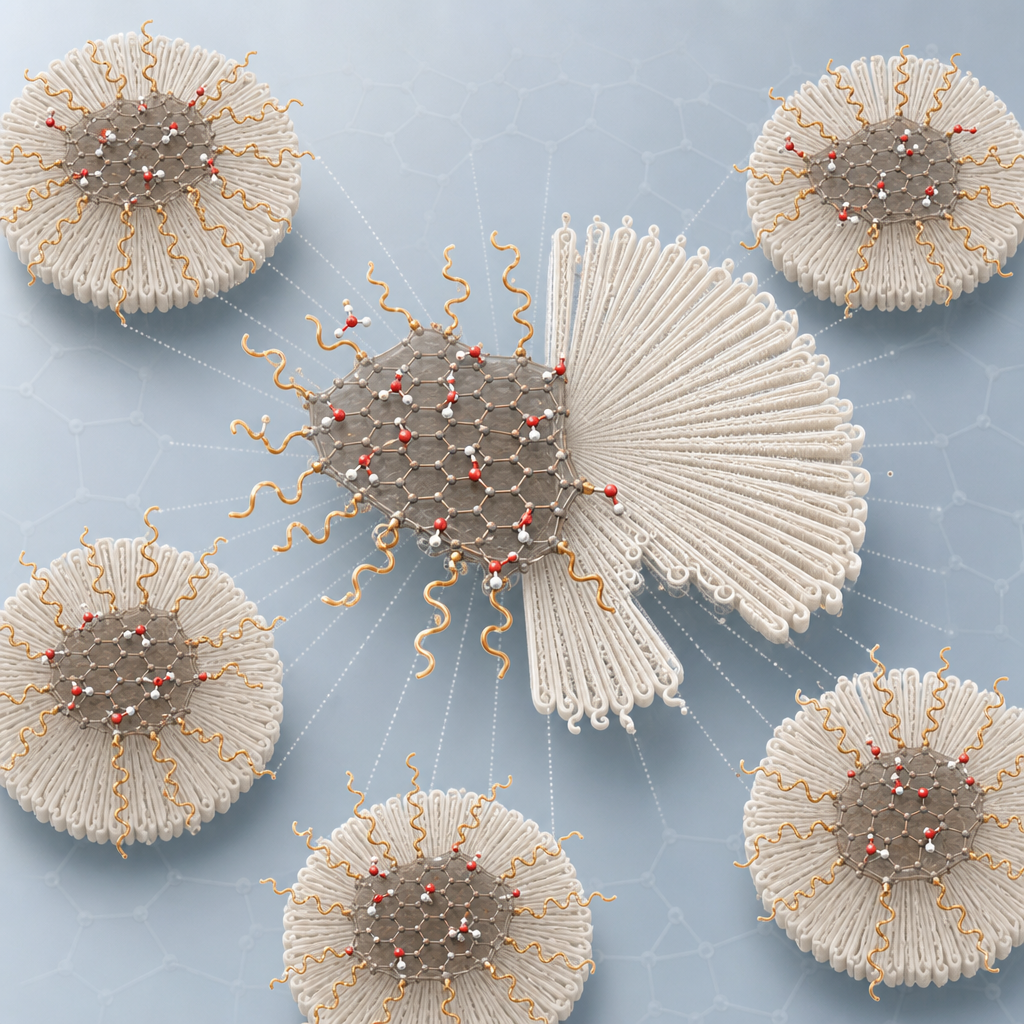
The ACS Material graphene nanoplatelets were used as the starting carbon source. According to the Materials section, the GNP product naturally contains up to 0.5 wt% oxygenated functional groups (ethers, carboxyls, hydroxyls). The team first oxidized the GNP using a modified Hummers method (H2SO4, NaNO3, KMnO4, controlled temperature staging, H2O2 quench, HCl wash, freeze drying) to produce GO. In a second step, GO was activated with 1,1′-carbonyldiimidazole (CDI) in DMSO and reacted with PEG 2000 to yield GO-g-PEG, with 17.6 wt% PEG grafting confirmed by TGA. The three fillers (GNP, GO, GO-g-PEG) were then dispersed in DMF at 1 mg/mL, sonicated, blended with PLLA/DMF solution at 80 °C, and cast into nanocomposite films at filler loadings of 0.5, 1.0, and 1.5 wt%. The ACS Material GNP product therefore underpins the entire filler synthesis workflow.
FTIR confirmed successful oxidation (C=O at 1710 cm⁻¹, broad O–H at 3430 cm⁻¹) and PEG grafting (ester C=O shift to 1731 cm⁻¹, C-O-C ether at 1106 cm⁻¹). XRD showed the GNP characteristic peak at 2θ = 26.6° shifting to 12.66° for GO (increased interlayer spacing) and almost vanishing for GO-g-PEG. SEM revealed that GNP aggregated, GO dispersed more uniformly, and GO-g-PEG appeared as well-separated platelets in the PLLA matrix. Isothermal DSC at 120, 125, and 130 °C showed neat PLLA produced no detectable endotherm at 120 °C, while all GO- and GO-g-PEG-filled samples crystallized. POM at 130 °C showed that PLLA with 0.5 wt% GO-g-PEG developed a uniform nucleation field within 3 minutes and that spherulites coalesced rapidly. Radial growth rate G = dR/dt was consistently higher for GO-g-PEG composites than for GO counterparts at all filler loadings. Bulk crystallization rate 1/t0.5 peaked at 1.5 wt% loading; the intermediate 1 wt% loading actually showed reduced rate, attributed to over-nucleation restricting chain mobility. Lauritzen–Hoffman fitting separated the contributions of secondary nucleation (Kg^s, crystal growth) and primary nucleation (Kg^n). Samples containing GO-g-PEG showed lower Kg^s values, evidencing that grafted PEG chains plasticize the local environment and lower the chain-folding barrier. At 1 wt% loading both fillers showed sharply reduced Kg^n, while at 1.5 wt% Kg^n rose again because nanoparticle aggregation reduced effective nucleation site density.
These results matter for the broader development of biodegradable polymer composites for sustainable packaging, biomedical scaffolds, and additive-manufacturing feedstocks where rapid crystallization is needed to achieve thermal stability and mechanical performance during cooling. The work shows that simply increasing carbon nanofiller loading is not always beneficial: an optimal filler-loading window exists, governed by the trade-off between nucleation site density and the resulting restriction of polymer chain mobility. The PEG-grafting strategy generalizes to other polyester matrices (PLA, PLGA, PCL) where chain compatibility is needed. Future directions pointed to by the authors include extending the framework to non-isothermal cooling and exploring mechanical and gas-barrier consequences of these crystallization changes.
For researchers working on graphene-modified biopolymers, the study illustrates how the choice of starting nanoplatelet material directly influences the quality of derived GO and grafted-GO fillers. Graphene nanoplatelets with the 2–10 nm thickness range used here remain available from ACS Material, and the broader Graphene Series and Carbon Series categories supply GO, functionalized GO, and related carbon nanofillers suitable for polymer-composite, crystallization-kinetics, and rheology studies.How ACS Material products were used
- Graphene Nanoplatelets (2-10nm) (Graphene Series) — “Graphene Nanoplatelet (GNP) was an ACS Material Graphene Nanoplatelet from Advanced Chemicals. GNP particles consisted of aggregates of submicron platelets with a particle diameter of less than 5 µm, and a typical particle thickness of 2-10nm.”
Product Performance in this Study
The ACS Material graphene nanoplatelets served as the precursor for both GO and PEG-grafted GO fillers. After oxidation and grafting, the resulting nanofillers acted as effective heterogeneous nucleating agents in the PLLA matrix, significantly enhancing crystallization kinetics.
Related product categories
Frequently asked questions
How do graphene nanoplatelets improve PLLA crystallization rate?
Graphene nanoplatelets and their oxidized derivatives act as heterogeneous nucleating agents that lower the free-energy barrier for nucleus formation in PLLA. Their high specific surface area promotes adsorption and conformational ordering of polymer chains. Surface functional groups, especially PEG grafted on GO, further enhance matrix-filler compatibility, leading to faster nucleation and accelerated spherulite growth rates compared with neat PLLA.
Why does PEG grafting on graphene oxide enhance polymer nucleation?
PEG is chemically compatible with PLLA across a wide concentration range. When grafted onto GO, PEG chains break π-π stacking between platelets, yielding finer dispersion in the matrix. The C-O-C ether groups of PEG also interact favorably with the methyl groups of PLLA, lowering the nucleation barrier energy and acting as a local lubricant that boosts chain mobility during crystal growth.
What is the optimal graphene oxide loading for PLLA nanocomposite crystallization?
The study found that 1 wt% loading produced the highest nucleation density but lowest overall crystallization rate, because over-nucleation restricts chain mobility. The 1.5 wt% loading produced the fastest bulk crystallization rate because partial nanoparticle aggregation reduced nucleation site density, freeing chain motion. The optimal loading therefore depends on whether nucleation density or bulk crystallization speed is the target.