-
GO/MoS2-PVA Membranes for Water Treatment — UTS, 2020
Jun 08, 2026 | ACS MATERIAL LLCYadav, S. et al. (2020). Feasibility of brackish water and landfill leachate treatment by GO/MoS2-PVA composite membranes. *Science of The Total Environment*. https://doi.org/10.1016/j.scitotenv.2020.141088
Science of The Total Environment · 2020
University of Technology Sydney researchers used ACS Material large-area graphene oxide to fabricate GO/MoS2-PVA membranes for brackish water and landfill leachate treatment.
About this research
Researchers at the University of Technology Sydney (UTS), working with collaborators in Australia, used large surface-area graphene oxide supplied by ACS Material, LLC to fabricate GO/MoS2-PVA composite membranes that successfully treated both brackish water and landfill leachate. Published in Science of the Total Environment in 2020, the study by Yadav, Ibrar, Altaee and co-workers demonstrates that combining ACS Material's graphene oxide (oxygen content ~40.78 wt%, BET >100 m²/g, lateral size 1–5 μm, thickness 0.8–1.2 nm) with MoS2 nano-spacers and a polyvinyl alcohol cross-linker yields stable membranes capable of rejecting common salts and a broad range of heavy metals, presented as a scalable low-energy alternative to polyamide reverse osmosis and nanofiltration membranes.
Water reuse is increasingly limited by the shortcomings of incumbent polyamide membranes — fouling, limited recovery, and pressure-dependent permeation losses. Graphene oxide membranes have emerged as a high-rejection, high-permeability alternative because their tunable interlayer d-spacing enables molecular sieving. However, two persistent challenges remain: GO laminates swell in aqueous and ionic environments (interlayer spacing can expand from ~0.3 nm dry to ~0.9 nm when hydrated, which is larger than the hydrated radius of Na+), and they compact under operating pressure, both of which degrade rejection over time. Treating landfill leachate — a complex mixture of salts, organics and toxic metals — places particularly harsh demands on membrane chemical stability. Addressing these issues with a 2D heterostructure approach has direct industrial relevance for desalination, mining wastewater treatment, and municipal solid-waste leachate management.
The ACS Material large-area graphene oxide functioned as the primary selective laminate as well as a dispersing surfactant that stabilized MoS2 nanopowder during membrane assembly. The methods section describes weighing 12.5 mg each of GO and MoS2 into separate 500 mL reagent bottles, adding 250 mL of deionized water, and ultrasonicating at 40 kHz for 12 hours at 40–45 °C to produce a homogeneous aqueous dispersion. A 5 wt% PVA solution was prepared separately by stirring PVA (M.W. 47,000) in DI water at 60 °C for 24 hours. The GO/MoS2 dispersion was then coated onto hydrophilic cellulose acetate filter supports (47 mm diameter, 0.2 μm pore size) by pressure-assisted dead-end filtration. PVA was introduced to cross-link with the polar oxygenated moieties of the GO sheets through hydrogen bonding and covalent linkages, with the MoS2 nanosheets acting as nano-spacers that fix interlayer channels and impart chemical robustness. The high oxygen content and large lateral size of the ACS Material GO were important for forming continuous, defect-tolerant laminates and for providing abundant hydroxyl and carboxyl groups to anchor PVA.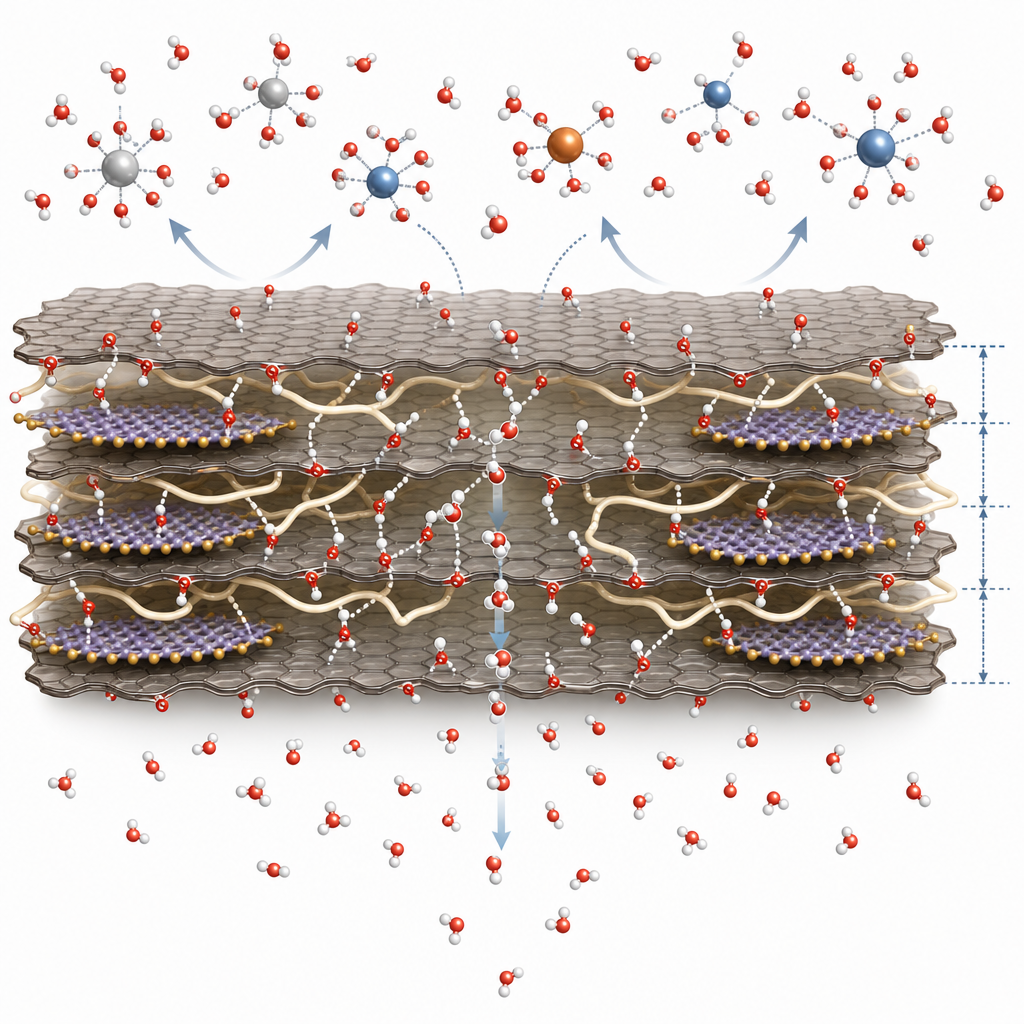
The GO/MoS2-PVA composite membranes were evaluated on synthetic brackish water (2 g/L NaCl) and real landfill leachate. Salt rejection from the 2 g/L NaCl feed was substantial, with the cross-linked PVA layer suppressing swelling-driven loss of selectivity. For landfill leachate, the membranes demonstrated high rejection across an unusually broad set of metal cations, including potassium, calcium, magnesium, aluminum, chromium, iron, zinc, silver, lead and thorium. Rejection of multivalent and heavy metal species is attributed to the combined effect of size exclusion through GO/MoS2 channels and Donnan exclusion from the negatively charged oxygenated GO surface. The MoS2 nano-spacer fixed the d-spacing to limit hydration-induced expansion, while PVA cross-linking enhanced mechanical stability against compaction. Compared with literature values for GO nanofiltration membranes (pure water permeability 11–20 L/m²·h·bar with Na2SO4/NaCl/MgSO4/MgCl2 rejection of 15–63%), the GO/MoS2-PVA system extends rejection to multiple toxic heavy metals encountered in real leachates while remaining producible by pressure-assisted filtration on inexpensive cellulose acetate supports.
The results point to practical roles in mine and landfill wastewater polishing, pretreatment for RO desalination of brackish groundwater, and decentralized water reuse systems where chemical robustness against complex feeds matters more than ultrahigh single-solute permeability. Because the fabrication route avoids polyamide interfacial polymerization and uses scalable vacuum/pressure filtration, it lends itself to scale-up on hollow-fiber or spiral-wound modules. Follow-up directions the authors identify include long-term fouling studies on real leachates, optimization of GO:MoS2:PVA mass ratios, and exploration of additional 2D nano-spacers (h-BN, MXenes) to further tune channel width and surface chemistry. Recovery and reuse of high-value metals (Ag, Th) captured on or rejected by the membrane is another worthwhile direction.
For researchers building GO laminate membranes, the specifications of the graphene oxide starting material — oxygen content, lateral flake size, and thickness — directly govern interlayer spacing, mechanical strength, and the density of functional anchoring sites for cross-linkers like PVA. ACS Material's Large-Size Graphene Oxide, used here, is part of a broader graphene series available to laboratories developing nanofiltration, desalination and heavy-metal removal membranes. The data in this paper support its use as a robust starting point for 2D composite membrane research targeting brackish water and complex industrial wastewater.How ACS Material products were used
- Large-Size Graphene Oxide (Graphene Series) — “Large surface area-graphene oxide (Brownish Yellow Powder; Oxygen Content: ~40.78 wt. %; BET: >100 m2/g; Lateral size: 1-5 μm; Thickness: 0.8-1.2 nm) was supplied by ACS Material, LLC., CA 91106, USA.”
Product Performance in this StudyThe large surface-area graphene oxide formed the core selective layer of the composite membrane, acting as a surfactant for MoS2 nano-spacers and providing high rejection performance for salts and heavy metals in brackish water and landfill leachate.
Related product categories
Frequently asked questionsHow does MoS2 improve graphene oxide membranes for water treatment?
MoS2 nanosheets act as nano-spacers between GO layers, fixing the interlayer d-spacing and preventing the hydration-driven swelling that normally expands GO channels in aqueous and ionic environments. They also provide chemical robustness against complex feeds such as landfill leachate. In the GO/MoS2-PVA system reported here, this combination enabled high rejection of NaCl and a broad set of heavy metals while keeping the membrane mechanically stable under pressure-driven filtration.
What grade of graphene oxide is best for nanofiltration membrane fabrication?
Large-area graphene oxide with high oxygen content (~40 wt%), large lateral flake size (1–5 μm), thin profile (0.8–1.2 nm), and high BET surface area (>100 m²/g) is well suited to laminate membranes. Large flakes form continuous, defect-tolerant films with longer transport paths, while abundant oxygenated groups provide anchoring sites for cross-linkers such as PVA. The ACS Material large surface-area GO used in this study matches these specifications.
Can graphene oxide membranes remove heavy metals from landfill leachate?
Yes. The GO/MoS2-PVA composite membrane in this study demonstrated high rejection of potassium, calcium, magnesium, aluminum, chromium, iron, zinc, silver, lead and thorium from real landfill leachate. Removal is driven by a combination of size exclusion through the GO/MoS2 interlayer channels and Donnan exclusion from the negatively charged oxygen functional groups on GO. PVA cross-linking suppresses swelling so that the rejection performance is maintained during operation.