-
Graphene Benchmark for AA/DA/UA Biosensor - Hunan Normal University, 2016
Jun 08, 2026 | ACS MATERIAL LLCDeng, W. et al. (2016). Three-dimensional graphene-like carbon frameworks as a new electrode material for electrochemical determination of small biomolecules. *Biosensors and Bioelectronics*.
Biosensors and Bioelectronics · 2016
Hunan Normal University researchers benchmarked 3D graphene-like carbon frameworks against ACS Material commercial graphene for simultaneous detection of ascorbic acid, dopamine, and uric acid.
About this research
Researchers at Hunan Normal University used commercial graphene (CG) purchased from ACS Material, LLC as the benchmark electrode material against which they evaluated a new 3D graphene-like carbon framework (3DGLCFs), achieving simultaneous voltammetric detection of ascorbic acid (AA), dopamine (DA), and uric acid (UA) with detection limits down to 1 × 10⁻⁸ M. The work, published in Biosensors and Bioelectronics in 2016 by Deng, Yuan, Tan, Ma, and Xie of the College of Chemistry and Chemical Engineering, demonstrates how a nitrogen-doped, mesoporous 3D carbon framework substantially outperforms a high-quality commercial graphene reference on a glassy carbon electrode (GCE) platform for clinically relevant small-molecule sensing.
Simultaneous electrochemical determination of AA, DA, and UA is a long-standing challenge in clinical electroanalysis. These three biomolecules coexist at very different concentrations in biological fluids, and on bare carbon electrodes their oxidation peaks overlap into a single broad wave, making selective quantification impossible. Dopamine monitoring in extracellular fluids is central to studies of neurotransmission and Parkinson's disease; uric acid is a biomarker for gout, hyperuricemia, and leukemia; ascorbic acid interferes with both. Researchers therefore search continually for carbon nanomaterials that combine high surface area, fast electron transfer, and nitrogen doping to separate the three peaks. Three-dimensional carbon architectures from CVD on porous metals are effective but expensive and low-yield, motivating cheaper template-free or salt-templated routes such as the polyaniline/Ni(NO₃)₂ co-pyrolysis used here.
The ACS Material commercial graphene was used as the comparison electrode modifier throughout the electrochemical study. The authors dispersed 5.0 mg of either the home-made 3DGLCFs or the ACS Material CG in 10 mL ethanol by 1 h of sonication to obtain stable inks, then cast-coated 2 μL onto a 3 mm-diameter polished GCE and dried in air. A 2 μL drop of 0.1 wt% chitosan in HAc-NaAc buffer was added to stabilize the film. The resulting CG/GCE served as the reference electrode for cyclic voltammetry and differential pulse voltammetry in 0.1 M phosphate buffer (pH 7.0) containing the three analytes. Independently, BET analysis on the CG gave a specific surface area of 650 m² g⁻¹, providing a calibration point against which the 1088 m² g⁻¹ of the 3DGLCFs could be assessed. The CG therefore plays two roles: it benchmarks both the electroactive surface area and the achievable peak separation that a state-of-the-art commercial graphene can deliver on this electrode format.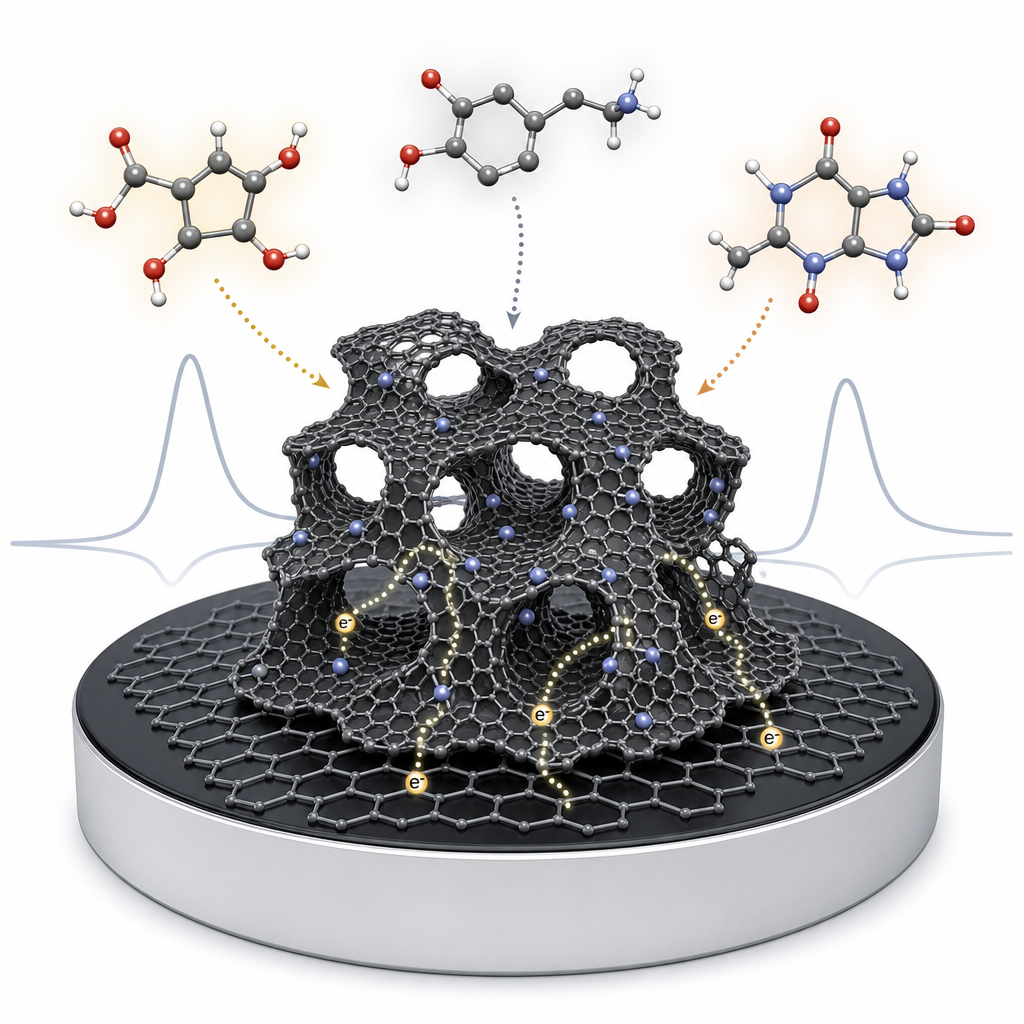
The 3DGLCFs prepared by co-pyrolysis of polyaniline and nickel nitrate at 800 °C followed by HCl etching showed an interconnected porous network of ~4 nm-thick graphene-like sheets with mesopores around 2-30 nm. XPS gave 89.11 at% C, 4.63 wt% N, and 6.26 wt% O, with the nitrogen distributed as 22.7% pyridinic, 16.5% pyrrolic, and 60.8% graphitic. Raman spectra showed D and G bands at 1347 and 1572 cm⁻¹ with I_G > I_D, indicating moderate graphitization. In cyclic voltammetry of 500 μM AA + 10 μM DA + 20 μM UA, the bare GCE produced only one broad anodic wave, whereas the 3DGLCFs/GCE resolved three well-defined peaks at 0.09, 0.14, and 0.27 V. Peak separations were 0.23 V (AA–DA), 0.13 V (DA–UA), and 0.36 V (AA–UA). The ACS Material CG/GCE separated the peaks but delivered substantially lower current response, consistent with its smaller BET surface area and lower nitrogen content. By differential pulse voltammetry the 3DGLCFs/GCE gave linear ranges of 1.25 × 10⁻⁵–4 × 10⁻⁴ M for AA, 5 × 10⁻⁸–1.0 × 10⁻⁵ M for DA, and 5 × 10⁻⁸–1.5 × 10⁻⁵ M for UA, with detection limits of 2 × 10⁻⁶, 1 × 10⁻⁸, and 1 × 10⁻⁸ M, respectively. The electrode was further validated on diluted human serum with satisfactory recoveries.
The results have direct implications for clinical electroanalysis, point-of-care neurochemistry, and metabolite monitoring. The salt-templated 3D carbon framework approach offers a scalable alternative to CVD-grown 3D graphene on nickel foams for biosensor electrodes, supercapacitor electrodes, and oxygen-reduction catalyst supports. By placing the new material on the same benchmark as commercial graphene from a well-known supplier, the authors make the performance gain reproducible and comparable across laboratories. Follow-up work suggested by the paper includes extending the same 3D nitrogen-doped framework to enzyme-free glucose sensing, neurotransmitter arrays in microfluidic chips, and high-rate supercapacitor electrodes where mesoporosity and graphitic nitrogen jointly govern performance.
For researchers running similar electrochemical benchmarking studies, the commercial graphene used in this paper is available from ACS Material's Graphene Series catalog. Using a consistent, well-characterized graphene reference is essential when claiming improvements with novel nanocarbons, since BET surface area, defect density, and dispersibility in casting inks can otherwise vary widely between suppliers. The same product line supports comparison studies in supercapacitors, electrocatalysis, and composite electrode development.How ACS Material products were used
- Commercial Graphene (CG) (Graphene Series) — “CG was purchased from ACS Material, LLC (Medford, MA).”
Product Performance in this StudyCommercial graphene from ACS Material served as the benchmark electrode modifier. The CG/GCE showed lower current response, smaller electrochemically active surface area, and poorer peak separation for AA/DA/UA compared with the 3DGLCFs/GCE, providing a clear performance baseline against which the new 3D carbon framework was validated. CG itself exhibited a BET surface area of 650 m² g⁻¹.
Related product categories
Frequently asked questionsWhy is commercial graphene used as a benchmark in electrochemical sensor studies?
Commercial graphene provides a reproducible reference electrode material with well-known BET surface area, conductivity, and dispersibility. Benchmarking novel carbon frameworks against a standard commercial graphene allows researchers to attribute observed performance gains—such as larger peak currents, better peak separation, or lower detection limits—to specific structural features like 3D porosity or nitrogen doping rather than to lot-to-lot variation in the reference material.
How do 3D graphene-like carbon frameworks improve simultaneous detection of dopamine, ascorbic acid, and uric acid?
The 3D interconnected porous network combines a high BET surface area of 1088 m² g⁻¹, nitrogen doping totaling 4.63 wt%, and moderate graphitization. Together these give a large electrochemically active area, fast electron transfer, and rapid analyte mass transport to the electrode surface. The result is three well-resolved oxidation peaks at 0.09, 0.14, and 0.27 V with separations up to 0.36 V between ascorbic acid and uric acid.
What detection limits were achieved for dopamine and uric acid with the 3DGLCFs-modified glassy carbon electrode?
Using differential pulse voltammetry in 0.1 M phosphate buffer, the 3DGLCFs/GCE reached detection limits of 1 × 10⁻⁸ M for dopamine and 1 × 10⁻⁸ M for uric acid, with a linear range of 5 × 10⁻⁸–1.0 × 10⁻⁵ M for DA and 5 × 10⁻⁸–1.5 × 10⁻⁵ M for UA. For ascorbic acid the detection limit was 2 × 10⁻⁶ M over a linear range of 1.25 × 10⁻⁵–4 × 10⁻⁴ M.