-
Graphene Carbon Foam Benchmark for 3D Microbatteries - Uppsala, 2014
Jun 26, 2026 | ACS MATERIAL LLCAsfaw, H. D. et al. (2014). Nanosized LiFePO4-Decorated emulsion-Templated carbon foam for 3D micro batteries: a study of structure and electrochemical performance. *Nanoscale*. https://doi.org/10.1039/c4nr01682c
Ångström Advanced Battery Centre (ÅABC) · Nanoscale · 2014
Uppsala University researchers benchmarked ACS Material graphene carbon foam while building a LiFePO4-coated polyHIPE carbon foam 3D microbattery cathode.
About this research
Researchers at the Ångström Advanced Battery Centre (ÅABC), Uppsala University, developed a 3D microbattery cathode by depositing nanosized LiFePO4 conformally onto an emulsion-templated (polyHIPE) carbon foam, and benchmarked their porous-carbon architecture against several reference foams including ACS Material's graphene carbon foam (13 voids per millimetre). The polyHIPE-derived foam (50 vpm, 20 µm macropores, 433 m² g⁻¹ specific surface area) hosts a porous LiFePO4–carbon overlayer roughly 175–200 nm thick, producing a hierarchically structured electrode that operates as both current collector and active-material support without binders or added conductive carbon.
The broader motivation is the push toward fully integrated millimetre-scale devices that pack a processor, sensors, communicator and power source into 1–5 mm³. Conventional 2D thin- and thick-film microbatteries cannot deliver enough energy at the rates such devices demand, so 3D electrode architectures – interdigitated arrays, 3DOM electrodes, trenched silicon, and porous carbon scaffolds – are being explored. Porous carbon foams are particularly attractive because they combine high surface area, good electrical conductivity, mechanical rigidity and chemical stability, and they provide the open interconnected void space needed to subsequently deposit electrolyte and counter-electrode layers. The challenge is to identify a carbon foam whose macropore size and wall porosity match the layer-by-layer deposition requirements of a 3D battery stack.
In the comparative figure that frames the paper's design rationale, the authors place ACS Material's graphene carbon foam (13 vpm) alongside graphite carbon foam, reticulated vitreous carbon, melamine-derived carbon foam, the polyHIPE-derived foam used in this work, and 3DOM carbons spanning more than three orders of magnitude in pore density. This benchmarking establishes the macropore length scale relevant to integrated 3D battery construction and positions the polyHIPE foam at an intermediate, application-favourable point. While the LiFePO4 deposition and electrochemical testing were performed on the polyHIPE foam, ACS Material's graphene carbon foam serves as one of the reference porous carbons against which the chosen architecture is compared. The LiFePO4 coating itself was applied by immersing the foam in a sol–gel precursor (FeSO4·7H2O, NH4H2PO4, citric acid, lithium acetate in water/methanol), vacuum-infiltrating the mesopores, drying, and pyrolyzing at 700 °C in argon.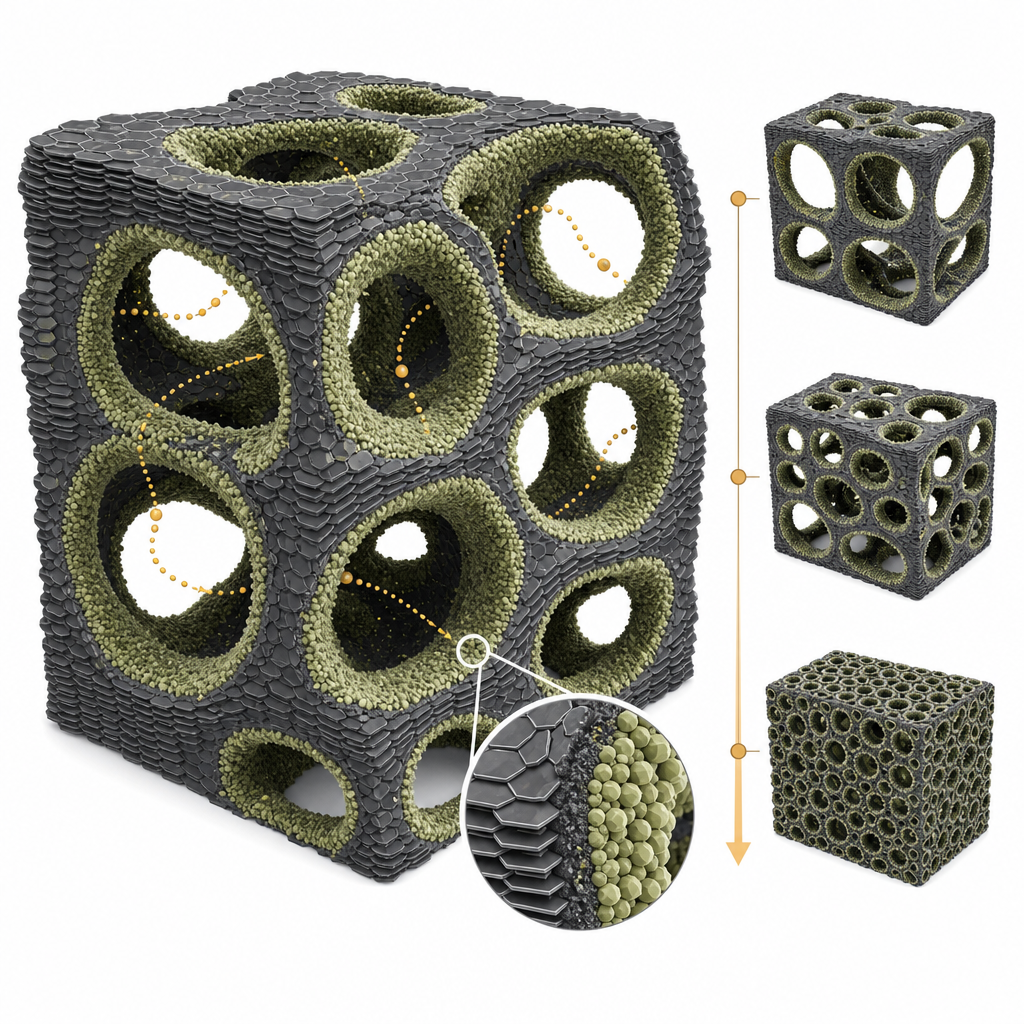
XRD confirmed phase-pure olivine LiFePO4 (Pnma). SEM and HAADF-STEM showed a conformal, non-blocking coating in which most LiFePO4 nanoparticles are below 70 nm, embedded in a residual carbon matrix derived from citric acid pyrolysis. The active-mass loading reached 1.7 mg of LiFePO4 per 2.9 mg of foam (37 wt%, 158 mg cm⁻³). In pouch cells against lithium metal in 1 M LiPF6 EC:DEC, cycled between 2.8 and 4.0 V, the electrode delivered footprint-area capacities of 1.72 mA h cm⁻² at 0.1 mA cm⁻², 1.65 at 0.2 mA cm⁻², 1.55 at 0.4 mA cm⁻², and 1.07 mA h cm⁻² at 6 mA cm⁻² – roughly 60 % of low-rate capacity at a 60-fold higher current. Gravimetric capacity at 0.1 C reached ~157 mA h g⁻¹ (92 % of theoretical), and coulombic efficiency exceeded 99.5 %. Cyclic voltammetry revealed diffusion-controlled Li⁺ insertion with IR-drop-limited rate behaviour; internal resistances were 53 Ω (charge) and 46 Ω (discharge).
The results matter for any application that needs millimetre-scale, high-rate lithium-ion power: wireless sensor nodes, implantable medical devices, RFID tags, autonomous environmental monitors, and MEMS actuators. The authors note that the same conductive carbon foam current collector should accept many other actives – LiCoO2, Li2FeSiO4, MnO2 on the cathode side, and TiO2 or Li4Ti5O12 as anodes – and that an electrodeposited polymer electrolyte could complete a fully integrated 3D cell. Identifying the right macropore length scale was a key design decision, which is why the comparison against commercially available reference foams (including the ACS Material graphene carbon foam) appears prominently in the paper.
For researchers working on 3D battery architectures, porous-carbon supercapacitor electrodes, or catalyst supports, ACS Material's graphene carbon foam and related 3D graphene products provide a well-characterized starting point for benchmarking and rapid prototyping. The product line of graphene foams, 3D graphene on Ni/Cu foam, and graphene aerogels is available to research groups exploring conductive 3D scaffolds for energy-storage and electrochemical applications.How ACS Material products were used
- Graphene carbon foam (13 vpm) (Graphene Series) — “(d) graphene carbon foam 13 vpm, from ACS materials”
Product Performance in this StudyThe ACS Material graphene carbon foam (13 voids per millimetre) is cited as a reference structure in the comparative survey of carbon foams used to contextualize the macropore size of the authors' polyHIPE-derived carbon foam (50 vpm). It is not used as the active electrode in this study but provides a benchmark for porous 3D carbon architectures.
Related product categories
Frequently asked questionsWhy are carbon foams useful as 3D microbattery current collectors?
Carbon foams combine good electrical conductivity, mechanical stiffness, chemical stability and a large interconnected pore network, providing the surface area and free volume needed to sequentially deposit active material, electrolyte and counter electrode layers. Their open, bicontinuous structure shortens ion-transport paths and accommodates volume changes, enabling high areal capacities and high-rate operation in millimetre-scale battery formats that thin-film designs cannot achieve.
How does macropore size influence 3D battery electrode design?
Macropore size determines whether subsequent battery layers can be conformally deposited inside the foam without blocking ion-transport channels. Carbons spanning 2 to over 6000 voids per millimetre exist, but only intermediate scales – on the order of tens of micrometres – leave room for an electrode/electrolyte/counter-electrode stack inside each cell. Reference foams such as graphene carbon foam at 13 vpm help benchmark this length scale for full-cell integration.
What limits high-rate capacity in LiFePO4-coated porous carbon electrodes?
At higher current densities, capacity loss is dominated by ohmic IR drop across the porous matrix and pore electrolyte, by solid-state Li⁺ diffusion in LiFePO4 nanoparticles, and by inhomogeneous local current densities that deplete electrolyte ions in some regions. Reducing particle size, improving electrolyte wetting and engineering uniform pore interconnections all help close the gap between low-rate and high-rate capacities.