-
Graphene Nano-Sheets in Cu/WC–TiC–Co Composites — Helwan University, 2018
Jun 23, 2026 | ACS MATERIAL LLCYehia, H., Nouh, F., & El-Kady, O. (2018). Effect of graphene nano-sheets content and sintering time on the microstructure, coefficient of thermal expansion, and mechanical properties of (Cu/WC–TiC-Co) nano …. *Journal of Alloys and Compounds*.
Journal of Alloys and Compounds · 2018
Researchers at Helwan University used ACS Material graphene nano-sheets (2–10 nm) to reinforce Cu/WC–TiC–Co composites, raising hardness 31% and lowering thermal expansion.
About this research
Researchers at Helwan University, working with Sinai University and Egypt's Central Metallurgical Research and Development Institute, used graphene nano-sheets (2–10 nm) supplied by ACS Material, LLC to reinforce Cu/WC–TiC–Co nano-composites, achieving a 31% increase in Vickers hardness, a reduced coefficient of thermal expansion (CTE), and improved compression strength at 1 wt.% graphene loading. Reported in the Journal of Alloys and Compounds (2018), the study systematically varied graphene content (0, 0.25, 0.5, 0.75, 1 wt.%) and sintering time (90, 120, 140 min) at 950 °C in argon to map how nano-carbon reinforcement and densification kinetics jointly govern the mechanical and thermal response of the composite.
The broader motivation is materials selection for Resistance Seam Welding (RSW) electrodes. Pure copper offers excellent thermal and electrical conductivity but suffers from low hardness, modest tensile strength, a relatively high CTE, and poor wear resistance — all of which shorten electrode life under the cyclic mechanical and thermal stresses of welding. Reinforcing copper with hard carbides such as WC–TiC–Co improves strength and wear behavior, but further reductions in CTE and additional hardening are needed to extend electrode service intervals. Graphene, with its in-plane tensile strength of ~130 GPa and Young's modulus near 1 TPa, is an attractive secondary reinforcement provided dispersion, wettability, and adhesion to the copper matrix can be controlled. This work addresses exactly that intersection of microstructure, processing, and performance for next-generation welding electrodes and copper-based functional composites.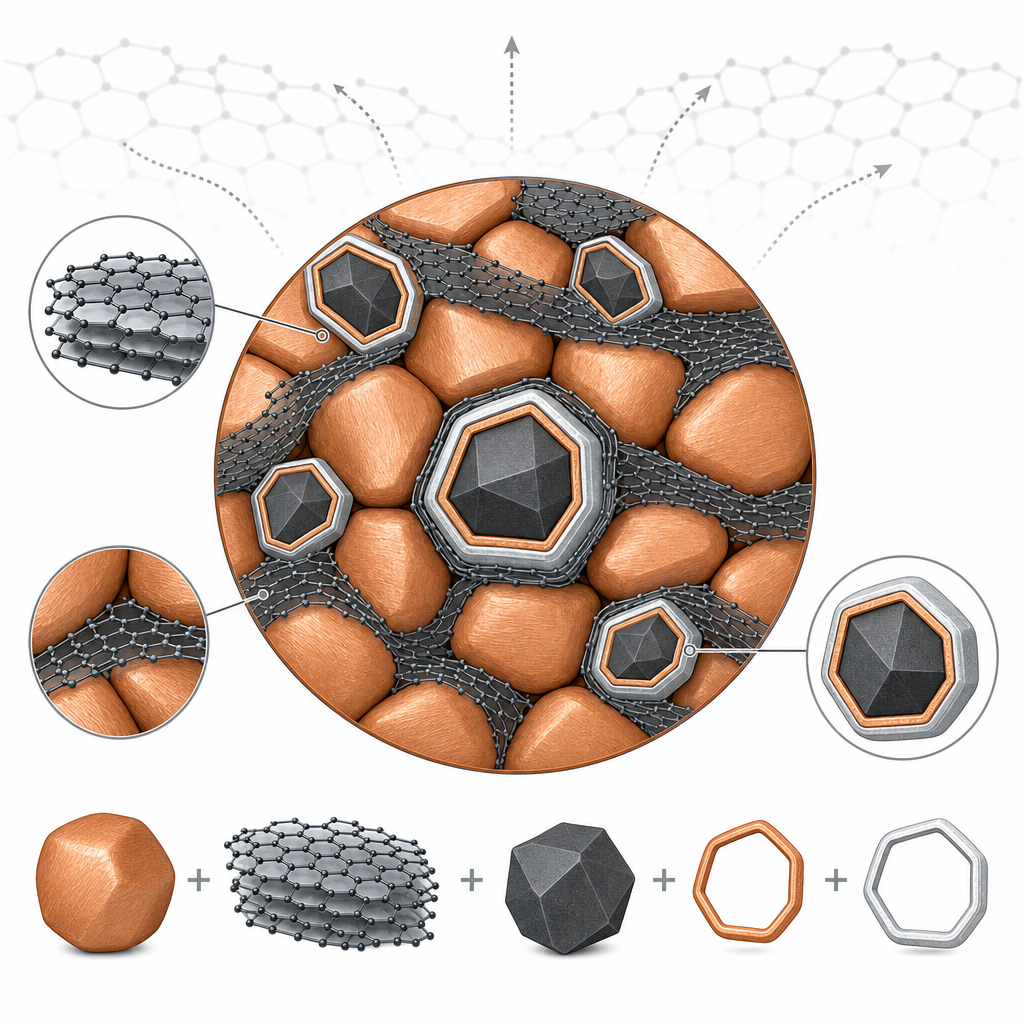
The ACS Material graphene nano-sheets entered the workflow as the reinforcing phase. The authors explicitly state, "Graphene nano-sheets of 2–10 nm size was supplied with ACS Material, LLC." Before mixing, both the WC–TiC–Co particles and the graphene were cleaned in 10% NaOH and acetone, then metallized with 3 wt.% silver to enhance wettability with copper. The WC–TiC–Co was first encapsulated by electroless copper deposition (CuSO4·5H2O, KNaC4H4O6·4H2O, NaOH, formaldehyde at 60 °C) to yield a 90 wt.% Cu / 10 wt.% WC–TiC–Co coated powder. This coated powder was hydrogen-reduced at 500 °C for 1 h, then blended with 0.25–1 wt.% silver-coated graphene for 30 min, uniaxially compacted at 900 MPa in a 12 mm die, and sintered in argon at 950 °C for 90, 120, or 140 min. SEM confirmed that the graphene was largely well dispersed in the copper matrix, with only minor agglomeration at the 1 wt.% loading.
Quantitatively, longer sintering time consistently improved densification: samples held for 140 min reached 92.62% relative density — about 10.5% higher than the 90 min counterparts. Volume shrinkage rose with sintering time and, at 140 min, also increased with graphene content, indicating enhanced neck growth and pore closure when graphene aided particle bridging. Relative density did decrease modestly with graphene content because of graphene's low intrinsic density (~2.2 g/cm³) and steric obstacles to consolidation at higher loadings. Mechanically, hardness rose monotonically with graphene addition, reaching a 31% increase at 1 wt.% graphene relative to the unreinforced Cu/WC–TiC–Co composite. The coefficient of thermal expansion measured between 100 and 600 °C decreased systematically with graphene loading; while the graphene-free composite showed strong expansion driven by copper's high CTE, 1 wt.% graphene markedly suppressed expansion at temperatures above 400 °C. Compression strength also improved with graphene content, and EDAX confirmed homogeneous distribution of carbon, tungsten, titanium, and copper without detrimental phases. SEM at high magnification (Fig. 6 g,h) showed tight adhesion between copper, the carbide particles, and the graphene nano-sheets.
These findings are directly relevant to resistance-welding electrodes, copper-based heat sinks, electrical contacts, and any application where copper composites must combine moderate CTE with high hardness and structural integrity at elevated temperature. The processing route — silver metallization plus electroless copper coating prior to graphene blending — offers a practical recipe for overcoming the long-standing graphene–copper wettability problem in powder metallurgy. Follow-on work suggested by the data includes optimizing mixing time beyond 30 min to eliminate residual graphene agglomeration at ≥1 wt.%, exploring higher sintering temperatures or hot-pressing for fuller densification, and evaluating electrical conductivity and wear life under simulated welding cycles.
For researchers replicating or extending this study, the relevant input is ACS Material's graphene nano-sheet product line, available in thickness ranges matching the 2–10 nm material used here. Consistent flake thickness, surface chemistry, and lateral size are critical for reproducible CTE and hardness behavior in metal-matrix composites, and this paper demonstrates the kind of property gains achievable when those parameters are controlled alongside a well-designed coating and sintering protocol.How ACS Material products were used
- Graphene Nano-Sheets (2–10 nm) (Graphene Series) — “Graphene nano-sheets of 2e10 nm size was supplied with ACS Material, LLC (Advanced Chemical Supplier)”
Product Performance in this StudyThe ACS Material graphene nano-sheets served as the principal reinforcement phase. Adding up to 1 wt.% graphene increased composite hardness by 31%, reduced the coefficient of thermal expansion, and improved compression strength, confirming the reinforcement's effectiveness in the Cu/WC–TiC–Co matrix.
Related product categories
Frequently asked questionsHow does adding graphene nano-sheets change the thermal expansion of copper composites?
Graphene's intrinsically low coefficient of thermal expansion suppresses copper's thermal growth. In this study, increasing graphene content from 0 to 1 wt.% in a Cu/WC–TiC–Co matrix progressively reduced CTE across 100–600 °C, with the strongest suppression above 400 °C. Good wettability achieved through silver metallization and homogeneous dispersion in the copper matrix restrict matrix expansion under thermal load, an effect critical for welding-electrode service life.
Why use silver metallization before mixing graphene with copper powder?
Silver coating improves the wettability and adhesion between graphene (or WC–TiC–Co) and the copper matrix during sintering. Without it, graphene's chemical inertness and poor affinity for liquid or solid copper cause interfacial voids and weak bonding. The authors applied 3 wt.% silver to both the carbide particles and the graphene nano-sheets, which produced pore-free interfaces visible by SEM and contributed to the 31% hardness gain at 1 wt.% graphene.
What graphene thickness is suitable for copper matrix composites in powder metallurgy?
Few-layer graphene nano-sheets in the 2–10 nm thickness range work well for copper matrix composites, balancing reinforcement efficiency with dispersibility. Thinner flakes expose more surface area for load transfer but agglomerate easily, while thicker platelets dilute the in-plane mechanical advantage. This study used 2–10 nm ACS Material graphene nano-sheets and achieved homogeneous distribution at up to 1 wt.%, with only minor agglomeration emerging at the upper end of that loading.