-
Graphene Nanoplate Pt-Cu Methanol Catalyst - Tianjin, 2016
Jun 05, 2026 | ACS MATERIAL LLCZhang, G. et al. (2016). Facile synthesis of graphene nanoplate-Supported porous Pt–Cu alloys with high electrocatalytic properties for methanol oxidation. *Journal of Materials Chemistry A*. https://doi.org/10.1039/c5ta09937d
School of Chemical Engineering and Technology · Journal of Materials Chemistry A · 2016
Researchers used ACS Material graphene nanoplates to support porous Pt-Cu alloy nanocrystals, delivering high methanol oxidation activity in alkaline media.
About this research
Researchers at the School of Chemical Engineering and Technology (Tianjin University) report a facile one-pot synthesis of porous Pt-Cu alloy nanocrystals supported on graphene nanoplates obtained from ACS Material, producing an electrocatalyst with strong methanol oxidation performance in alkaline media. The graphene nanoplates (GNPs) were functionalized with 1-aminopyrene (AP) by π-π interaction, after which Pt and Cu precursors were co-reduced directly onto the support in ethanol/water using ascorbic acid - no surfactants, organic solvents or hard templates required. The resulting p-Pt-Cu/AP-GNPs catalysts combine an alloyed, porous nanostructure with a high-surface-area carbon support.
Direct methanol fuel cells (DMFCs) remain a promising power source for portable and transportation applications, but their commercialization is bottlenecked by the cost and CO-poisoning of platinum anode catalysts. Alloying Pt with a cheaper, more oxophilic metal such as Cu reduces noble metal loading and accelerates the oxidation of CO-like intermediates via the bifunctional mechanism. However, most reported porous Pt-Cu nanocrystals depend on surfactants or templates whose removal damages or contaminates the active surface. Pairing porous Pt-Cu with a robust, conductive carbon support that does not require harsh oxidation pretreatment is therefore highly desirable for DMFC electrode development.
The authors specify the ACS Material graphene nanoplates in detail: >99.5 wt% carbon content, lateral width 0.5-20 µm, thickness 1-5 nm, surface area 110 m²/g, conductivity 10,000 S/m, and zeta potential -19.6 mV. These GNPs combine the high surface area and conductivity of monolayer graphene with the stability, low cost and structural ordering of graphitic carbon, making them well suited as catalyst supports. Because the basal plane of GNPs is chemically inert, the authors anchored 1-aminopyrene onto the GNP surface via π-π stacking, generating positively charged amine sites at pH 3 that electrostatically captured PtCl6²⁻ and then Cu²⁺ ions. Ascorbic acid then simultaneously reduced both precursors at 60 °C to produce porous Pt-Cu alloy nanocrystals directly attached to the AP-GNPs. Raman spectra of bare and AP-functionalized GNPs are nearly identical, with a slight drop in the ID/IG ratio, indicating that the functionalization preserves the GNP electronic structure while covering original defect sites.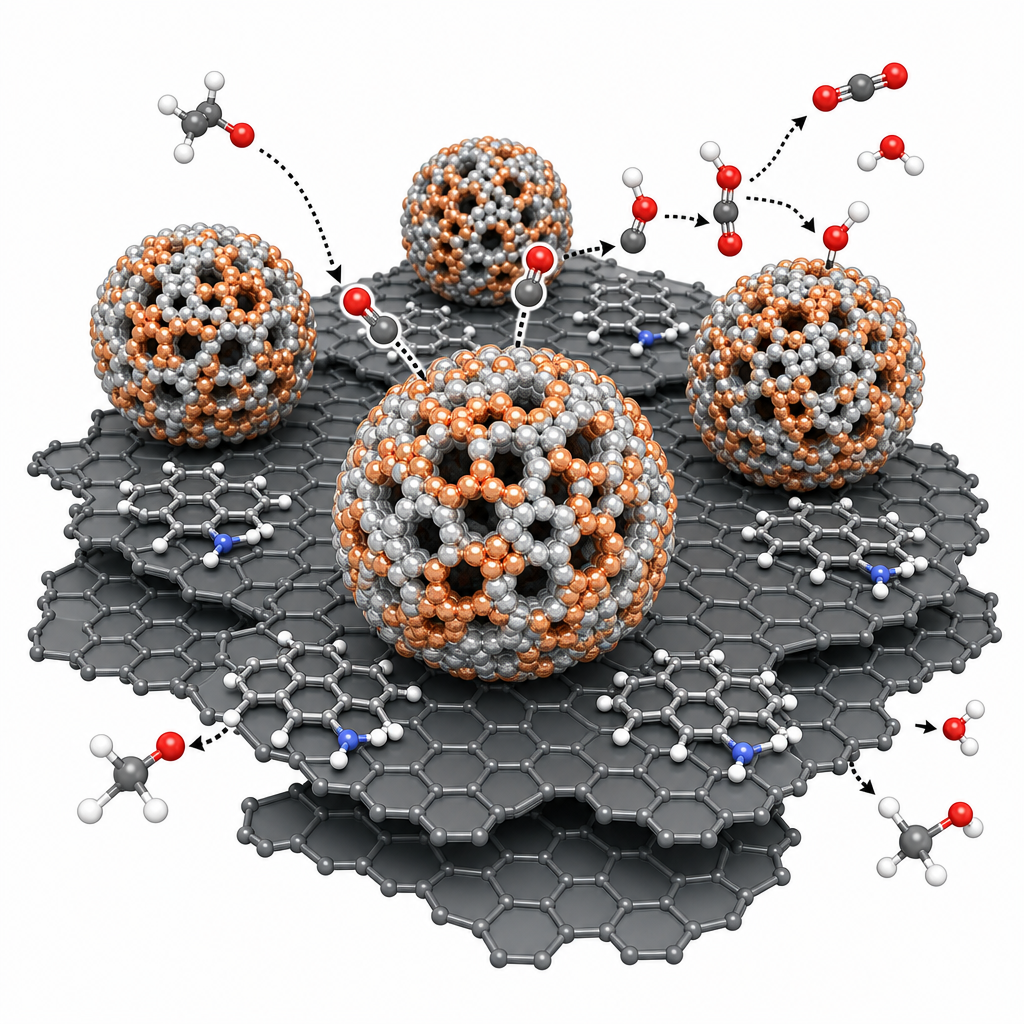
TEM, HRTEM, SAED, FFT and HAADF-STEM imaging confirmed near-spherical, single-crystalline, porous Pt-Cu nanocrystals uniformly anchored on the GNPs. Compositional line scans and elemental mapping showed that Pt and Cu were co-deposited as alloys at the targeted ratios. XRD (111) peaks shifted to higher 2θ as the Cu content increased, and applying Vegard's law gave Cu contents of 24.69%, 47.89% and 70.24% for the p-Pt3Cu1, p-Pt1Cu1 and p-Pt1Cu3 catalysts, in good agreement with ICP-MS. XPS Pt 4f peaks shifted to lower binding energy with rising Cu content, evidence of electron donation from Cu to Pt and genuine alloy formation. BET surface areas were 115.3 m²/g for AP-GNPs alone and 156.6, 158.1 and 158.8 m²/g for the three Pt-Cu catalysts, reflecting the additional porosity contributed by the alloy nanocrystals. Electrochemical testing in N2-saturated 0.1 M NaOH with 0.5 M methanol, using a glassy carbon working electrode and SCE reference, showed that the p-Pt-Cu/AP-GNPs catalysts deliver superior methanol oxidation activity in alkaline conditions relative to commercial Pt/C (Johnson Matthey, 20 wt%), with the electrochemically active surface area calculated from hydrogen adsorption/desorption charge using 210 µC/cm². Chronoamperometry at -0.3 V vs SCE over 7200 s further supported the catalysts' improved durability.
This work points to several near-term applications. The aqueous, surfactant-free synthesis is attractive for scaling Pt-Cu alloy electrocatalysts for direct methanol and direct ethanol alkaline fuel cells, where Pt loading and CO tolerance dominate cost and lifetime. The same 1-aminopyrene-on-GNP platform could anchor other bimetallic systems (Pd-Pt, Pt-Ni, Pt-Ru) for oxygen reduction, formic acid oxidation, or electrocatalytic ammonia and CO2 conversion. The approach also fits broader trends in low-Pt electrode design and in carbon-supported nanocatalyst inks for membrane electrode assemblies.
For researchers pursuing supported precious-metal electrocatalysts, ACS Material offers graphene nanoplates with specifications consistent with those used here (high conductivity, controlled thickness and lateral size), alongside related graphene, graphene oxide and CVD graphene products. The paper's results demonstrate that GNPs can serve as a reliable, high-conductivity scaffold for porous alloy nanocrystals when activated by mild non-covalent functionalization, supporting their use in fuel cell, sensor and electrochemical synthesis research.How ACS Material products were used
- Industrial Thin Layer Graphene Nanoplatelets (Graphene Series) — “Graphene nanoplates (GNPs, >99.5 wt% carbon content, width 0.5-20 µm, thickness 1-5 nm, surface area 110 m2/g, conductivity 10000 S/m, zeta potential -19.6 mV, ACS Material, USA)”
Product Performance in this StudyThe ACS Material graphene nanoplates served as the high-surface-area, conductive support that, after 1-aminopyrene functionalization, anchored the porous Pt-Cu alloy nanocrystals and contributed to the markedly enhanced electrocatalytic activity and durability for methanol oxidation.
Related product categories
Frequently asked questionsWhy are graphene nanoplates used as a support for Pt-Cu methanol oxidation catalysts?
Graphene nanoplates combine the high surface area and electrical conductivity of single-layer graphene with the stability and low cost of graphitic carbon. In this study, ACS Material GNPs provided 110 m²/g surface area and 10,000 S/m conductivity, giving Pt-Cu alloy nanocrystals fast electron transport and stable anchoring. After non-covalent 1-aminopyrene functionalization, the GNPs hosted well-dispersed porous Pt-Cu nanocrystals that significantly outperformed commercial Pt/C in alkaline methanol oxidation.
How does 1-aminopyrene functionalization activate inert graphene nanoplate surfaces?
1-Aminopyrene binds to graphene nanoplates through π-π stacking between its pyrenyl group and the GNP basal plane, leaving free amine groups exposed. At pH 3, those amines protonate and electrostatically capture PtCl6²⁻ and Cu²⁺ ions, providing uniform nucleation sites for subsequent reduction. Raman analysis showed the ID/IG ratio slightly decreased after functionalization, indicating that the electronic structure of GNPs is preserved while original defect sites are passivated.
What performance gain did porous Pt-Cu/AP-GNPs show over commercial Pt/C?
The porous Pt-Cu alloy nanocrystals supported on AP-functionalized graphene nanoplates delivered higher methanol oxidation current densities and improved durability than 20 wt% Pt/C from Johnson Matthey in 0.1 M NaOH + 0.5 M methanol. Chronoamperometry at -0.3 V vs SCE for 7200 s confirmed stable activity. XPS showed Pt 4f binding energy shifts caused by electron donation from Cu, while BET surface areas of 156-159 m²/g supported high active-site exposure.