-
Graphene Nanoplatelets for ABS Fatigue Models - U Toronto, 2025
Jun 30, 2026 | ACS MATERIAL LLCHassanifard, S., & Behdinan, K. (2025). Energy-Based Approach for Fatigue Life Prediction of Additively Manufactured ABS/GNP Composites. *Polymers*. https://doi.org/10.3390/polym17152032
University of Toronto · Polymers · 2025
University of Toronto researchers used ACS Material graphene nanoplatelets to reinforce 3D-printed ABS and validate an R-dependent energy-based fatigue life prediction model.
About this research
Researchers at the University of Toronto used graphene nanoplatelets (GNPs) purchased from ACS Material, LLC to reinforce additively manufactured acrylonitrile butadiene styrene (ABS) and to develop a new stress-ratio-dependent energy-based model that predicted fatigue life within a ±2 error band for all raster orientations. The study, published in Polymers in 2025, tested ABS reinforced with 0.1, 0.5, and 1.0 wt.% GNP and printed at 0°, 45°, and 90° raster angles. By combining Neuber and Ramberg–Osgood equations with notch strength reduction factors, the team derived stress and strain values needed to feed several established energy-based fatigue models, then proposed a hybrid model that more reliably handles negative mean stress conditions.
This research matters because fused deposition modelling (FDM) is widely used to fabricate complex thermoplastic parts, yet the durability and fatigue resistance of these components remain underexplored compared with experimental statistical analysis. Most fatigue studies on additively manufactured parts focus on data collection rather than predictive modelling, and the few prediction methods that exist were developed mainly for metals. Inter-filament voids, porosity, and raster-induced anisotropy create stress concentrators that strongly influence fatigue behavior of 3D-printed polymers. A validated, efficient fatigue life prediction framework reduces the substantial cost and time of repeated experimental campaigns, which is increasingly important as FDM moves into load-bearing applications across aerospace, automotive, and lightweight structural sectors where graphene-reinforced thermoplastics are attractive candidates.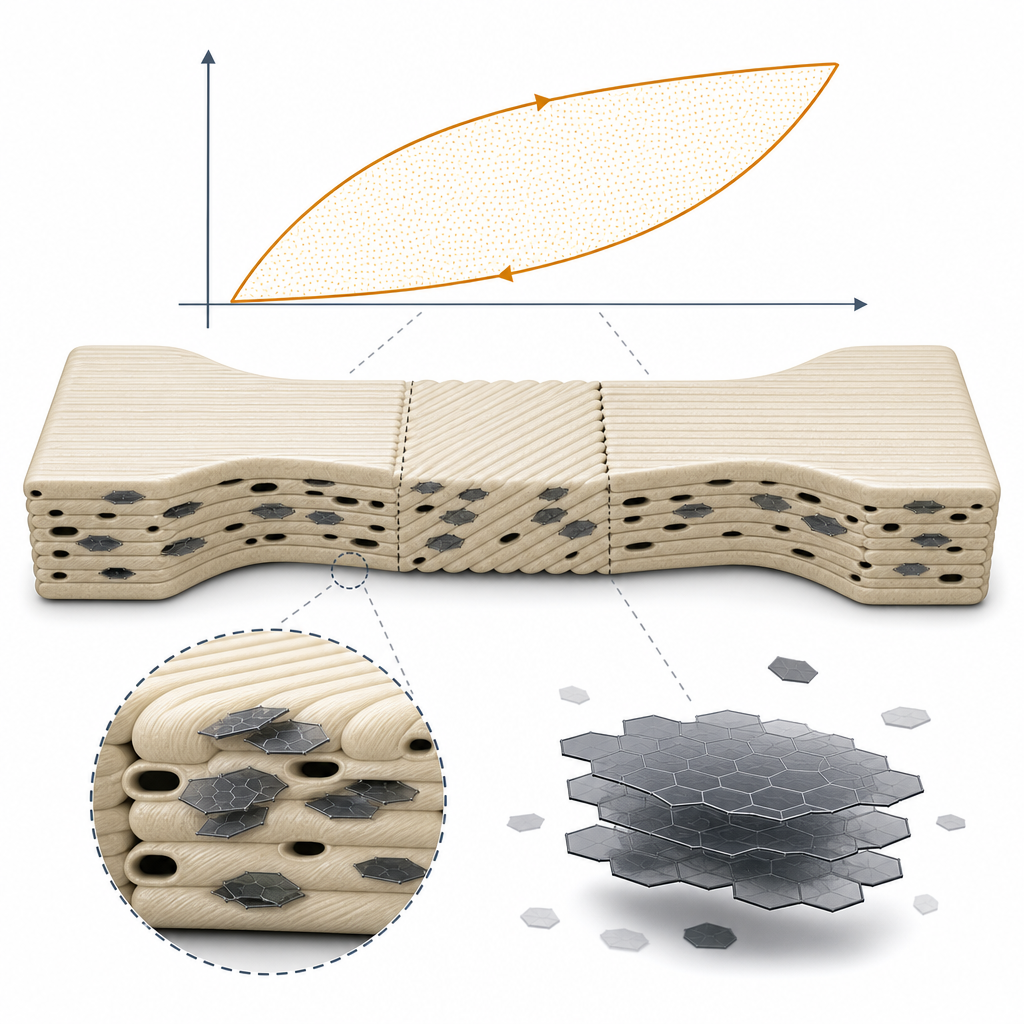
The GNPs from ACS Material served as the reinforcing filler dispersed into the ABS matrix at three loadings: 0.1, 0.5, and 1.0 wt.%. ABS itself was obtained from a separate supplier (3DXTECH), while the GNPs provided the multiscale reinforcement central to the composite's mechanical performance. The nanocomposite filament and printed specimens were characterized through quasi-static testing per ASTM D638-22 and fatigue testing per ASTM D7791-22, using Type IV dog-bone specimens. The GNP content directly shaped the cyclic stress–strain response: the measured Young's modulus rose from 1643 MPa for pure ABS to 1942, 2081, and 2095 MPa for 0.1, 0.5, and 1.0 wt.% GNP respectively. During cyclic loading the filaments showed gradual modulus degradation of roughly 4–15% along with ratcheting, so an averaged degraded modulus (E*) was adopted for the modelling. GNP content also influenced yield strength, UTS, the cyclic strength coefficient H′, and the strain-hardening exponent n′, all of which enter the energy-based fatigue parameters tabulated for each composition.
Key quantitative results illustrate both the reinforcement effect and the modelling outcome. Energy-life parameters varied strongly with GNP content: the fatigue toughness coefficient W′f ranged from 67.98 MJ/m³ for pure ABS up to 248.68 MJ/m³ for ABS/0.1% GNP, while fatigue strength coefficients W′e fell between 1.94 and 4.65 MJ/m³. The highest standard deviation in quasi-static stress was 2.4 MPa for the 1.0 wt.% GNP filament. Across the four tested models (Koh, Lin et al., Fan, and Roostaei et al.), none accurately predicted fatigue life across the full high- and low-cycle range; Lin and Fan models overpredicted at high loads and underpredicted at low loads, Koh performed better at higher loads, and Roostaei was more accurate at lower loads. The proposed hybrid model segments negative mean stress into two regions—using the Roostaei formulation for R ≥ −0.1 and the Koh formulation for R < −0.1. Tested over R values between roughly −0.22 and 0, this model placed most predicted fatigue lives within a factor of ±2 of experimental data for all GNP contents and all three raster orientations.
The work enables more efficient, physics-grounded fatigue assessment of FDM-fabricated polymer nanocomposites, reducing reliance on exhaustive experimental testing. Although the model was developed for ABS/GNP composites, the authors note it rests on general energy-based fatigue principles and stress/strain behavior near stress concentrators, so it can extend to other FDM thermoplastics with similar microstructural features—particularly inter-filament voids and raster-induced anisotropy—such as PLA and Nylon. This supports design of lightweight load-bearing components in additive manufacturing and informs how graphene reinforcement levels can be tuned to balance stiffness, strength, and fatigue durability. The authors point to continued refinement of energy-based models to better capture mean-stress effects and complex stress interactions across broader loading conditions.
For researchers working on graphene-reinforced polymers, the study shows that well-dispersed graphene nanoplatelets at modest weight fractions meaningfully change the stiffness and fatigue parameters of FDM thermoplastics. The graphene nanoplatelets used here are part of ACS Material's Graphene Series, available to groups developing similar nanocomposites, fatigue models, or additively manufactured structural parts. The reinforcement performed as a filler that increased modulus and altered fatigue energy parameters in a content-dependent way, consistent with the paper's quantitative findings.How ACS Material products were used
- Graphene Nanoplatelets (GNPs) (Graphene Series) — “reinforced with varying concentrations of GNPs (purchased from ACS Material, LLC, Pasadena, CA, USA) at 0.1, 0.5, and 1.0 wt.%”
Product Performance in this StudyGNPs were used as a reinforcing filler in ABS at 0.1, 0.5, and 1.0 wt.%, measurably altering Young's modulus, strain energy density, and fatigue response of the 3D-printed composites.
Related product categories
Frequently asked questionsHow do graphene nanoplatelets affect the fatigue behavior of 3D-printed ABS?
Adding graphene nanoplatelets to ABS raised the Young's modulus from 1643 MPa for pure ABS to as high as 2095 MPa at 1.0 wt.% GNP and changed key cyclic parameters such as yield strength, the cyclic strength coefficient, and strain-hardening exponent. These changes directly altered the elastic and plastic strain energy densities that govern fatigue life in energy-based models.
What is an energy-based approach for fatigue life prediction?
An energy-based approach correlates the total dissipated strain energy density per cycle, comprising both elastic and plastic components, with fatigue life. In this study, stress and strain inputs were obtained by solving Neuber and Ramberg–Osgood equations using notch strength reduction factors, then fed into energy-life models to predict the number of cycles to failure for 3D-printed ABS/GNP composites.
Why is raster orientation important for the fatigue life of FDM parts?
Raster orientation sets the direction of filament deposition relative to loading and controls inter-filament void geometry, which acts as stress concentrators. Specimens with 90° raster orientation showed higher elastic and plastic strain energy densities due to larger notch strength reduction factors, demonstrating that printing direction strongly influences fatigue performance of additively manufactured components.