-
Graphene Nanoplatelets for Alkali-Activated Mortar - Chulalongkorn University, 2024
Jun 17, 2026 | ACS MATERIAL LLCHaruna, S. et al. (2024). Optimizing mechanical properties of one-part alkali-activated mortar with recycled plastic and graphene nanoplatelets using response surface methodology. *Construction and Building Materials*. https://doi.org/10.1016/j.conbuildmat.2024.138701
Construction and Building Materials · 2024
Chulalongkorn University researchers used ACS Material graphene nanoplatelets to offset recycled-plastic strength loss in one-part alkali-activated mortar, raising 28-day compressive strength.
About this research
Researchers at Chulalongkorn University used graphene nanoplatelets (GNP) purchased from ACS Materials LLC to recover the mechanical strength lost when recycled plastic aggregate (RPA) is substituted for natural sand in one-part alkali-activated mortar (OPAAM), achieving up to a 28.6% gain in 28-day compressive strength at 0.2% GNP loading in mixtures containing 50% RPA. The team, led by Pitcha Jongvivatsakul, combined fly ash, anhydrous sodium metasilicate, recycled polypropylene plastic, and GNP, then applied response surface methodology (RSM) to optimize the dosages of RPA and GNP for compressive, flexural, and splitting tensile strength as well as water absorption. The optimized mortar used 10.7% RPA and 0.2% GNP, validated experimentally with errors below 10%.
This research matters because the construction sector is a major source of CO2 emissions and consumes vast quantities of Portland cement and natural sand. One-part alkali-activated materials offer a low-carbon binder that uses solid alkali activators, simplifying mixing and handling compared with conventional alkaline-solution geopolymers. Embedding recycled plastic aggregate addresses a parallel environmental problem—plastic waste accumulation—but plastic's hydrophobic, smooth surface weakens the interfacial bond and reduces strength. The open challenge is to keep the sustainability benefits of recycled plastic while restoring mechanical performance. Nanoscale reinforcement with graphene nanoplatelets, which possess high aspect ratio, large specific surface area, and strong mechanical properties, provides a route to bridge this gap. The study targets the long-tail need for high-performance yet sustainable building materials in infrastructure exposed to corrosion and chemical attack.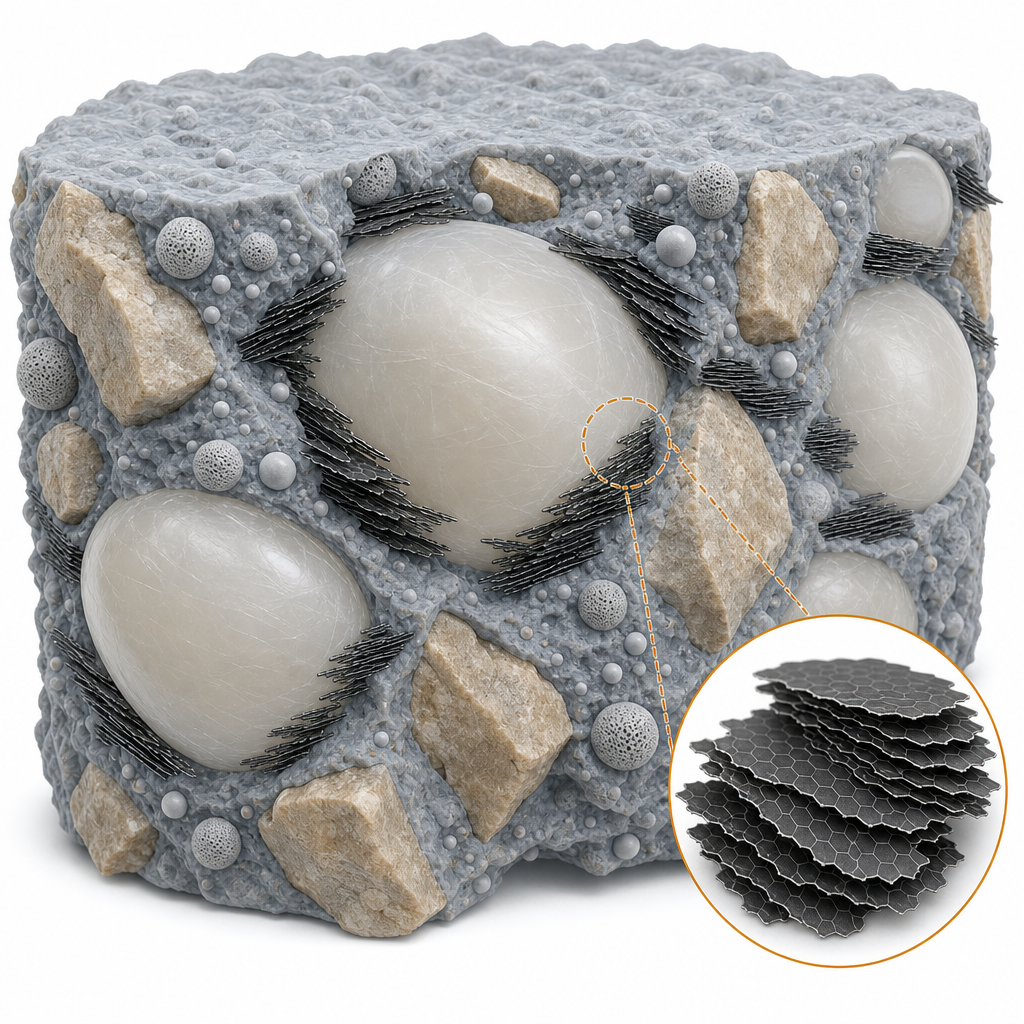
The ACS Material graphene nanoplatelets were supplied as a gray/black powder. According to the paper's Table 2, the GNP had a diameter of 2–7 µm, thickness of 2–10 nm, electrical conductivity of 80,000 S/m, specific surface area of 20–40 m²/g, carbon content greater than 95%, and apparent density of 0.06–0.09 g/mL. Energy-dispersive spectroscopy confirmed the platelets comprised 95.79 wt% carbon and 4.21 wt% oxygen, and FESEM showed the characteristic sheet-like morphology. The GNP was added as an additive at 0.1%, 0.2%, 0.3%, and 0.4% by weight of the binder, without replacing any binder. To disperse the platelets, a portion of mixing water was combined with GNP, manually stirred, then ultrasonicated for one hour at 60 Hz to form a homogeneous suspension. This suspension was introduced during mortar mixing in a Hobart mixer alongside fly ash, sodium metasilicate, sand, and recycled plastic aggregate, following ASTM C305. Specimens were cured at 25 °C until testing at 3, 7, and 28 days.
The quantitative results show clear trends. Replacing sand with RPA reduced 28-day compressive strength by 27.5% at 25% RPA and 46.9% at 50% RPA versus the control; flexural strength fell by 34.2% and 56.2%, and splitting tensile strength by 19.4% and 41.9% respectively. Adding GNP reversed much of this loss. In plastic-free mixtures, 0.1–0.4% GNP raised 28-day compressive strength by 11.1%, 27.2%, 15.6%, and 14.5%, with the 0.2% dose being optimal. In RPA mixtures, 0.2% GNP increased the compressive strength of MP25 and MP50 mortars by 17.2% and 28.6% at 28 days; the lower gain at 0.4% reflected GNP agglomeration. Maximum 28-day compressive strengths reached 57 MPa, 38 MPa, and 31 MPa for 0%, 25%, and 50% RPA mortars at 0.2% GNP. GNP also reduced porosity and water absorption. The RSM models were statistically significant, with R² values of 0.989 (compressive), 0.994 (flexural), 0.984 (splitting tensile), and 0.984 (water absorption). The optimized 10.7% RPA / 0.2% GNP mix predicted 47.0 MPa compressive, 8.6 MPa flexural, 3.2 MPa splitting tensile, and 5.7% water absorption, with experimental verification giving 51.2 MPa, 6.7 MPa, 3.1 MPa, and 5.8%.
The findings enable greener mortar formulations that valorize plastic waste without sacrificing structural performance, relevant to sustainable concrete, precast elements, and infrastructure requiring corrosion and chemical resistance. By densifying the microstructure and accelerating C-A-S-H/N-A-S-H formation, GNP supports stronger, less permeable binders. The authors recommend follow-up work on GNP dispersion methods to prevent agglomeration at higher dosages, RPA surface treatments to improve bonding, and characterization of fire resistance, shrinkage, acid resistance, thermal conductivity, and long-term plastic degradation. The RSM framework also reduces the number of experimental trials needed for mix-design optimization, useful for materials engineers screening multi-component cementitious systems.
For researchers working on graphene-reinforced cementitious composites, the graphene nanoplatelets used here are available from ACS Material as part of its Graphene Series. The paper demonstrates that even a modest 0.2 wt% addition can meaningfully offset strength losses from recycled aggregates, provided dispersion is controlled by ultrasonication. The well-characterized platelet specifications—micron-scale diameter, nanometer thickness, and high carbon purity—make this grade a practical reference point for those formulating sustainable mortars, self-sensing structures, or other graphene-modified binders.How ACS Material products were used
- Graphene Nanoplatelets (GNP) (Graphene Series) — “The gray/black powdered GNP used in this investigation was purchased from ACS Materials LLC, Canada.”
Product Performance in this StudyThe graphene nanoplatelets (0.2 wt% of binder) densified the OPAAM microstructure and mitigated strength losses caused by recycled plastic aggregate, increasing 28-day compressive strength by up to 28.6% in 50% RPA mixtures.
Related product categories
Frequently asked questionsHow do graphene nanoplatelets improve the strength of alkali-activated mortar with recycled plastic?
Graphene nanoplatelets densify the binder microstructure and provide nucleation sites that accelerate the formation of C-A-S-H and N-A-S-H gels. In this study, adding 0.2% GNP increased the 28-day compressive strength of a 50% recycled-plastic mortar by 28.6%, offsetting the strength loss caused by the plastic aggregate's hydrophobic, smooth surface.
What is the optimal graphene nanoplatelet dosage for alkali-activated mortar?
The study found 0.2% GNP by weight of binder to be optimal across all mixtures. At this dosage, compressive strength reached its peak, while higher loadings such as 0.4% gave smaller gains due to GNP agglomeration. The optimized mortar combined 10.7% recycled plastic aggregate with 0.2% GNP, validated experimentally with errors below 10%.
Why is dispersion important when adding graphene nanoplatelets to cementitious materials?
Graphene nanoplatelets tend to agglomerate, which limits their reinforcing effect. The authors mixed GNP into part of the mixing water and ultrasonicated for one hour at 60 Hz to produce a homogeneous suspension before mortar mixing. Poor dispersion at higher dosages reduced strength gains, showing that uniform distribution is essential to maximize the benefit of the platelets.