-
Graphene Nanoplatelets for Fly Ash Concrete - Chulalongkorn, 2021
Jun 17, 2026 | ACS MATERIAL LLCAdamu, M. et al. (2021). Mechanical performance and optimization of high-volume fly ash concrete containing plastic wastes and graphene nanoplatelets using response surface methodology. *Construction and Building Materials*. https://doi.org/10.1016/j.conbuildmat.2021.125085
Construction and Building Materials · 2021
Chulalongkorn University used ACS Material graphene nanoplatelets to offset strength loss in high-volume fly ash concrete with plastic waste, boosting 3-day strength up to 43.5%.
About this research
Researchers at Chulalongkorn University used graphene nanoplatelets (GNP) supplied by ACS Materials LLC to counteract the mechanical and durability penalties of incorporating recycled plastic waste and high-volume fly ash (HVFA) into structural concrete, raising early-age compressive and splitting tensile strengths by up to 37% and 43.5% respectively. The study combined three sustainability levers—plastic waste as coarse-aggregate replacement, fly ash as a supplementary cementitious material, and GNP as a nanoscale additive—and used response surface methodology (RSM) to model and optimize the resulting concrete. The team established empirical models for compressive, splitting tensile, and flexural strength as well as water absorption, then experimentally validated an optimized mix with errors below 5%.
This research matters because plastic waste and fly ash are abundant, low-cost, and environmentally attractive ingredients for concrete, yet both reduce mechanical strength and durability. Plastic waste bonds poorly with the cement matrix and entraps air, while fly ash exhibits slow pozzolanic reactivity that depresses early strength. The construction industry needs ways to harness the sustainability benefits of these materials—reduced landfill burden, lower CO2 emissions, conservation of natural aggregate—without sacrificing performance. Carbon nanomaterials such as graphene nanoplatelets are promising because they fill nanoscale pores, act as nucleation sites for hydration products, and bridge microcracks. However, research on GNP-modified HVFA concrete containing plastic waste was scarce, motivating a systematic, model-based investigation that could guide practical mix design.
The ACS Material graphene nanoplatelets were received as a grey/black powder with a sheet-like morphology confirmed by FESEM. According to the reported specification, the GNP had a diameter of 2–7 µm, thickness of 2–10 nm, specific surface area of 16.48 m²/g, electrical conductivity of 80,000 S/m, and carbon content greater than 95%. GNP was dosed as an additive by weight of binder at 0%, 0.075%, 0.15%, 0.225%, and 0.3%. To avoid agglomeration, part of the mixing water was combined with a polycarboxylate superplasticizer in a beaker, the GNP was stirred in manually, and the suspension was sonicated with a 60 Hz/280 W ultrasonicator for one hour to achieve a uniform dispersion. This GNP suspension was then added to the dry constituents—cement, fly ash, sand, gravel, and polypropylene plastic waste—in a pan mixer. RSM (central composite design in Design Expert 10) generated 19 mixes spanning plastic waste (0–60% of coarse aggregate), HVFA (0–80% of cement), and GNP, enabling ANOVA-based modeling of each property.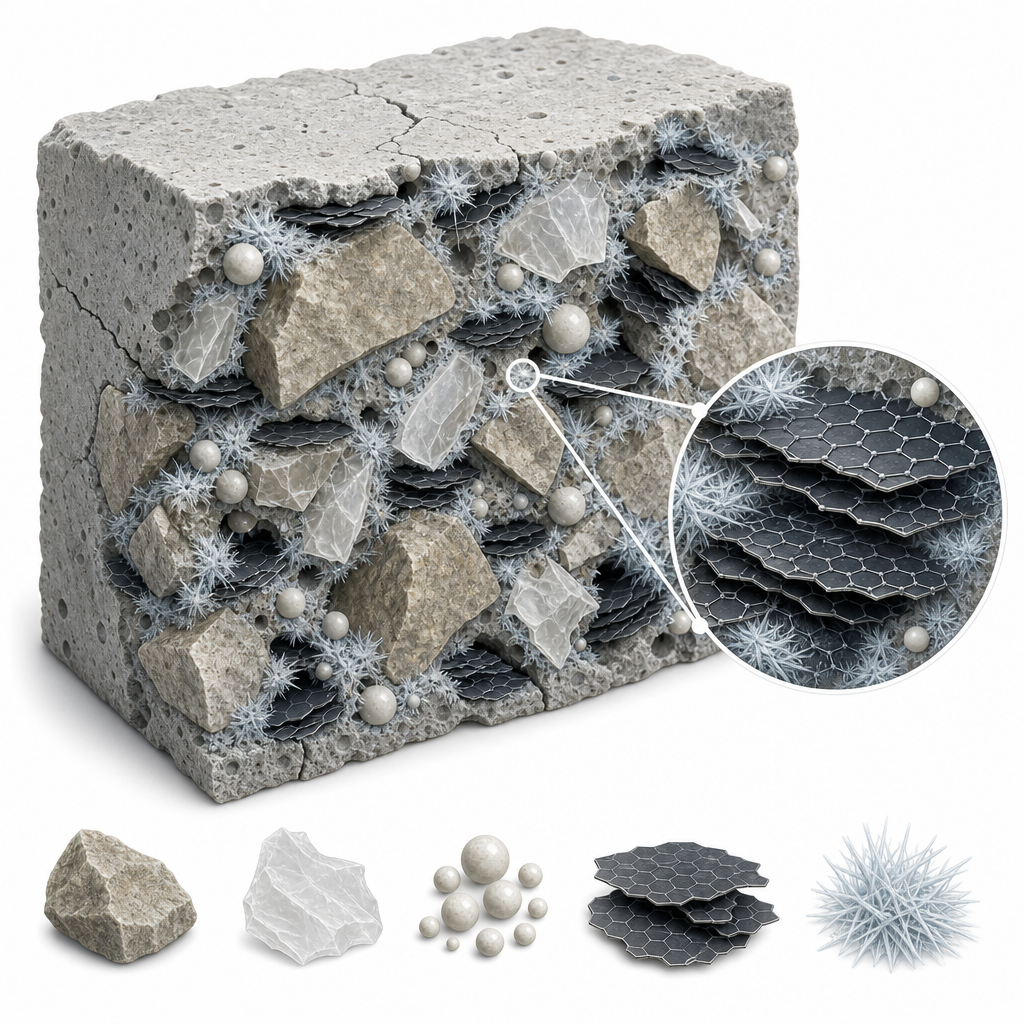
The quantitative results showed clear, opposing trends. Plastic waste and fly ash each reduced strength and increased water absorption: mixes with 30% plastic waste and 40% fly ash without GNP lost up to 30%, 35%, and 15% of their 28-day compressive, splitting tensile, and flexural strengths, while water absorption rose by as much as 58.5% in a 45% plastic waste/60% fly ash mix. GNP reversed these effects, with the strongest benefit at early ages. Adding 0.225% GNP to a mix with 15% plastic waste and 20% fly ash improved compressive and splitting tensile strengths by up to 37% and 43.5% at 3 days, and 10% and 27% at 28 days. The same dosage cut water absorption by up to 38%, and 0.075% GNP raised flexural strength of a 25% plastic waste/20% fly ash mix by over 21% and 27% at 7 and 28 days. The RSM models were statistically significant with R² values above 0.90 and non-significant lack-of-fit. Multi-objective optimization identified an optimum mix—15.3% coarse aggregate replaced by plastic waste, 6.07% cement replaced by fly ash, and 0.22% GNP—predicting 46.15 MPa compressive, 4.42 MPa splitting tensile, 9.45 MPa flexural strength, and 1.97% water absorption, all validated with average absolute relative deviations below 5%.
These findings enable greener structural concrete that recycles polypropylene plastic waste and incorporates high fly ash content without the usual loss in mechanical performance. The work is directly relevant to sustainable construction, pavement engineering, precast elements, and any application seeking lower embodied carbon and reduced reliance on natural aggregate. The validated RSM models give engineers a practical tool to proportion GNP-modified HVFA concrete for target strength and durability. The authors highlight GNP's role in densifying the microstructure and accelerating the pozzolanic reaction of fly ash, pointing toward further study of long-term durability, freeze-thaw resistance, and cost optimization given that graphene materials remain comparatively expensive.
For researchers pursuing similar cementitious or nanocomposite work, the graphene nanoplatelets used here are available from ACS Material in the 2–10 nm thickness grade described in the paper. The study demonstrates that a low dosage (0.22%) of well-dispersed GNP can measurably restore the early-age strength and reduce the water absorption of high-volume fly ash concrete containing plastic waste, making this product category a credible additive for groups exploring sustainable construction materials, geopolymers, and cement nanocomposites.How ACS Material products were used
- Graphene Nanoplatelets (2-10nm) (Graphene Series) — “Graphene nanoplatelets (GNP) used in this study was in grey/black powdered form, obtained from ACS Materials LLC, Canada.”
Product Performance in this StudyThe GNP from ACS Material served as a nanoscale additive that densified the concrete microstructure, accelerated C-S-H formation and significantly mitigated the strength loss caused by plastic waste and fly ash. Addition of 0.225% GNP improved 3-day compressive and splitting tensile strengths by up to 37% and 43.5% respectively.
Related product categories
Frequently asked questionsHow do graphene nanoplatelets improve high-volume fly ash concrete?
Graphene nanoplatelets densify the cement microstructure, fill nanoscale pores, act as nucleation sites, and accelerate the pozzolanic reaction of fly ash. In this study, adding 0.225% GNP to a mix with 15% plastic waste and 20% fly ash raised early compressive and splitting tensile strengths by up to 37% and 43.5% at 3 days and cut water absorption by up to 38%.
What grade of graphene nanoplatelets was used in the concrete study?
The graphene nanoplatelets, obtained from ACS Materials LLC, were a grey/black powder with a diameter of 2–7 µm, thickness of 2–10 nm, specific surface area of 16.48 m²/g, electrical conductivity of 80,000 S/m, and carbon content greater than 95%. They were dosed by weight of binder and dispersed with a superplasticizer and ultrasonication before mixing.
Why is response surface methodology useful for designing concrete mixes?
Response surface methodology establishes mathematical relationships between input variables and responses while minimizing the number of experiments. Here it modeled plastic waste, fly ash, and GNP against strength and water absorption, producing significant models with R² above 0.90. It also enabled multi-objective optimization, yielding a validated optimum mix with errors below 5%.